
Introduction
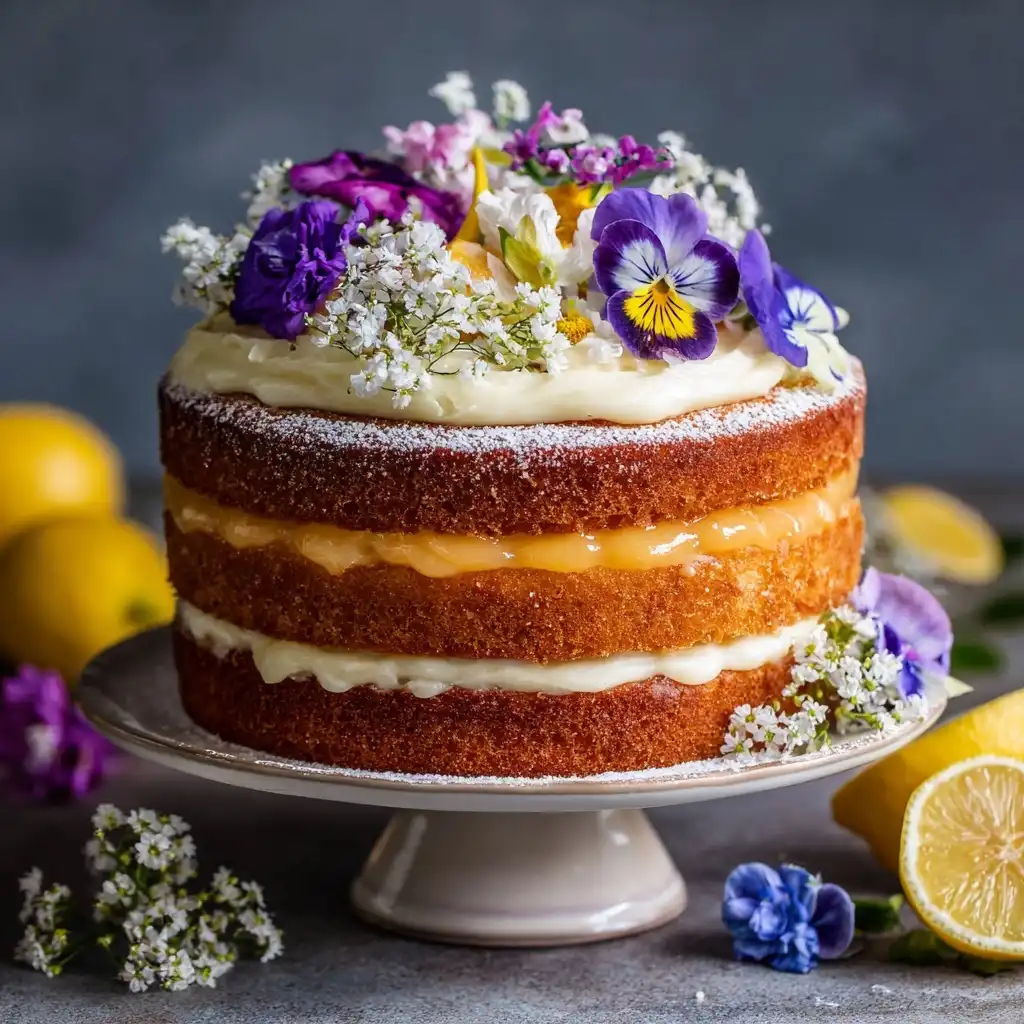
The Easy Lemon Curd Layer Cake is a bright, buttery, and refreshingly zesty dessert that effortlessly bridges the gap between classic elegance and approachable home baking. With its tender vanilla cake layers, luxuriously smooth homemade lemon curd, and a cloud-like vanilla buttercream, this cake delivers a harmonious balance of tart and sweet—making it ideal for spring gatherings, afternoon tea, birthday celebrations, or simply treating yourself on an ordinary Tuesday. Unlike many layered cakes that demand advanced techniques or hours of labor, this version prioritizes simplicity without sacrificing depth of flavor or visual appeal. Every bite offers a gentle citrus lift, rich creaminess, and just the right amount of crumb-to-filling ratio—proving that extraordinary flavor doesn’t require complicated methods.
The History
Lemon curd has its roots in early 19th-century England, where resourceful cooks preserved seasonal citrus by combining lemon juice and zest with sugar, butter, and eggs—a method originally known as “lemon cheese” due to its thick, spreadable texture. By the Victorian era, it had become a beloved staple served at tea time alongside scones and shortbread. Meanwhile, layer cakes evolved from earlier “plum cakes” and “sponge cakes” popularized in the 18th and 19th centuries, gaining structural sophistication with the advent of reliable chemical leaveners like baking powder in the 1850s. The marriage of lemon curd and layer cake emerged gradually—first as a filling for simple two-layer sponge cakes in British home kitchens, then later refined in mid-century American bakeries and cookbooks as bakers experimented with brighter, fruit-forward alternatives to traditional chocolate or spice cakes. Today, the lemon curd layer cake stands as a transatlantic favorite—celebrated in food magazines, viral baking reels, and family recipe boxes alike—for its nostalgic charm and vibrant, palate-cleansing personality.
Ingredients Breakdown
Understanding each ingredient’s role ensures consistent success—and opens doors for thoughtful substitutions. Below is a functional breakdown:
- All-Purpose Flour: Provides structure and tender crumb; measured correctly (spooned & leveled) to avoid density.
- Granulated Sugar: Sweetens, aids in creaming for air incorporation, and contributes to browning and moisture retention.
- Baking Powder & Baking Soda: Dual leavening agents—baking powder provides primary lift, while soda reacts with acidic components (lemon juice, buttermilk) for extra rise and tenderness.
- Salt: Enhances all other flavors and balances sweetness and acidity.
- Unsalted Butter (room temperature): Essential for creaming; adds richness, mouthfeel, and flakiness in crumb. Unsalted allows precise salt control.
- Eggs (room temperature): Emulsify the batter, add structure, and contribute to volume and moisture.
- Buttermilk (or DIY substitute): Adds tang, tenderness, and activates leaveners. Its acidity also helps break down gluten for a softer crumb.
- Fresh Lemon Juice & Zest: The soul of the cake’s brightness—zest contains aromatic oils; juice provides acidity and flavor depth. Bottled juice lacks nuance and can taste metallic.
- Heavy Cream (for buttercream): Adjusts consistency without diluting flavor; adds silkiness and stability.
- High-Quality Unsalted Butter (for buttercream): Must be cool-room temperature (65–68°F) for optimal whip and structure.
- Powdered Sugar (sifted): Dissolves seamlessly into buttercream; unsifted sugar causes grittiness and air pockets.
- Vanilla Extract (pure): Complements lemon without competing—adds warmth and complexity.
- Homemade Lemon Curd (key!): Not store-bought—homemade ensures proper thickness, balanced sweetness, and no stabilizers or artificial flavors. Made with fresh lemons, egg yolks, sugar, butter, and a touch of cornstarch (optional, for extra stability).
Step-by-Step Recipe
- Prepare Equipment: Preheat oven to 350°F (175°C). Grease and line three 8-inch round cake pans with parchment paper rounds; lightly flour or spray with non-stick baking spray with flour.
- Make Lemon Curd (Start First): In a heavy-bottomed saucepan, whisk together 1 cup fresh lemon juice (about 5–6 lemons), 1/2 cup finely grated lemon zest, 1 cup granulated sugar, 4 large egg yolks, and 1/4 teaspoon salt. Add 6 tablespoons cold unsalted butter, cut into cubes. Cook over medium-low heat, stirring constantly with a silicone spatula, until mixture thickens enough to coat the back of a spoon (approx. 12–18 minutes). Do not boil vigorously—curds will scramble. Strain through a fine-mesh sieve into a clean bowl. Press plastic wrap directly onto surface to prevent skin formation. Chill for at least 3 hours—or overnight—for optimal firmness and flavor development.
- Cream Butter & Sugar: In a stand mixer fitted with paddle attachment, beat 1 cup (2 sticks) softened unsalted butter and 1 1/2 cups granulated sugar on medium-high for 4–5 minutes until pale, fluffy, and nearly doubled in volume.
- Add Eggs & Flavor: Add 4 large room-temperature eggs one at a time, beating well after each addition (about 30 seconds per egg). Scrape bowl thoroughly. Mix in 2 teaspoons pure vanilla extract and 2 tablespoons fresh lemon juice.
- Dry Ingredients: In a separate bowl, whisk together 3 cups all-purpose flour, 2 teaspoons baking powder, 1/2 teaspoon baking soda, and 1 teaspoon fine sea salt.
- Alternate Wet & Dry: On low speed, add 1/3 of dry ingredients → mix until just combined. Add 1/2 of 1 cup buttermilk → mix. Repeat: 1/3 dry → 1/2 buttermilk → final 1/3 dry. Mix only until no streaks remain—do not overmix. Batter will be silky and slightly thick.
- Divide & Bake: Evenly divide batter among prepared pans (use a kitchen scale for precision: ~580g per pan). Smooth tops gently. Tap pans once on counter to release air bubbles. Bake 22–27 minutes, rotating pans halfway, until a toothpick inserted into center comes out clean and edges pull slightly from pan.
- Cool Completely: Let cakes cool in pans on wire racks for 20 minutes. Run thin offset spatula around edges, invert onto racks, peel off parchment, and reinvert right-side-up. Cool fully (at least 2 hours) before assembling—warm cake melts curd and causes sliding.
- Make Buttercream: Beat 1 1/2 cups (3 sticks) cool-room-temp unsalted butter on medium until creamy (~1 min). Gradually add 5 cups sifted powdered sugar (1/2 cup at a time), beating on low until incorporated. Add 2 tsp vanilla, 1 tbsp fresh lemon juice, and 2–3 tbsp heavy cream. Increase speed to medium-high; beat 4–5 minutes until light, airy, and spreadable. If too soft, chill bowl 10 minutes; if too stiff, add cream 1 tsp at a time.
- Assemble: Level cooled cake layers with serrated knife or cake leveler. Place first layer on turntable or cake board. Spread 3/4 cup chilled lemon curd evenly to edges (use offset spatula + bench scraper for smoothness). Top with second layer. Repeat curd layer. Top with third layer. Apply thin crumb coat of buttercream; refrigerate 20 minutes. Finish with generous final coat of buttercream—smooth with bench scraper or textured with piping tips. Optional: pipe rosettes, top with candied lemon slices, edible flowers, or lemon zest curls.
Tips
- Zest First, Juice Second: Always zest lemons before juicing—they’re easier to handle and yield more oil when firm and cold.
- Room-Temperature = Non-Negotiable: Cold eggs or buttermilk cause batter to seize and result in uneven texture. Take ingredients out 90+ minutes ahead—or use warm water bath trick (submerge sealed egg carton in warm tap water for 10 mins).
- Don’t Skip the Chill on Curd: Warm curd weeps, slides, and breaks emulsion in buttercream. Overnight chilling also deepens flavor and improves sliceability.
- Strain Your Curd: Even if it looks smooth, straining removes any tiny cooked egg bits and ensures velvety mouthfeel—especially critical for visible layers.
- Level Layers While Slightly Warm: Cakes are easiest to level at 15–20 minutes post-cooling—still pliable but set enough to hold shape.
- Buttercream Temperature Matters: If your kitchen exceeds 72°F, work in AC-cooled space or chill buttercream bowl every 5 minutes during finishing.
- Prevent Curd Bleed: After spreading curd, freeze layers for 10 minutes before adding buttercream—creates a barrier against moisture migration.
- Storage Hack: Keep assembled cake uncovered in fridge for first 2 hours to set, then loosely tent with foil (never airtight—condensation blurs buttercream).
- Revive Stale Buttercream: If left out too long and grainy, rewhip with 1 tsp hot milk or cream—emulsifies instantly.
- Test Doneness Correctly: Insert toothpick *between* center and edge—not dead center—to avoid false positives from residual heat.
Variations and Customizations
This cake is gloriously adaptable—whether accommodating dietary needs, seasonal produce, or creative whims:
- Gluten-Free: Substitute 3:1 gluten-free all-purpose blend (like King Arthur Measure-for-Measure or Bob’s Red Mill 1-to-1) + 1/2 tsp xanthan gum. Add 2 tbsp almond milk to compensate for absorption differences.
- Vegan: Use flax eggs (4 tbsp ground flax + 10 tbsp water), vegan butter (Miyoko’s or Country Crock Plant Butter), oat or soy buttermilk (1 cup plant milk + 1 tbsp lemon juice), and agar-based lemon curd (replace eggs with 1 tbsp agar powder bloomed in 1/4 cup water).
- Lemon Blueberry Layer Cake: Gently fold 1 cup fresh or frozen (unthawed) blueberries into batter. Reduce lemon juice in cake by 1 tbsp to balance added fruit acidity.
- Earl Grey Infused: Steep 2 tbsp loose-leaf Earl Grey in warm buttermilk for 10 minutes; strain before using. Add 1 tsp bergamot oil to buttercream for intensity.
- Champagne Lemon Curd: Replace 2 tbsp lemon juice in curd with chilled brut champagne—adds delicate effervescence and floral notes.
- Coconut-Lime Twist: Swap 1/2 cup flour for toasted coconut flour; use lime zest/juice instead of lemon; add 1/2 cup toasted shredded coconut to buttercream.
- Layer Height Options: Bake as 2 x 9-inch layers (bake 28–32 mins) or 4 x 6-inch layers (bake 18–22 mins) for taller, more dramatic presentation.
- Flavor Swirl: Before baking, drop spoonfuls of lemon curd onto batter in pans and swirl gently with knife for marbled effect.
- Alcohol-Enhanced: Add 1–2 tbsp limoncello to buttercream or brush cooled layers with simple syrup infused with lemon verbena and 1 tbsp vodka (evaporates, leaves aroma).
- Decorative Variations: Pipe buttercream “grass” with star tip and top with fondant bees; create ombré yellow-to-white gradient; embed crystallized lemon slices into sides.
Health Considerations and Nutritional Value
While undeniably indulgent, mindful preparation can enhance nutritional integrity without compromising joy:
- Sugar Awareness: This cake contains approximately 58g added sugar per standard slice (1/12 of cake). To reduce: cut granulated sugar in cake by 1/4 cup (maintains texture), use monkfruit-blend powdered sugar in buttercream (reduces carbs by ~60%), and rely on lemon zest’s natural intensity to boost perception of sweetness.
- Butter & Fat Profile: Each slice contains ~22g total fat (13g saturated). For heart-health alignment, replace half the butter in cake with cold-pressed avocado oil (retains moisture, adds monounsaturated fats) and use grass-fed butter (higher in CLA and omega-3s).
- Protein & Fiber Boost: Add 1/4 cup almond flour to dry ingredients (+2g protein, 1g fiber/slice) or stir 2 tbsp ground flaxseed into buttermilk mixture.
- Lemon Benefits: One cake uses ~12 lemons—delivering ~360mg vitamin C (400% DV), flavonoids (hesperidin, diosmin) linked to reduced inflammation, and citric acid supporting kidney stone prevention.
- Dairy Alternatives: Buttermilk can be replicated with unsweetened soy or oat milk + vinegar (higher in protein than almond milk); cultured coconut yogurt works in curd for probiotic benefit.
- Glycemic Impact: Despite high sugar, the presence of fat, protein, and fiber (from zest and optional add-ins) slows glucose absorption—resulting in lower glycemic load than many fruit-only desserts.
- Allergen Notes: Contains eggs, dairy, gluten, and citrus—all common allergens. Always label clearly when serving others.
- Portion Mindfulness: Serve smaller slices (1/16 instead of 1/12) with herbal tea or Greek yogurt parfait—enhances satisfaction while moderating intake.
Nutrition facts (per standard 1/12 slice, approx. 180g): Calories: 492 • Total Fat: 22g (Sat Fat: 13g) • Cholesterol: 138mg • Sodium: 328mg • Total Carbs: 68g (Fiber: 1g • Sugars: 58g) • Protein: 5g • Vitamin C: 28mg • Calcium: 62mg • Iron: 1.4mg
Ingredients
For the Lemon Curd:
- 1 cup freshly squeezed lemon juice (5–6 large lemons)
- 1/2 cup finely grated lemon zest (from same lemons)
- 1 cup granulated sugar
- 4 large egg yolks
- 1/4 teaspoon fine sea salt
- 6 tablespoons (3/4 stick) cold unsalted butter, cubed
- Optional: 1 tablespoon cornstarch (for extra stability—mix with 2 tbsp cold lemon juice before adding)
For the Vanilla Lemon Cake Layers:
- 3 cups (360g) all-purpose flour (spooned & leveled)
- 1 1/2 cups (300g) granulated sugar
- 2 teaspoons baking powder
- 1/2 teaspoon baking soda
- 1 teaspoon fine sea salt
- 1 cup (227g / 2 sticks) unsalted butter, softened to 65–68°F
- 4 large eggs, room temperature
- 2 teaspoons pure vanilla extract
- 2 tablespoons fresh lemon juice
- 1 cup (240ml) full-fat buttermilk, room temperature
For the Vanilla Lemon Buttercream:
- 1 1/2 cups (340g / 3 sticks) unsalted butter, cool-room temperature
- 5 cups (600g) powdered sugar, sifted
- 2 teaspoons pure vanilla extract
- 1 tablespoon fresh lemon juice
- 2–3 tablespoons heavy cream or whole milk
- Pinch of fine sea salt
For Assembly & Garnish:
- 3/4 cup chilled lemon curd (per layer—total ~2 1/4 cups)
- Extra lemon zest, candied lemon slices, edible flowers, or white chocolate curls (optional)
Directions
- Make the Lemon Curd: In a medium heavy-bottomed saucepan, whisk together lemon juice, lemon zest, sugar, egg yolks, and salt until smooth. Whisk in cold butter cubes. Place over medium-low heat. Stir constantly with a heat-resistant silicone spatula, scraping the bottom and sides, until mixture thickens and coats the back of the spoon (160–170°F on instant-read thermometer), about 12–18 minutes. Do not let it boil rapidly or simmer vigorously—this causes curdling. Immediately remove from heat and strain through a fine-mesh sieve into a clean heatproof bowl. Press plastic wrap directly onto the surface. Refrigerate for at least 3 hours or preferably overnight.
- Preheat & Prep Pans: Position oven racks in upper and lower thirds. Preheat oven to 350°F (175°C). Grease three 8-inch round cake pans with non-stick spray, line bottoms with parchment rounds, then lightly flour insides or spray again.
- Mix Dry Ingredients: In a medium bowl, whisk together flour, sugar, baking powder, baking soda, and salt. Set aside.
- Cream Butter & Sugar: Using stand mixer with paddle attachment, beat butter on medium speed until creamy and smooth (~1 minute). Gradually add sugar and beat on medium-high for 4–5 minutes until very light, fluffy, and pale yellow.
- Add Wet Ingredients: Add eggs one at a time, beating well (about 30 seconds) after each addition until fully incorporated and glossy. Scrape bowl thoroughly. Mix in vanilla and 2 tbsp lemon juice.
- Combine Wet & Dry: On low speed, add 1/3 of flour mixture; mix until mostly combined. Add 1/2 of buttermilk; mix until just incorporated. Repeat with another 1/3 flour, remaining buttermilk, and final 1/3 flour—mixing only until no dry streaks remain. Do not overmix—batter should be smooth and pourable but not runny.
- Bake: Divide batter evenly among prepared pans (use scale for accuracy: ~580g each). Smooth tops with offset spatula. Tap pans firmly once on counter. Bake 22–27 minutes, rotating pans top-to-bottom and front-to-back at 15-minute mark, until cakes are golden, spring back when gently pressed, and toothpick inserted 1 inch from edge comes out clean.
- Cool Completely: Cool cakes in pans on wire racks for 20 minutes. Run thin knife around edges, invert onto racks, peel off parchment, flip right-side-up, and cool completely (2+ hours). Do not rush—warm layers compress under weight and melt curd.
- Make Buttercream: Beat butter on medium speed until creamy (~1 min). Gradually add powdered sugar, 1/2 cup at a time, mixing on low until incorporated. Add vanilla, lemon juice, salt, and 2 tbsp cream. Beat on medium-high for 4–5 minutes until very light and fluffy. Add extra cream (1 tsp at a time) if too thick; chill bowl 5 minutes if too soft.
- Assemble: Level each cake layer with serrated knife or cake leveler. Place first layer on turntable or cardboard cake circle. Spread 3/4 cup chilled lemon curd evenly with small offset spatula, stopping 1/4 inch from edge. Top with second layer. Repeat curd layer. Top with third layer. Apply thin crumb coat of buttercream; refrigerate 20 minutes. Apply final coat—smooth with bench scraper or decorate as desired. Chill 30 minutes before slicing. Serve at cool room temperature for best texture.
FAQ
- Can I make this cake ahead of time?
- Yes! Cake layers freeze beautifully for up to 3 months—wrap tightly in plastic + foil. Thaw overnight in fridge, then bring to room temp before assembling. Lemon curd keeps refrigerated for 2 weeks or frozen for 3 months. Fully assembled cake stays fresh in refrigerator for up to 5 days (cover loosely with foil)—let sit at room temperature 30–45 minutes before serving.
- Why did my lemon curd curdle?
- Curdling occurs from overheating (boiling), insufficient whisking, or adding cold butter to hot mixture. Always cook over medium-low, stir constantly, and remove from heat as soon as it coats the spoon. If it does curdle, immediately strain and whisk in 1 tbsp cold butter—it often recovers.
- Can I use bottled lemon juice?
- Not recommended. Bottled juice lacks volatile citrus oils found in zest and fresh juice, resulting in flat, one-dimensional flavor—and sometimes bitter or metallic notes. Fresh is non-negotiable for authenticity and brightness.
- My cake layers sank in the center—what went wrong?
- Common causes: opening oven door too early (before 20 mins), underbaking, overmixing batter, expired leaveners, or incorrect oven temperature. Calibrate your oven thermometer and test doneness near the edge—not center.
- Can I bake this as cupcakes?
- Absolutely! Fill lined muffin tins 2/3 full. Bake at 350°F for 18–22 minutes. Fill with lemon curd using piping bag + #2 tip (poke hole in center, pipe 1 tsp), then top with buttercream. Makes ~36 standard cupcakes.
- How do I prevent buttercream from melting or becoming greasy?
- Use cool-room-temp butter (65–68°F), not warm or melted. Beat just until smooth—overbeating incorporates excess air and causes separation. If greasy, chill bowl 10 minutes, then rewhip on low until cohesive.
- Is there a way to make this cake less sweet?
- Reduce sugar in cake batter by 1/4 cup (still yields tender crumb). In buttercream, use 4 cups powdered sugar + 1 cup erythritol blend. Rely on lemon zest (double the amount!) and a pinch of black pepper to enhance perceived brightness and complexity—reducing need for sugar.
- Can I substitute buttermilk?
- Yes: combine 1 cup whole milk + 1 tbsp white vinegar or lemon juice. Let sit 5–10 minutes until slightly clabbered. Avoid low-fat or skim—they lack fat needed for tenderness.
- What if my lemon curd is too thin to spread?
- Refrigerate longer—up to 24 hours. If still soft, gently reheat in double boiler and whisk in 1/2 tsp cornstarch slurry (mixed with 1 tsp cold water), then cool completely before using.
- Can I use store-bought lemon curd?
- You can—but most commercial versions contain gums, preservatives, and excessive sugar that weaken structure and mute flavor. Homemade is superior in texture, stability, and taste. If using store-bought, choose a high-end brand (like Fortnum & Mason or Dickinson’s) and chill thoroughly.
Summary
The Easy Lemon Curd Layer Cake is a triumph of accessible elegance—featuring moist, lemon-kissed vanilla layers, luxuriously tart-sweet housemade curd, and silky vanilla buttercream, all assembled with straightforward techniques and zero fancy equipment required.
With make-ahead flexibility, endless customization options—from vegan adaptations to boozy infusions—and nutritionally mindful tweaks, it’s a joyful, versatile centerpiece that delivers restaurant-worthy impact straight from your home kitchen.