
Introduction
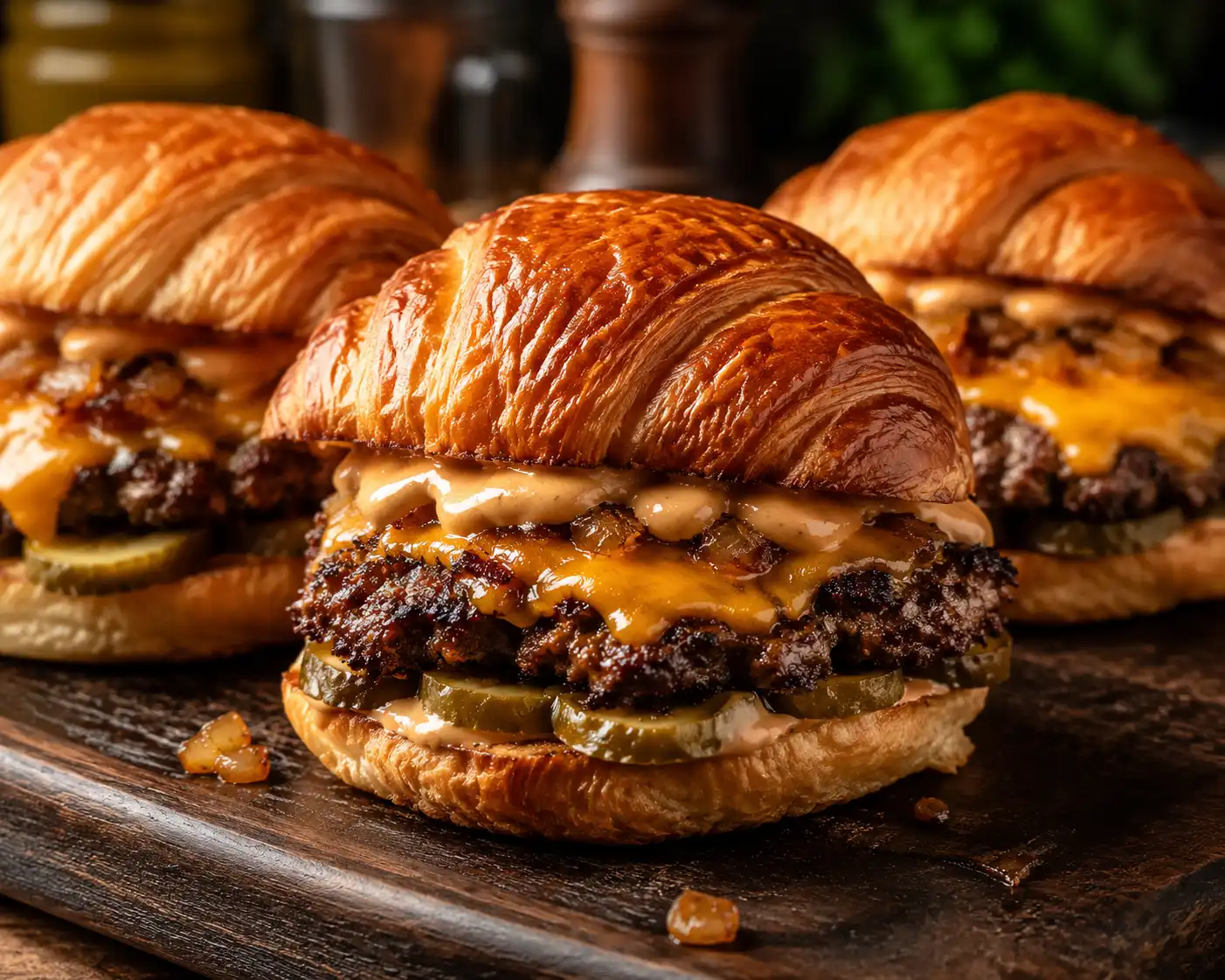
The Croissant Smash Burger is a decadent, buttery, and texturally revolutionary twist on the classic American smash burger — a culinary love letter to indulgence, craftsmanship, and comfort food evolution. Born from the collision of French pastry tradition and Midwestern diner grit, this dish replaces the standard sesame or brioche bun with a golden, flaky, laminated croissant — not as mere bread, but as an integral structural and flavor component that transforms every bite. Unlike conventional burgers where the bun plays a supporting role, the croissant here contributes rich layers of cultured butter, delicate crispness, tender crumb, and subtle tang — all while holding up (just barely, gloriously) to a sizzling, deeply caramelized, double-smashed patty crowned with melty cheese, house-style sauces, and artisanal toppings. It’s not just a burger; it’s an experience — one that balances sophistication and soulfulness, elegance and edge, precision and playful excess.
The History
While the smash burger itself traces its roots to mid-20th-century diners and roadside grills — notably popularized by places like Steak ‘n Shake and later refined by modern icons such as The Original Dinerant in Louisville and Au Cheval in Chicago — the Croissant Smash Burger emerged organically from the “luxury fast-casual” movement of the late 2010s. Chefs and food entrepreneurs began experimenting with high-end ingredients in approachable formats, seeking to elevate the humble smash without sacrificing its essential identity: thin, crispy-edged, maximally seared beef cooked on a scorching flat-top grill. Early iterations appeared at pop-ups in Brooklyn, Portland, and Austin, where pastry-trained chefs collaborated with pitmasters and burger artisans. A pivotal moment came in 2021, when Los Angeles’ “Butter & Buns” launched their “Golden Crescent” — a double-smash Angus patty draped in aged Gruyère, caramelized shallot jam, and black truffle aioli, served on house-laminated, slow-fermented croissants baked fresh hourly. Its viral success ignited a wave of copycats, adaptations, and serious culinary discourse — sparking debates over authenticity, temperature control, structural integrity, and whether croissants truly belong “in the smash.” Food media outlets including Eater, Bon Appétit, and Food & Wine dedicated features to the trend, dubbing it “the most polarizing yet delicious burger innovation of the decade.” Today, the Croissant Smash Burger appears on menus across the U.S., Canada, the UK, and increasingly in Tokyo and Seoul — often customized to regional palates, yet always anchored by its core ethos: reverence for technique, respect for fat, and unapologetic richness.
Ingredients Breakdown
Every element of the Croissant Smash Burger serves a precise functional and sensory purpose — nothing is arbitrary. Below is a deep-dive analysis of each key component:
- Croissants: Not just any croissant will do. Ideal specimens are day-of-baked, medium-sized (approx. 4–5 inches long), with visible lamination, a glossy chestnut-brown crust, and interior layers that separate cleanly without crumbling. Butter content should be ≥82% (European-style), and the dough must contain no shortening or margarine — only flour, water, yeast, salt, and premium unsalted butter. Under-proofed croissants lack tenderness; over-proofed ones collapse under weight and moisture. Slightly stale croissants (6–12 hours old) actually perform better for structural integrity — their crust firms just enough to resist immediate sogginess while still yielding to heat and pressure.
- Ground Beef: An 80/20 blend (80% lean, 20% fat) is non-negotiable for optimal smashability, juiciness, and fond development. Chuck is preferred for its balanced marbling and robust beefy flavor; adding 10–15% brisket trim enhances umami depth and improves binding. Never use pre-formed patties — fresh, loosely packed 3-ounce portions (per patty) ensure even compression and consistent edge formation. Avoid over-handling; cold meat smashes cleaner and renders fat more efficiently.
- Seasoning: Coarse kosher salt (Diamond Crystal preferred for even dissolution and controlled salinity) and freshly ground black pepper are applied *only* after smashing — never before — to prevent premature protein tightening and moisture loss. Some chefs add a whisper of white pepper or smoked paprika to the seasoning blend for aromatic nuance, but purists insist on salt-and-pepper purity to honor the beef’s terroir.
- Cheese: Melting performance and flavor synergy are paramount. American cheese remains the gold standard for its sodium citrate-enhanced flow, neutral tang, and ability to form a seamless “cheese skirt” around the patty edges. High-quality processed cheddar or Vermont white cheddar blends offer sharper profiles, while Gruyère or Comté deliver nutty complexity — though they require careful temperature management to avoid greasiness. Always slice cheese thin (1/16 inch) and place immediately after flipping to maximize adhesion.
- Special Sauce: A harmonious bridge between rich beef and buttery croissant. Typically built on a base of high-fat mayonnaise (made with pasteurized egg yolk and avocado or grapeseed oil), blended with minced cornichons, capers, shallots, Dijon mustard, lemon zest, and a touch of Worcestershire. Variations include roasted garlic aioli, miso-tahini drizzle, or Calabrian chili–infused crema — but the sauce must remain cool, emulsified, and acidic enough to cut through fat.
- Toppings: Less is more — but what’s included must earn its place. Classic pairings include thinly sliced red onion (quick-pickled in rice vinegar and sugar for brightness), crisp iceberg lettuce (shredded or chiffonade for crunch without bulk), and tomato (heirloom or Campari, seeded and patted dry). Gourmet riffs feature caramelized leeks, black garlic jam, fried shallots, micro arugula, or pickled fennel. Raw vegetables must be impeccably dry; moisture is the archenemy of croissant integrity.
- Grill Medium: A commercial-grade flat-top griddle (preferably 1/2-inch thick steel) preheated to 425–475°F is ideal. Cast iron works well at home if properly seasoned and heated until smoking lightly. Surface cleanliness matters — residual oil buildup creates uneven browning; a clean, hot surface ensures instant sear and proper fond formation.
Step-by-Step Recipe
- Prep the Croissants: Slice each croissant horizontally *just before assembly* — not earlier — using a serrated knife with gentle sawing motion. Wipe cut surfaces with a dry paper towel to remove loose flakes. Lightly toast cut sides on the griddle for 20–30 seconds per side until golden and fragrant, but *do not brown deeply*. Remove and rest cut-side-up on a wire rack — never on paper towels, which trap steam and soften crust.
- Chill & Portion Beef: Keep ground beef refrigerated at 34–36°F until ready to cook. Divide into 2-ounce portions for single smash, or 3-ounce portions for double-smash (two patties stacked). Gently form each into a loose, round ball — no compacting. Place on a chilled stainless-steel tray lined with parchment.
- Heat the Griddle: Preheat griddle to 450°F. Test by flicking a few drops of water — they should skitter and evaporate within 1 second. Season surface lightly with refined avocado oil (smoke point 520°F) using a high-heat brush or folded paper towel.
- First Smash: Place one beef ball onto the hot griddle. Wait exactly 10 seconds — no stirring, no pressing yet. Then, using a stiff, flat-edged metal spatula (not flexible), press down firmly and evenly with 15–20 lbs of pressure for 3 full seconds. Lift spatula straight up — do not scrape. Let cook undisturbed for 60–75 seconds until deep mahogany edges form and center begins to set.
- Add Cheese & Flip: Place one thin slice of cheese directly onto patty. After 15 seconds, flip patty *in one confident motion*, cheese-side-down. Immediately smash again — same pressure, same duration — creating a second seared surface and forcing cheese to adhere and melt into the underside.
- Second Patty & Stack: While first patty cooks cheese-side-down for 45 seconds, place second beef ball adjacent on griddle. Smash, cook, flip, and cheese as above. At the 30-second mark of the second patty’s cheese phase, carefully lift the first patty and place it — cheese-side-up — directly atop the second patty. Press gently to fuse. Cook stacked unit for final 20 seconds.
- Build the Burger: Remove stacked patty from griddle. Immediately spoon 1 tbsp special sauce onto bottom croissant half. Layer with patty stack, then top with pickled onions, lettuce, tomato, and a final ½ tsp sauce. Cap with top croissant half, cut-side-down. Serve immediately — no resting, no wrapping, no delay. Optimal eating window: 90 seconds post-griddle.
Tips
- Temperature is Everything: Cold meat + hot griddle = optimal smash. Warm meat spreads instead of compresses, leading to ragged edges and poor fond. Chill your spatula too — a cold metal surface helps retain patty shape during initial press.
- Don’t Crowd the Griddle: Allow minimum 2-inch clearance between patties. Overcrowding drops surface temperature, steams instead of sears, and prevents proper Maillard reaction.
- Spatula Discipline: Use only one spatula — never two. Lifting mid-smash releases juices and breaks crust formation. If sticking occurs, wait 5 more seconds — release will happen naturally as proteins denature.
- Croissant Toasting Precision: Over-toasting creates bitterness and shattering; under-toasting invites sogginess. Aim for audible “crisp-hiss” upon contact — that’s the sweet spot. Never use a toaster oven or air fryer; radiant heat lacks the instantaneous conductive transfer needed.
- Sauce Application Timing: Apply sauce to *bun*, not patty. Hot sauce on hot beef separates and weeps. Cool sauce on warm bun creates a protective barrier against moisture migration.
- Assembly Sequence Matters: Always layer wet ingredients (onions, tomato) *between* cheese and lettuce — the cheese acts as a moisture shield for the croissant, while lettuce provides a final dry buffer.
- Griddle Maintenance: Scrape and wipe surface with hot water and stiff brush *between every batch*. Residual fond builds up and burns, imparting acrid notes. Re-oil only as needed — excessive oil pools and fries the patty edges.
- Beef Fat Management: As patties cook, rendered fat accumulates. Use a small stainless cup to skim excess fat every 2–3 burgers — too much causes spattering, uneven cooking, and greasy cheese skirts.
- Resting is Forbidden: Unlike thick burgers, smash patties have zero carryover cooking. Resting only cools them, solidifies fat, and softens crust. Serve blazing hot — the contrast of molten cheese, crackling edges, and warm, yielding croissant is the entire point.
- Knife Skills for Serving: If photographing or plating formally, use a *hot* knife (dipped in boiling water and wiped) for clean cuts. A cold blade smears cheese and crushes layers.
Variations and Customizations
The Croissant Smash Burger is a canvas — endlessly adaptable while honoring its foundational principles. Here are meticulously tested variations, grouped by theme:
Regional & Cultural Twists
- Korean-Inspired Kimchi Smash: Replace American cheese with mild mozzarella; top stacked patties with house-fermented napa cabbage kimchi, gochujang aioli, and toasted sesame seeds. Serve on slightly sweeter, milk-enriched croissants.
- Japanese Umami Bomb: Use wagyu chuck blend; top with shiitake-dashi caramelized onions, furikake-spiced American cheese, and yuzu-kosho mayo. Croissants brushed with nori-infused clarified butter pre-toast.
- Mexican Al Pastor: Add achiote and pineapple juice to beef blend; top with grilled pineapple rings, pickled red onions, queso fresco crumbles, and chipotle crema. Croissants infused with toasted ancho powder in laminating butter.
Dietary & Lifestyle Adaptations
- Vegetarian Smash: House-made black bean–lentil–walnut patty with smoked paprika, cumin, and tamari; smashed with sharp cheddar and caramelized onions. Croissants made with plant-based European-style butter (e.g., Miyoko’s) and oat milk.
- Pescatarian Option: Smashed wild salmon cakes (with dill, lemon zest, and panko) topped with dill crème fraîche and pickled fennel. Served on herb-flecked, dill-seed croissants.
- Gluten-Free Approach: GF laminated roll made with high-protein sorghum-tapioca-almond flour blend and ghee; paired with grass-fed beef and dairy-free cheese alternative (e.g., Violife smoked provolone).
Gourmet Elevations
- Truffle & Bone Marrow: Blend 1 tbsp roasted bone marrow per 8 oz beef; top with black truffle shavings, aged Gouda, and truffle salt. Croissants brushed with marrow-infused clarified butter.
- Blue Cheese & Fig: Beef blended with crumbled Maytag blue; topped with fig-onion jam, caramelized shallots, and crumbled Point Reyes blue. Croissants made with fig-infused honey in laminating syrup.
- Smoked Paprika & Manchego: Spanish-style beef with smoked paprika and garlic; topped with Manchego, roasted piquillo peppers, and sherry vinegar aioli. Croissants laminated with smoked sea salt and olive oil.
Breakfast Smash Fusion
- Brunch Croissant Smash: Breakfast sausage blend (pork, fennel, sage); topped with cheddar, fried egg (runny yolk), maple-glazed bacon, and bourbon-maple syrup drizzle. Croissants studded with candied pecans and cinnamon-sugar glaze.
Health Considerations and Nutritional Value
Let’s address the elephant in the (buttery) room: The Croissant Smash Burger is, by intentional design, a celebration of abundance — not a health food. That said, nutritional transparency and mindful customization empower informed choices without sacrificing joy. A standard 6-ounce double-smash Croissant Burger (using 80/20 chuck, American cheese, standard croissant, and 2 tbsp special sauce) contains approximately:
- Calories: 980–1,120 kcal
- Total Fat: 72–85g (Saturated: 32–41g)
- Protein: 48–54g
- Carbohydrates: 42–51g (Dietary Fiber: 2–3g; Sugars: 5–8g)
- Sodium: 1,320–1,680mg (66–84% DV)
- Key Micronutrients: Excellent source of Vitamin B12, Zinc, Selenium, and Choline; good source of Iron and Niacin.
Health-Conscious Strategies:
- Fat Quality Matters: Choosing grass-fed beef increases omega-3s and CLA (conjugated linoleic acid); using cultured, high-butterfat European butter adds beneficial butyric acid and vitamin K2.
- Sodium Reduction: Omit added salt on patty (rely on cheese and sauce sodium), use low-sodium Worcestershire, and skip pre-salted butter in croissants. Saves ~350mg sodium.
- Fiber Boost: Add a layer of sautéed spinach or shredded Brussels sprouts beneath the patty — their natural moisture barrier protects the croissant while contributing fiber and phytonutrients.
- Portion Control: Opt for a single-smash (3 oz beef) on a demi-croissant (half-size) — reduces calories by ~35% and total fat by ~40% without sacrificing core experience.
- Smart Swaps: Replace special sauce with herbed Greek yogurt (reduces fat by 60%, adds probiotics); use aged white cheddar instead of American (cuts sodium by 30%, adds calcium).
- Balance the Meal: Serve with a vibrant, vinegar-dressed kale and apple slaw (adds fiber, vitamin C, and acidity to cut richness) instead of fries. Hydrate with sparkling water + lemon, not sugary sodas.
Note: Individuals with specific dietary restrictions (e.g., lactose intolerance, celiac disease, hypertension) should consult a registered dietitian for personalized modifications. This dish shines brightest as an occasional, intentional indulgence — not daily fare — aligning with principles of intuitive and sustainable eating.
Ingredients
Makes 4 Croissant Smash Burgers
For the Patties
- 1 lb (454g) fresh 80/20 ground chuck (preferably dry-aged or grass-fed)
- 1 ½ tsp Diamond Crystal kosher salt (or 1 tsp Morton’s)
- 1 tsp freshly ground black pepper
For the Croissants
- 4 high-quality, day-of-baked plain croissants (5–6 inches long, approx. 3.5 oz each)
- 1 tbsp refined avocado oil (for toasting)
For the Cheese Skirt
- 8 thin slices (1/16-inch) high-melt American cheese (e.g., Boar’s Head American or Kraft Deli Deluxe)
For the Special Sauce
- ½ cup high-fat mayonnaise (e.g., Duke’s or Hellmann’s Real)
- 1 tbsp finely minced cornichons
- 1 tsp minced capers, rinsed
- 1 tsp finely minced shallot
- 1 tsp Dijon mustard
- ½ tsp fresh lemon zest
- ¼ tsp Worcestershire sauce
- Pinch of white pepper
For Toppings
- ½ cup quick-pickled red onions (thinly sliced red onion soaked 15 min in ¼ cup rice vinegar + 1 tbsp sugar + ½ tsp salt)
- 1 cup shredded iceberg lettuce (centrifuged dry)
- 1 medium heirloom tomato, sliced ¼-inch thick, seeds scooped and patted dry
- Optional: 4 leaves of butter lettuce for extra layer
Directions
- Make the Special Sauce: In a small bowl, whisk together all sauce ingredients until fully emulsified. Cover and refrigerate for minimum 30 minutes to allow flavors to meld. Stir before using.
- Prep Pickled Onions: Combine red onion slices, rice vinegar, sugar, and salt in a small jar. Shake vigorously. Refrigerate for at least 15 minutes (up to 3 days).
- Chill & Portion Beef: Place ground beef in freezer for 10 minutes to firm. Divide into eight 2-ounce balls (for single smash) or four 3-ounce balls (for double smash). Place on chilled plate; cover loosely with plastic wrap.
- Preheat Griddle: Heat heavy-duty flat-top griddle or large cast-iron skillet over medium-high heat for 12–15 minutes until surface reads 450°F on infrared thermometer. Wipe lightly with avocado oil using heatproof brush.
- Toast Croissants: Slice each croissant horizontally. Toast cut sides on griddle 25 seconds per side until golden and crisp. Transfer to wire rack, cut-side up.
- Smash First Patties: Place four beef balls on griddle. Wait 10 seconds, then smash firmly with metal spatula for 3 seconds. Cook 70 seconds. Place one cheese slice on each patty. After 15 seconds, flip and smash again. Cook cheese-side-down 45 seconds.
- Smash Second Patties & Stack: Place remaining four beef balls on griddle. Smash and cook as above. At 30-second mark of their cheese phase, lift first patties and place — cheese-side-up — atop second patties. Press gently to fuse. Cook stacked patties 20 seconds.
- Assemble Immediately: Spread 1 tbsp sauce on bottom croissant half. Add stacked patty. Top with 2 tbsp pickled onions, ¼ cup lettuce, 2 tomato slices. Drizzle with ½ tsp sauce. Cap with top croissant half.
- Serve Hot: Present on pre-warmed plates. Serve within 90 seconds for optimal texture contrast. Provide extra napkins — generously.
FAQ
- Q: Can I make Croissant Smash Burgers on a regular home stove?
- A: Absolutely — but success hinges on equipment. Use the heaviest-bottomed skillet you own (cast iron or carbon steel), preheat over medium-high for 10+ minutes until smoking lightly, and work in batches to maintain temperature. Electric coils require longer preheat; induction heats fastest and most evenly.
- Q: Why can’t I use store-bought frozen croissants?
- A: Most frozen croissants contain palm oil, hydrogenated fats, or lower-butter formulations that lack proper lamination, melt unpredictably under heat, and impart off-flavors. They also often contain dough conditioners that interfere with toasting integrity. For authentic results, seek local bakeries or high-end grocery delis with in-house laminated pastries.
- Q: My croissants get soggy instantly. What am I doing wrong?
- A: Three likely culprits: (1) Applying sauce directly to hot patty instead of bun — always sauce the bun; (2) Using tomatoes or onions with excess moisture — seed, drain, and pat *thoroughly* dry; (3) Toasting croissants too far in advance — assemble within 2 minutes of toasting.
- Q: Can I prep components ahead?
- A: Yes — with caveats. Beef can be portioned and refrigerated (covered) up to 24 hours. Sauce keeps refrigerated 5 days. Pickled onions last 3 days. Croissants *must* be toasted and assembled à la minute. Pre-toasted croissants lose structural integrity within minutes.
- Q: What’s the best cheese for maximum “cheese skirt”?
- A: American cheese remains unparalleled due to sodium citrate, which lowers melting point and prevents separation. For gourmet alternatives, try Velveeta Queso Blanco (higher melt stability than cheddar) or a 50/50 blend of American and young Gouda for complexity without sacrificing flow.
- Q: Can I air-fry the croissants?
- A: Not recommended. Air fryers rely on convection, which dries out the delicate exterior without achieving the conductive sear needed for crisp-yet-tender contrast. A griddle or cast iron delivers superior texture and flavor development.
- Q: Is there a vegetarian version that truly satisfies?
- A: Yes — but it requires rethinking, not just substituting. Our top-performing veggie patty uses black beans, lentils, walnuts, sautéed mushrooms, tamari, smoked paprika, and vital wheat gluten for chew. It’s formed cold, smashed aggressively, and topped with sharp cheddar and caramelized onions — delivering umami depth, textural interest, and satisfying heft.
- Q: How do I achieve perfect, lacy cheese edges?
- A: Key factors: (1) Cheese must be *cold* when placed on hot patty — chill slices 5 minutes before use; (2) Flip *immediately* after placing cheese — don’t wait; (3) Press gently but firmly after stacking to encourage cheese flow over edges; (4) Cook stacked patties just long enough for cheese to bubble and fringe — overcooking causes greasiness.
- Q: Can I use turkey or chicken instead of beef?
- A: Technically yes, but strongly discouraged. Poultry lacks the fat content and collagen structure needed for proper smash adhesion and fond development. It dries out rapidly and fails to create the signature crust. If pursuing lighter protein, consider a high-fat pork blend (70/30) or duck confit patty — both deliver requisite richness and texture.
- Q: Why is the smash technique so important?
- A
Advertisment