
Introduction
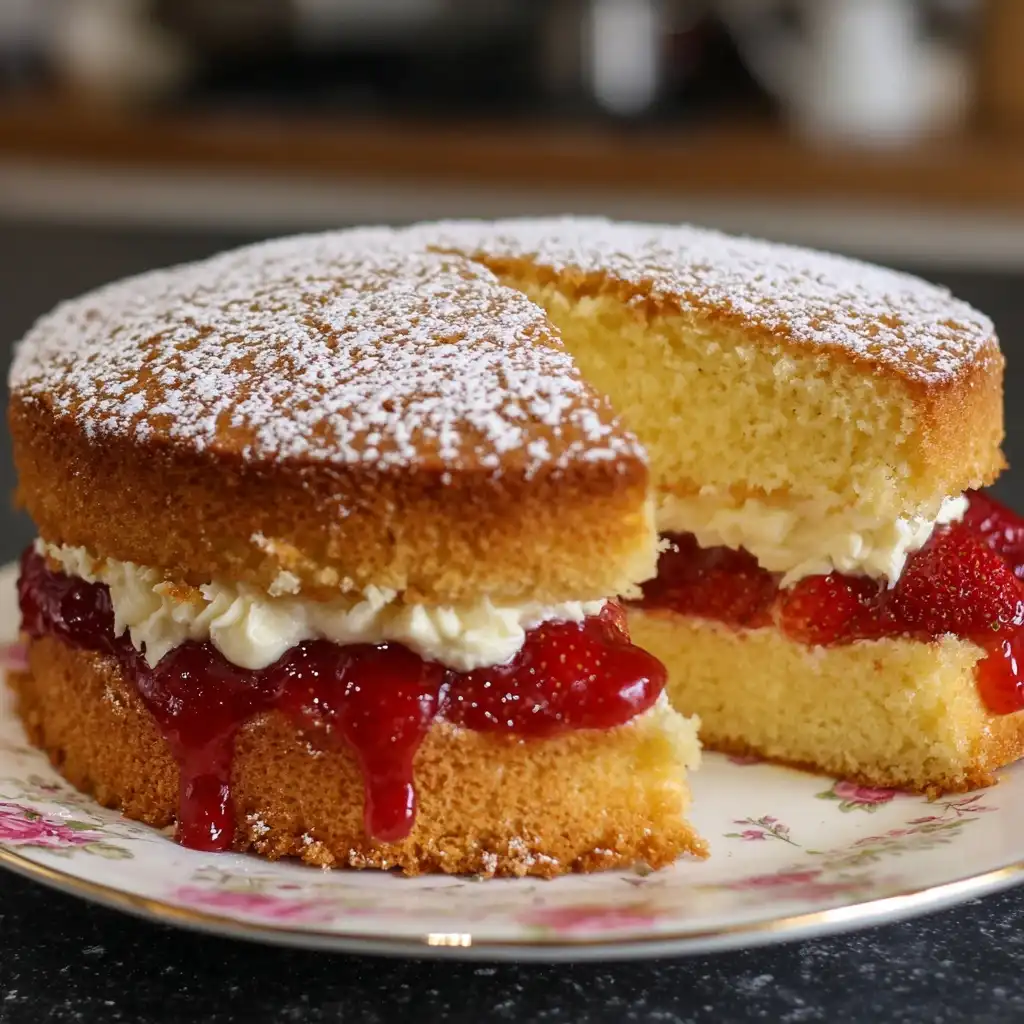
The Traditional British Victoria Sponge is more than just a cake—it’s an enduring symbol of British culinary heritage, afternoon tea culture, and quiet domestic elegance. Light, tender, and deceptively simple, this iconic two-layer sponge embodies the very essence of classic British baking: balance, restraint, and reverence for quality ingredients. Named in honour of Queen Victoria—who was famously fond of a slice with her afternoon tea—the Victoria Sponge has graced drawing rooms, village fairs, and family kitchens for over 170 years. Its charm lies not in extravagance but in its perfect harmony: airy vanilla-scented sponge, luxuriously smooth raspberry or strawberry jam, and a whisper-thin dusting of icing sugar. Unlike richer, layered continental cakes, the Victoria Sponge celebrates purity of texture and flavour—making it a timeless benchmark against which all other sponge cakes are measured.
The History
The origins of the Victoria Sponge trace back to the early 19th century, though its evolution reflects pivotal shifts in British baking technology and social custom. Before the 1840s, most “sponges” were yeast-leavened and dense—closer to brioche than what we recognise today. The true breakthrough came with the advent of chemical leavening agents, particularly baking powder (first patented in England by Alfred Bird in 1843). Bird—a chemist and food manufacturer—developed his version to accommodate his wife’s egg allergy, inadvertently revolutionising home baking. His phosphate-based raising agent allowed bakers to create light, even-textured cakes without eggs or yeast—though the traditional Victoria Sponge would soon embrace eggs wholeheartedly.
Queen Victoria’s documented love of sponge cake—recorded in royal household accounts and diaries from the 1850s—cemented its cultural status. Her daily tea service at Buckingham Palace regularly featured a plain, unfrosted, two-layer sponge filled with jam and served with clotted cream (though purists note that cream is traditionally reserved for Cornish splits or scones—not the authentic Victoria Sponge). By the late Victorian era, the cake appeared in seminal cookbooks: Isabella Beeton’s Book of Household Management (1861) included a “Victoria Sandwich” recipe using equal weights of flour, butter, sugar, and eggs—a principle still sacred today. Over time, regional interpretations emerged (Devonshire vs. Cornish preferences, use of red currant vs. raspberry jam), yet the core structure remained untouched: two identical layers, minimal adornment, maximum respect for technique.
During both World Wars, the Victoria Sponge adapted heroically—substituting lard for butter, using treacle or carrot for sweetness during rationing—but never lost its identity. Its post-war resurgence in the 1950s coincided with the rise of televised cooking shows and the “Agony Aunt” columns advising on proper tea service etiquette—further embedding it in national consciousness. Today, it remains a staple of the Great British Bake Off signature challenge, a litmus test for precision, patience, and pastry poise.
Ingredients Breakdown
What makes the Victoria Sponge extraordinary is its radical simplicity—and the non-negotiable integrity of each component. Every ingredient serves a precise structural and sensory function; substitutions alter chemistry, not just taste.
- Unsalted Butter (225g, softened to cool room temperature ~18°C): Provides richness, tenderness, and emulsification. Must be softened—not melted nor greasy—to properly aerate with sugar. Salted butter risks inconsistent salinity and can mask delicate vanilla notes.
- Caster Sugar (225g): Finer than granulated sugar, it dissolves rapidly into butter, enabling superior air incorporation during creaming. Icing sugar is too fine and introduces starch; demerara or muscovado add moisture and acidity that destabilise crumb structure.
- Large Free-Range Eggs (4, cold): Cold eggs emulsify more effectively into the butter-sugar mixture, preventing curdling. Each egg should weigh approx. 59–63g in shell. Egg whites provide lift; yolks contribute fat, emulsifiers (lecithin), and colour. Organic or pasture-raised eggs yield deeper golden crumb and richer aroma.
- Self-Raising Flour (225g): The cornerstone of authenticity. Contains precisely balanced baking powder (approx. 1.5 tsp per 150g) and a small amount of salt. Using plain flour + separate baking powder risks uneven distribution and over-leavening; strong flour adds excess gluten, yielding toughness. Sift *twice*—once before measuring, once after—to ensure levity and remove lumps.
- Good-Quality Vanilla Extract (1½ tsp, Madagascar Bourbon preferred): Alcohol-based extract (not essence or paste) delivers volatile aromatic compounds that survive baking. Seeds from ½ a vanilla pod may be scraped in for heightened complexity—but avoid artificial vanillin, which tastes medicinal when concentrated.
- Seedless Raspberry Jam (200g, unsweetened or lightly sweetened): The definitive traditional choice—tart enough to cut through sweetness, thick enough to hold without seeping. Avoid “jam with pectin added” (overly gelatinous) or strained blackberry (too tannic). Red currant is a period-accurate alternative; strawberry works but lacks depth. Never use jelly—it’s too runny and lacks fruit fibre for grip.
- Icing Sugar (for dusting, approx. 2 tbsp): Pure, finely ground sucrose—no anti-caking agents. Sifted just before application to prevent clumping. A single, ethereal snowfall—not a heavy blanket.
Note on Equipment: Two identical 20cm (8-inch) round, deep (7.5cm / 3-inch) sandwich tins with removable bases; parchment paper liners (not greaseproof alone); digital kitchen scale (gram precision essential); balloon whisk and silicone spatula; stand mixer or hand-held electric whisk (wooden spoons are insufficient for proper aeration).
Step-by-Step Recipe
Follow these steps with disciplined timing and tactile awareness—the Victoria Sponge rewards mindfulness, not speed.
- Preparation (15 mins): Preheat oven to 180°C (160°C fan)/350°F/Gas Mark 4. Butter tins thoroughly, line bases with parchment, then butter parchment. Dust insides lightly with flour, tapping out excess. Weigh all ingredients *before* beginning—no approximations. Remove eggs from fridge 10 minutes prior.
- Creaming (5–7 mins): In a large bowl, beat softened butter and caster sugar with electric mixer on medium-high for 5 minutes until pale, voluminous, and creamy—scraping down sides twice. Texture should resemble whipped cream, not grainy paste. If it looks curdled, continue beating—most recover. Add vanilla; mix 30 seconds.
- Adding Eggs (3 mins): Add eggs *one at a time*, beating for 1 minute after each addition until fully incorporated and glossy. If mixture threatens to split, add 1 tsp flour from the measured amount and beat briefly to stabilise. Do *not* rush this stage—cold eggs + gradual incorporation = stable emulsion.
- Folding (2 mins): Sift self-raising flour *twice* over mixture. Using a large metal spoon or silicone spatula, fold gently in a figure-eight motion—cutting down centre, scraping base, lifting up and over—until *just* combined. Do not overmix: streaks of flour are preferable to grey, dense batter. Batter should drop slowly from spoon in thick ribbons.
- Pouring & Levelling (1 min): Divide batter *exactly* between tins using a scale (112–113g per tin). Smooth tops with offset spatula. Tap tins sharply *three times* on counter to release air bubbles—critical for even rise and no sunken centres.
- Baking (22–26 mins): Place tins on middle rack, spaced apart. Bake 22 minutes, then rotate tins front-to-back. Check at 24 mins: sponge should be golden, springy to gentle touch, and shrinking slightly from tin edges. A skewer inserted should emerge clean. *Do not open oven before 20 minutes*—temperature shock causes collapse.
- Cooling (45 mins minimum): Remove cakes from oven. Run palette knife around edges. Invert tins onto wire racks, peel off parchment, then re-invert cakes *right-side-up*. Cool completely (45–60 mins)—warm cakes absorb jam and disintegrate. Never refrigerate to hasten cooling.
- Assembling (5 mins): Place one cake layer on serving plate. Warm jam gently (10 sec microwave) if stiff—do not boil. Spread evenly to edges with small offset spatula, leaving 3mm border. Top with second layer, pressing *gently*—no twisting. Sift icing sugar liberally through a fine-mesh sieve held 30cm above cake for flawless, feathery coverage.
Tips
- Temperature is Non-Negotiable: Butter must be cool-room temp (16–18°C). Too warm = greasy batter; too cold = poor aeration. Test by pressing fingertip—it should indent slightly without oil pooling.
- Weigh, Don’t Measure: Volume measurements for flour vary by up to 30% due to settling and scooping method. Gram weight ensures the exact 1:1:1:1 ratio—the soul of the Victoria Sponge.
- Sifting is Structural: Self-raising flour compacts in the packet. Sifting incorporates air, distributes raising agents evenly, and prevents dense pockets. Skipping this step guarantees tunneling or doming.
- Resist the “Extra” Egg: Some modern recipes add a fifth egg for height—but this increases moisture and gluten development, yielding rubberiness, not lightness. Four eggs are scientifically optimal for 225g ratios.
- Jam Consistency Matters: If jam is overly liquid, simmer 2 mins to reduce, then cool completely before spreading. Runny jam migrates into sponge, making layers soggy within hours.
- No Cream, No Buttercream: Authentic Victoria Sponge contains *only* jam and icing sugar. Adding buttercream, whipped cream, or lemon curd transforms it into a different cake entirely (e.g., Battenberg or Lemon Drizzle). Tradition demands purity.
- Cut with a Serrated Knife: Use a long, thin bread knife with gentle sawing motion—no downward pressure. Wipe blade clean between slices for sharp edges.
- Serve Within 8 Hours: Best eaten the day it’s made. Store uncovered at cool room temperature (not in airtight container—it sweats). Refrigeration dries it out; freezing is possible (wrap layers separately in clingfilm + foil) but thaw at room temp 3 hours before assembling.
Variations and Customizations
While purists defend the canonical raspberry-jam-and-icing-sugar format, thoughtful adaptations exist within historical and regional frameworks—never compromising the cake’s structural DNA.
- Lemon Victoria Sponge: Replace vanilla with 2 tsp finely grated unwaxed lemon zest + 1 tbsp fresh lemon juice (reduce milk if using—though traditional recipe uses none). Pair with lemon curd *only if used as a 50/50 blend with raspberry jam*—never solo. Zest must be added with butter-sugar cream for oil infusion.
- Almond Victoria Sponge: Substitute 30g of the self-raising flour with finely ground blanched almonds (almond meal). Enhances nuttiness and moisture retention. Add ¼ tsp almond extract *with* vanilla. Traditionally served with apricot jam in East Anglia.
- Earl Grey Infused: Steep 2 Earl Grey tea bags in 2 tbsp hot milk for 5 minutes, cool completely, then add with eggs. Omit vanilla. Pairs exquisitely with blackcurrant jam—evokes Victorian apothecary sensibilities.
- Wholegrain “Brown” Victoria: Replace 75g self-raising flour with dark rye or spelt flour + ½ tsp extra baking powder. Adds malty depth and denser crumb—best with damson or sloe gin jam. Requires 2–3 extra minutes baking.
- Gluten-Free Victoria Sponge: Use certified GF self-raising blend (Doves Farm or Freee brand). Add 1 tsp xanthan gum if not included. Increase eggs to 5 (one extra yolk) for binding. Rest batter 15 minutes before baking to hydrate flours.
- Vegan Victoria Sponge: Replace butter with Stork Block (the only UK vegan margarine with identical fat content); eggs with “aquafaba” (6 tbsp reduced chickpea brine, whipped to soft peaks, folded in last); use agave-sweetened seedless jam. Texture is closer to chiffon than classic—but accepted in modern tea rooms.
- Mini Victoria Sandwiches: Bake in 12-hole deep muffin tin (15–18 mins). Fill with jam piped through star nozzle, dust with icing sugar. Ideal for weddings or afternoon tea buffets.
Important Note: Any variation altering the 1:1:1:1 weight ratio, omitting eggs, or adding liquids (milk, cream, yoghurt) fundamentally changes the cake classification—it becomes a “Victoria-style” sponge, not a Traditional British Victoria Sponge.
Health Considerations and Nutritional Value
A single generous slice (1/10th of a full-size cake, approx. 120g) contains roughly:
- Calories: 340–370 kcal
- Total Fat: 18–20g (11–13g saturated)
- Carbohydrates: 42–45g (32–35g sugars)
- Protein: 5–6g
- Fibre: 0.5g (increases to 1.2g with wholegrain variation)
- Sodium: 120–150mg
Nutritional Context: As a celebratory baked good, the Victoria Sponge is not designed for daily consumption—but it is nutritionally honest: no hidden oils, hydrogenated fats, or artificial preservatives. Its primary energy source is sucrose (from cane sugar) and dairy fat, both metabolised efficiently in moderation. Butter contributes vitamins A, D, and K2; eggs supply choline (vital for brain health) and lutein (for eye protection). Raspberry jam adds polyphenols (ellagic acid) and modest vitamin C—especially if made with whole fruit and minimal added sugar.
Dietary Adaptations:
- Lower-Sugar Option: Reduce caster sugar to 180g and use 100% fruit raspberry jam (no added sugar). Crumb remains tender due to egg/butter balance—sugar’s main role here is aeration, not just sweetness.
- Heart-Healthy Tweaks: Replace 75g butter with cold-pressed rapeseed oil (adds omega-3s, maintains moisture). Not traditional—but yields identical rise and a subtly nuttier finish.
- Allergen Notes: Naturally nut-free and soy-free (if using pure vanilla extract). Contains gluten (from wheat flour) and dairy (butter, eggs). For egg allergy, commercial egg replacers fail structurally—stick to aquafaba or commercial vegan sponge mixes.
- Diabetic-Friendly? Not inherently—but pairing with a protein-rich accompaniment (e.g., Greek yoghurt on the side) slows glucose absorption. Portion control (smaller 12-slice cut) is more effective than ingredient substitution.
Mindful Enjoyment: The Victoria Sponge invites slow, sensory eating—its delicate crumb dissolving on the tongue, tart jam cutting richness, icing sugar providing ephemeral sweetness. This ritualistic pace supports satiety cues far better than ultra-processed snacks. Historically, it was served in small portions with tea—never as dessert after a heavy meal—aligning with intuitive eating principles long before they were named.
Ingredients
- 225g unsalted butter, softened to cool room temperature (16–18°C)
- 225g golden caster sugar
- 4 large free-range eggs, cold (approx. 59–63g each, in shell)
- 225g good-quality self-raising flour, sifted twice
- 1½ tsp pure Madagascar bourbon vanilla extract
- 200g seedless raspberry jam (unsweetened or lightly sweetened)
- 2–3 tbsp icing sugar, for dusting
Directions
- Preheat oven to 180°C (160°C fan)/350°F/Gas Mark 4. Prepare two 20cm (8-inch) round, deep (7.5cm / 3-inch) sandwich tins: butter generously, line bases with parchment paper, butter parchment, then dust insides with flour, tapping out excess.
- Weigh all ingredients precisely. Remove eggs from refrigerator 10 minutes before starting.
- In a large mixing bowl, beat butter and caster sugar with an electric mixer on medium-high speed for 5–7 minutes until pale, thick, and creamy—scraping down sides twice. Beat in vanilla extract for 30 seconds.
- Add eggs one at a time, beating for 60 seconds after each addition until fully incorporated and glossy. If mixture begins to look curdled, add 1 tsp of the measured flour and continue beating until restored.
- Sift the double-sifted self-raising flour over the batter. Using a large metal spoon or silicone spatula, fold gently using a figure-eight motion until *just* combined—streaks of flour are acceptable; overmixing causes toughness.
- Divide batter equally between tins (weigh for accuracy: approx. 112–113g each). Smooth tops level with an offset spatula. Tap each tin sharply three times on the work surface to release trapped air.
- Bake for 22–26 minutes on the middle shelf—rotate tins front-to-back at 22 minutes. Cake is done when golden, springy to light touch, shrinking slightly from edges, and a skewer comes out clean.
- Immediately remove from oven. Run a palette knife around edges, then invert tins onto wire racks. Peel off parchment, then carefully reinvert cakes right-side-up. Cool completely (45–60 minutes)—do not rush.
- To assemble: place one cooled layer on a cake stand or plate. Warm jam gently if stiff (10 seconds in microwave), then spread evenly to edges, leaving a 3mm border. Carefully place second layer on top, pressing gently—no twisting.
- Just before serving, sift icing sugar generously through a fine-mesh sieve held 30cm above the cake for an even, cloud-like finish. Serve with English Breakfast tea and a quiet moment of appreciation.
FAQ
- Why does my Victoria Sponge sink in the middle?
- Most commonly caused by opening the oven too early (before 20 minutes), under-baking, excessive raising agent (using plain flour + extra baking powder), or overmixing the batter after adding flour. Also check oven temperature with an oven thermometer—many domestic ovens run hot or cold.
- Can I make it the day before?
- Yes—but only as unfilled layers. Wrap *completely cooled* sponges separately in clingfilm and store at cool room temperature (not refrigerated) for up to 24 hours. Assemble no earlier than 2 hours before serving to preserve texture.
- My batter split while adding eggs—can I save it?
- Almost always, yes. Immediately add 1–2 tsp of the measured flour and beat on low for 30 seconds. The flour absorbs excess moisture and rebuilds the emulsion. Continue adding remaining eggs one at a time as directed.
- What’s the difference between Victoria Sponge and Madeira Cake?
- Madeira has more flour and less butter/eggs, yielding a denser, drier, longer-lasting loaf ideal for carving and icing. Victoria Sponge is maximally aerated, tender, and designed for immediate, unfrosted enjoyment.
- Can I use frozen raspberries for the jam?
- Yes—but thaw completely and drain *all* excess liquid (press through sieve), then cook with sugar to set properly. Frozen berries release more water and have lower pectin, so add ½ tsp lemon juice per 200g to aid gelling.
- Is there a “correct” jam-to-sponge ratio?
- Traditional guidance is a 1:1 thickness ratio—jam layer should be approximately the same height as each sponge layer (approx. 5–6mm). Too little lacks impact; too much saturates the crumb.
- Why do some recipes include a teaspoon of milk?
- Milk is a modern, non-traditional addition—likely introduced to compensate for over-creamed or overheated butter. Authentic Victorian-era recipes contain *no liquid beyond eggs*. If your batter feels dry, your butter wasn’t soft enough—or you overmixed.
- Can I bake it in a single deep tin and split?
- Strongly discouraged. Single-layer baking creates uneven heat distribution—edges overbake while centre stays gummy. Splitting warm cake tears the crumb; splitting cold cake is brittle and crumbly. Two tins guarantee structural integrity and professional results.
Summary
The Traditional British Victoria Sponge is a masterclass in minimalist perfection—four equal parts (butter, sugar, eggs, flour), two golden layers, one vibrant layer of seedless raspberry jam, and a sigh of icing sugar.
Its enduring legacy rests not on novelty, but on the quiet excellence of precise technique, seasonal integrity, and the profound satisfaction of a slice shared slowly, with tea, in good company.