
Introduction
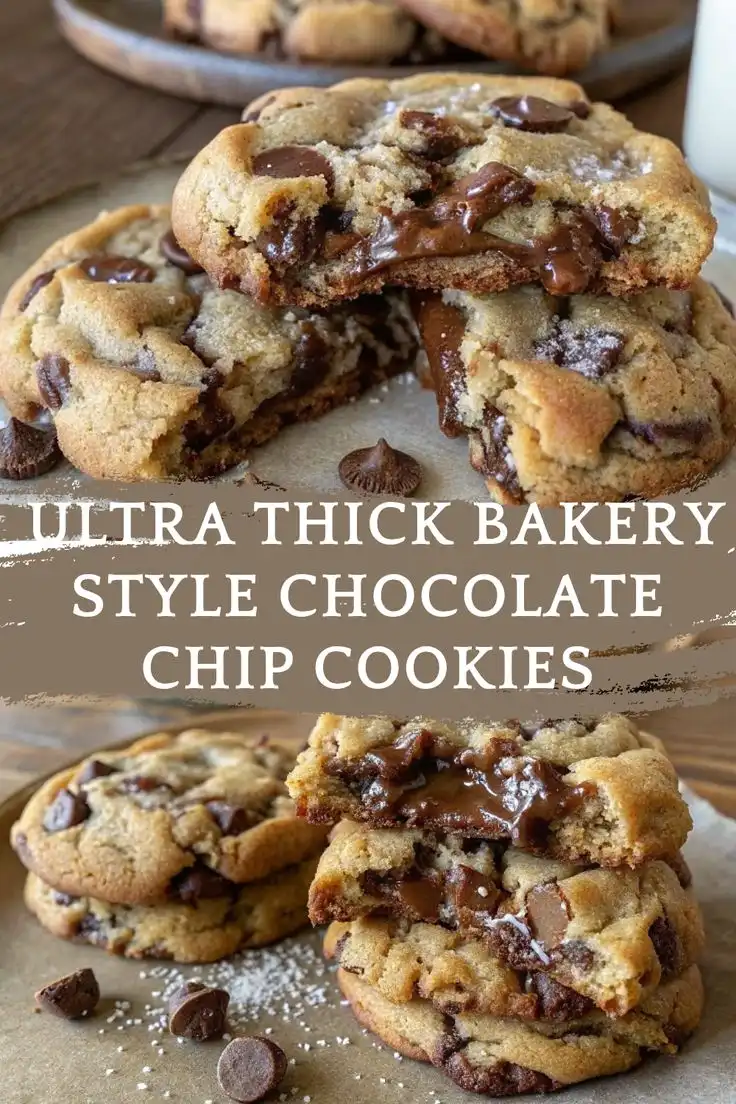
Welcome to the ultimate guide for crafting Ultra Thick Bakery Style Chocolate Chip Cookies—the kind that instantly transport you to your favorite artisanal bakery: towering, golden-brown domes with crispy, caramelized edges that shatter delicately under gentle pressure, giving way to a luxuriously gooey, molten, slightly underbaked center studded with generous pools of rich, bittersweet chocolate. These aren’t just cookies—they’re an experience. Baked with precision, patience, and premium ingredients, each 4-ounce cookie boasts a remarkable 1.5-inch height, a chewy-yet-crisp texture gradient, and deep, complex flavor notes of brown sugar molasses, toasted butter, and vanilla bean. Whether you’re feeding a crowd, gifting a dozen, or treating yourself to pure indulgence, this recipe delivers professional-level results—no fancy equipment required, just meticulous technique and respect for the science of cookie baking.
The History
The ultra-thick, bakery-style chocolate chip cookie is a relatively modern evolution rooted in the iconic Toll House Cookie—but elevated through decades of culinary experimentation and consumer demand for textural contrast and visual impact. While Ruth Wakefield’s original 1938 recipe yielded flat, evenly spread cookies, bakers in the 1980s and ’90s—particularly at chains like Levain Bakery (founded 1995 in NYC) and later Milk Bar and Insomnia Cookies—began intentionally engineering thicker, denser, higher-moisture doughs using techniques like cold fermentation, increased brown sugar ratios, and strategic flour blends. The “Levain-style” cookie—famous for its 6-ounce, crackled, craggy exterior and lava-like center—became the gold standard for thick cookies, inspiring countless home bakers to reverse-engineer its magic. This recipe honors that legacy while refining it further: incorporating European-style butter for superior browning, bread flour for structural integrity without toughness, and a precise chilling protocol to prevent spreading—transforming nostalgia into next-level, restaurant-worthy confectionery artistry.
Ingredients Breakdown
Every ingredient in this ultra-thick cookie serves a distinct, science-backed purpose—not just flavor, but function:
- Unsalted European-Style Butter (1½ cups / 340g, cold & cubed): Higher fat content (82–86%) and lower water yield richer flavor, deeper browning, and less steam-induced spreading. Cold temperature preserves structure during mixing and ensures optimal creaming.
- Granulated Sugar (¾ cup / 150g): Provides sweetness, crispness, and aids in initial aeration during creaming. Its fine crystals dissolve slowly, contributing to edge crunch.
- Packed Dark Brown Sugar (1¼ cups / 270g): Adds moisture, acidity (from molasses), and complex caramel notes. The molasses also reacts with baking soda for lift and browning—critical for that signature golden halo.
- Large Eggs (2, cold): Cold eggs help maintain dough temperature. They supply structure (proteins), tenderness (fats), and emulsification—binding fat and water for uniform dough consistency.
- Pure Vanilla Extract (2 tsp) + Vanilla Bean Paste (1 tsp): Dual vanilla infusion maximizes aromatic depth—extract for volatile top notes, paste for creamy, seed-speckled richness and lingering warmth.
- Bread Flour (2 cups / 260g): Higher protein (12–14%) than all-purpose flour creates more gluten network—essential for supporting the massive dough volume without collapse, yielding chew without gumminess.
- All-Purpose Flour (½ cup / 60g): Balances bread flour’s strength; too much gluten would make cookies tough. This blend achieves ideal elasticity and bite.
- Unsweetened Natural Cocoa Powder (¼ cup / 20g): A secret weapon! Adds subtle roasted depth, enhances browning via Maillard reactions, and intensifies chocolate flavor without adding extra fat or moisture.
- Baking Soda (1 tsp): Reacts immediately with brown sugar’s acidity to create carbon dioxide bubbles—key for lift, spread control, and edge crispness. No baking powder is used to avoid cakey texture.
- Fine Sea Salt (1½ tsp): Enhances all flavors, balances sweetness, and strengthens gluten. Fine salt dissolves fully and distributes evenly—critical in thick dough where clumps won’t melt mid-bake.
- High-Quality Semi-Sweet Chocolate (12 oz / 340g, coarsely chopped): We use 55–60% cacao bars (e.g., Valrhona Guanaja, Ghirardelli Intense Dark) for optimal melt pool formation and nuanced bitterness. Chopping—not chips—ensures irregular, generous shards that create gooey pockets and visual drama.
- Flaky Sea Salt (for finishing, e.g., Maldon): A pinch atop each cookie pre-bake amplifies sweetness, adds textural contrast, and elevates the entire sensory profile.
Step-by-Step Recipe
- Pre-Chill All Wet Ingredients (2 hours ahead): Place eggs, butter (cut into ½” cubes), and even measuring cups in the refrigerator. Cold ingredients = minimal early melting = better structure.
- Whisk Dry Ingredients (5 min): In a medium bowl, thoroughly whisk together bread flour, all-purpose flour, cocoa powder, baking soda, and fine sea salt. Sift twice to aerate and eliminate lumps—critical for even rise and no dense pockets.
- Cream Butter & Sugars (4–5 min, stand mixer): Using paddle attachment on medium speed, beat cold butter, granulated sugar, and brown sugar until *just combined* (1 min). Then increase to medium-high and beat for 3–4 minutes until pale, fluffy, and visibly expanded—scraping bowl every 60 seconds. Do NOT over-cream; we want air pockets, not heat-induced melting.
- Incorporate Eggs & Vanilla (2 min): Add cold eggs one at a time, beating 30 seconds after each until fully emulsified. Scrape bowl. Add vanilla extract and paste; mix 30 seconds until homogenous. Batter should be thick, glossy, and hold soft peaks.
- Gradual Dry Ingredient Incorporation (3 min): With mixer on low, add dry mixture in three equal portions, mixing only until *no streaks remain* after each addition (≈20 seconds per portion). Overmixing develops excess gluten → toughness. Dough will be very stiff and shaggy.
- Chocolate Folding (2 min): Using a flexible silicone spatula, fold in chopped chocolate by hand—15–20 gentle turns—until evenly distributed with visible shards. Avoid pressing down; preserve airiness.
- Chill Dough—Non-Negotiable (Minimum 24 hours, up to 72): Divide dough into 4-ounce (115g) portions (~¼ cup + 1 tbsp). Roll tightly into smooth balls. Place on parchment-lined tray, cover *tightly* with plastic wrap touching surface, then refrigerate for ≥24 hours. This hydrates flour, firms fats, concentrates flavors, and allows enzymatic development of caramel notes. For best results, chill 36–48 hours.
- Preheat & Prep (1 hour before baking): Position oven rack in center. Preheat to 375°F (190°C) for full 60 minutes—oven thermal mass is vital. Line two half-sheet pans (13″x18″) with heavy-duty parchment (no greasing!).
- Portion & Salt (5 min): Remove chilled dough balls from fridge. Place 3–4 inches apart on pans (6 cookies max per pan). Gently press 2–3 flakes of Maldon salt onto the top center of each. Let rest at room temp 15 minutes—dough surface softens slightly for optimal oven spring, but interior remains cold.
- Bake with Precision (18–20 min): Bake one pan at a time. At 12 minutes, rotate pan ½ turn. At 16 minutes, gently lift edge with spatula—if edges are deeply golden and set but center looks soft and slightly shiny, they’re ready. Total bake: 18 min yields perfectly gooey centers; 19–20 min for slightly firmer (but still molten) centers. Do not overbake—carryover cooking continues for 5+ minutes.
- Cool Strategically (20 min minimum): Immediately upon removal, bang pan firmly on counter twice to collapse air pockets and enhance crackle. Let cookies cool on pan for 15 minutes—this sets structure and prevents breakage. Then carefully slide parchment onto wire rack for final 5-minute cooling. Eat warm for maximum gooeyness.
Tips
- Weigh Everything: Volume measurements for flour and brown sugar vary wildly. A kitchen scale ensures reproducible thickness and texture—non-negotiable for ultra-thick success.
- Butter Temperature Is Everything: It must be cold enough to hold shape when pressed, but not frozen. If cubes flex slightly without cracking, it’s ideal. Too warm? Dough spreads. Too cold? Won’t cream properly.
- No Microwave “Softening”: Never zap butter—it melts unevenly. If rushed, grate cold butter on box grater for faster, even incorporation.
- Chill Time Cannot Be Rushed: Skipping or shortening the 24-hour chill guarantees flat, greasy, overly spread cookies. The dough transforms during this rest—flavor deepens, gluten relaxes, and starches fully hydrate.
- Oven Thermometer Required: Most ovens run hot or cold. An accurate thermometer ensures 375°F is *true*—even 25°F variance causes major spread or dryness.
- Rotate Pans Mid-Bake: Home ovens have hot spots. Rotating guarantees even browning and prevents lopsided domes.
- Underbake Relentlessly: Pull cookies when centers look soft, puffy, and just barely set at edges. They firm up dramatically as they cool—but retain that signature ooze.
- Use Heavy-Duty Parchment: Thin parchment buckles or browns excessively. Look for brands labeled “heavy-duty” or “silicone-coated.” Never substitute aluminum foil—it conducts too much heat, burning bottoms.
- Rest Dough Balls Before Baking: That 15-minute sit allows surface moisture to evaporate slightly, promoting better browning and preventing “steam explosions” that cause cracks.
- Store Properly: Keep cooled cookies in an airtight container at room temp for up to 5 days. To revive freshness, warm 8–10 seconds in microwave or 3 minutes in 350°F oven.
Variations and Customizations
This ultra-thick foundation welcomes endless creativity—while preserving its structural integrity and textural hallmarks:
- Double Chocolate: Add ¼ cup (20g) Dutch-process cocoa + reduce bread flour by 1 tbsp. Fold in ½ cup (85g) dark chocolate chunks *plus* ½ cup (85g) white chocolate for yin-yang contrast.
- Espresso Crunch: Dissolve 2 tsp instant espresso powder in vanilla extract. Add 1 cup (120g) toasted, chopped walnuts and ½ cup (60g) crushed toffee bits.
- Sea Salt & Caramel: Swirl in ⅓ cup (80g) thick homemade or high-quality store-bought caramel sauce (cooled) during final fold. Finish with flaky salt + caramel drizzle post-cool.
- Oatmeal Stout: Replace ½ cup (60g) all-purpose flour with old-fashioned rolled oats. Substitute ¼ cup (60ml) cold stout beer for 1 egg—and reduce other egg to 1 large. Adds malty depth and tender crumb.
- Spiced Maple Pecan: Replace brown sugar with 1¼ cups (300g) pure maple syrup (reduce granulated sugar to ½ cup); add 1 tsp cinnamon, ¼ tsp cardamom, ½ tsp ginger. Fold in 1 cup (115g) toasted pecans.
- Vegan Ultra-Thick: Use cold, high-fat vegan butter (e.g., Miyoko’s), flax eggs (2 tbsp ground flax + 6 tbsp water, chilled 15 min), and dairy-free dark chocolate. Increase bread flour by 1 tbsp for binding.
- Gluten-Free Powerhouse: Substitute 2½ cups (325g) GF measure-for-measure flour blend *with xanthan gum* + 2 tbsp psyllium husk powder (for elasticity). Chill dough 48 hours for optimal hydration.
- Mini Bakery Bites: Portion into 1.5-oz balls, bake at 375°F for 10–11 minutes. Yields 36 petite, intensely chewy cookies—ideal for parties or lunchboxes.
- Cookie Cake Version: Press 24 oz (680g) chilled dough into greased 9-inch springform pan. Bake at 350°F for 28–32 minutes until center is just set. Cool 1 hour. Top with ganache and flaky salt.
- Freezer-Friendly Dough Balls: Freeze unbaked portions on tray, then bag airtight. Bake straight from frozen—add 2–3 minutes to bake time. Dough keeps 3 months.
Health Considerations and Nutritional Value
While undeniably indulgent, this recipe incorporates thoughtful upgrades to maximize quality without compromising authenticity:
- No Artificial Additives: Zero preservatives, emulsifiers, or artificial flavors—only whole, recognizable ingredients.
- Reduced Refined Sugar Profile: The 1.25:1 brown-to-granulated ratio leverages natural molasses for sweetness depth, allowing modest overall sugar vs. traditional bakery versions (which often use 2+ cups).
- Enhanced Micronutrients: Cocoa powder contributes flavonoids and magnesium; bread flour offers more B vitamins and iron than AP flour; dark chocolate (>60% cacao) delivers antioxidants and heart-healthy polyphenols.
- Higher Satiety Factor: Increased fat (from butter + chocolate) and protein (from eggs + flour) promote slower digestion and longer-lasting fullness—making portion control more intuitive.
- Nutritional Snapshot (Per 4-oz Cookie, approx.): Calories: 580 | Fat: 32g (19g saturated) | Carbs: 68g (42g sugars) | Protein: 7g | Fiber: 2g | Sodium: 390mg. Note: Values vary based on chocolate % and exact flour weights.
- Mindful Enjoyment Tips: Serve warm with cold unsweetened almond milk for balance. Pair with fresh berries to add fiber and vitamin C. Practice mindful eating—savor each bite slowly. One ultra-thick cookie satisfies more than two thin ones due to density and richness.
- Dietary Modifications: For lower-sugar: replace ¼ cup brown sugar with coconut sugar (same volume) and use 70%+ chocolate. For nut-free: ensure chocolate is processed in dedicated facility. For dairy-free: see vegan variation above.
Ingredients
- 1½ cups (340g) unsalted European-style butter, cold and cubed
- ¾ cup (150g) granulated sugar
- 1¼ cups (270g) packed dark brown sugar
- 2 large eggs, cold
- 2 tsp pure vanilla extract
- 1 tsp vanilla bean paste
- 2 cups (260g) bread flour
- ½ cup (60g) all-purpose flour
- ¼ cup (20g) unsweetened natural cocoa powder
- 1 tsp baking soda
- 1½ tsp fine sea salt
- 12 oz (340g) high-quality semi-sweet or bittersweet chocolate (55–60% cacao), coarsely chopped
- Flaky sea salt (e.g., Maldon), for finishing
Directions
- Place eggs and butter in refrigerator for at least 2 hours before beginning.
- In a medium bowl, whisk together bread flour, all-purpose flour, cocoa powder, baking soda, and fine sea salt. Sift twice and set aside.
- In the bowl of a stand mixer fitted with paddle attachment, combine cold cubed butter, granulated sugar, and brown sugar. Beat on medium speed for 1 minute until just combined. Increase to medium-high and beat for 3–4 minutes until light, fluffy, and pale—scraping bowl every 60 seconds.
- Add cold eggs one at a time, beating 30 seconds after each until fully incorporated. Add vanilla extract and vanilla bean paste; mix 30 seconds until smooth and glossy.
- Reduce mixer speed to low. Add dry ingredients in three equal portions, mixing only until no dry streaks remain after each addition (≈20 seconds per portion). Do not overmix.
- Using a flexible silicone spatula, fold in chopped chocolate with 15–20 gentle turns until evenly distributed.
- Divide dough into 4-ounce (115g) portions. Roll each into a tight, smooth ball. Place on parchment-lined tray, cover *tightly* with plastic wrap (touching dough surface), and refrigerate for minimum 24 hours, up to 72 hours.
- At least 1 hour before baking, preheat oven to 375°F (190°C) with rack in center position. Line two half-sheet pans with heavy-duty parchment paper.
- Remove chilled dough balls from fridge. Place 6 per pan, spaced 4 inches apart. Gently press 2–3 flakes of flaky sea salt onto top center of each. Let rest at room temperature for 15 minutes.
- Bake one pan at a time for 18–20 minutes: rotate pan halfway through. Cookies are done when edges are deeply golden and crisp, centers look soft, puffy, and slightly shiny—but not wet or raw.
- Immediately upon removing from oven, bang pan firmly on countertop twice. Cool cookies on pan for 15 minutes. Carefully slide parchment onto wire rack; cool 5 more minutes. Serve warm for peak gooeyness.
FAQ
- Why do my cookies spread too much?
- Most common causes: butter too warm during creaming, insufficient chilling time (<24 hours), using all-purpose instead of bread flour, or oven temperature too low. Always verify oven temp with a thermometer.
- Can I use regular butter instead of European-style?
- Yes—but expect slightly less browning and a marginally softer edge. Increase chill time to 36 hours and add 1 tbsp extra bread flour to compensate for higher water content.
- What if I don’t have a stand mixer?
- A hand mixer works well—just take extra care not to over-cream. For manual mixing: cut cold butter into flour/sugar with pastry cutter until pea-sized, then gradually work in liquids with fork/spatula until shaggy. Fold in chocolate by hand.
- Can I freeze baked cookies?
- Absolutely. Cool completely, layer between parchment in airtight container, and freeze up to 3 months. Thaw at room temp 30 minutes or reheat 10 sec in microwave for gooey revival.
- Why do you use both granulated AND brown sugar?
- Granulated provides structure and crispness; brown sugar adds moisture, acidity (for leavening), and complex molasses flavor. The ratio is calibrated for maximum edge/crumb contrast.
- My cookies are too cakey—what went wrong?
- Overmixing after adding flour is the #1 culprit. Also check: expired baking soda (test in vinegar—if no fizz, replace), or accidental addition of baking powder. Stick strictly to baking soda only.
- Can I make these gluten-free?
- Yes—with caveats. Use a certified GF 1:1 blend containing xanthan gum + 2 tbsp psyllium husk powder. Chill dough 48 hours minimum. Expect slightly less rise but excellent chew.
- How do I get those dramatic cracks on top?
- Cold dough + hot oven + immediate post-bake pan bang. The rapid expansion followed by sudden collapse creates the signature craggy, artisanal surface.
- Is the cocoa powder necessary?
- Yes—it’s not for “chocolate flavor” per se, but for browning enhancement, pH balancing (to optimize soda reaction), and flavor layering. Omitting it yields paler, blander, less complex cookies.
- Can I substitute chocolate chips for chopped chocolate?
- You can—but you’ll lose the signature gooey pools and textural variation. Chips contain stabilizers that resist melting; chopped bars create fluid, luxurious pockets. It’s the single biggest upgrade.
Summary
These Ultra Thick Bakery Style Chocolate Chip Cookies redefine homemade indulgence—towering, craggy, and impossibly textured with shatteringly crisp edges cascading into a warm, molten, deeply flavorful center studded with rivers of premium dark chocolate.
Forged through 24+ hours of patient chilling, European butter, a strategic flour blend, and obsessive attention to temperature and timing, they deliver genuine bakery majesty—right from your own kitchen.