
Introduction
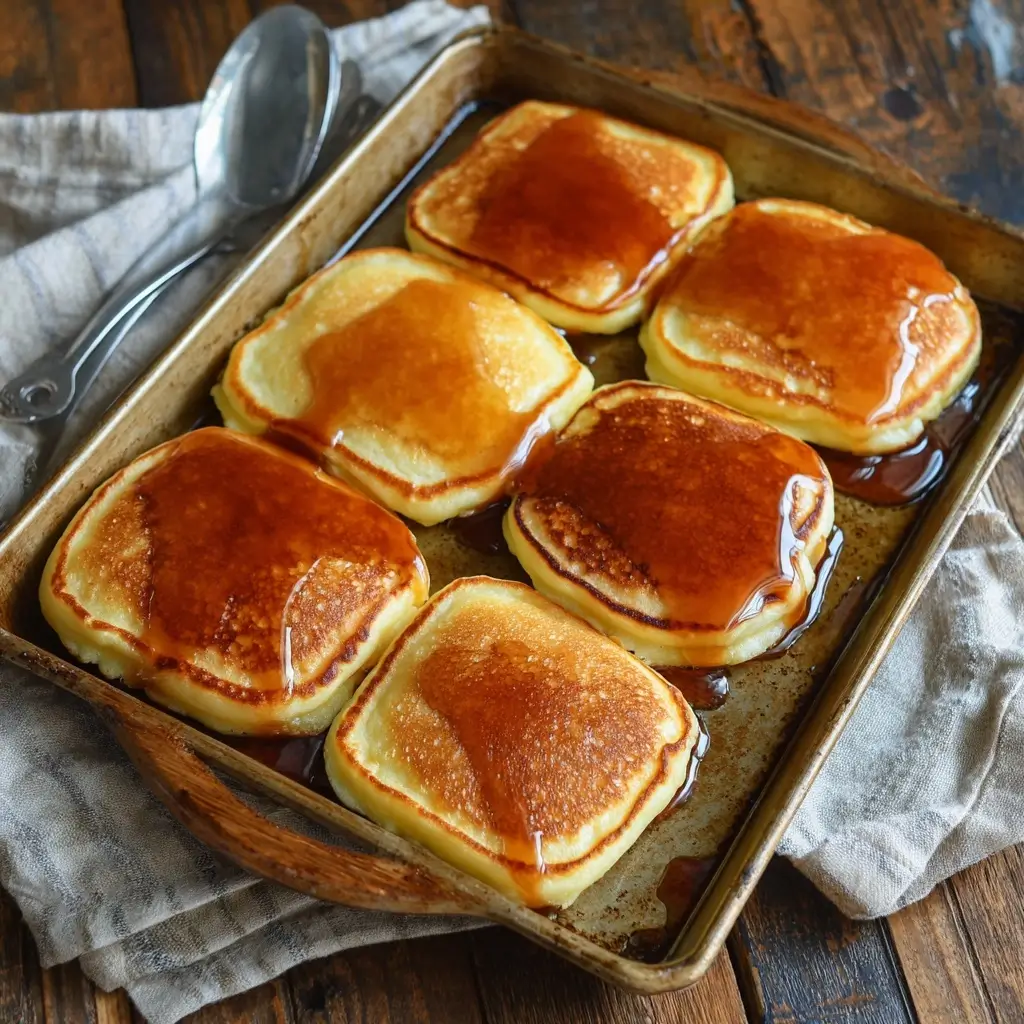
Sheet Pan Pancakes are the revolutionary, stress-free answer to weekend breakfast chaos—imagine all the fluffy, golden charm of classic pancakes, but baked evenly on a single sheet pan with minimal mixing, zero flipping, and maximum flavor. Born from the modern kitchen’s need for simplicity without sacrifice, this clever twist transforms pancake-making from a fussy, stove-top ballet into a hands-off, oven-baked celebration. Whether you’re feeding a crowd, meal prepping for busy mornings, accommodating dietary restrictions, or simply craving that nostalgic stack without the splatter and steam, Sheet Pan Pancakes deliver consistent texture, customizable toppings, and delightful ease—all while freeing up your stovetop for bacon, eggs, or coffee brewing. They’re not just a recipe—they’re a breakfast philosophy reimagined.
The History
While traditional griddle-style pancakes trace back over 5,000 years—to ancient Jōmon-era Japan (where rice-based flatbreads were cooked on hot stones) and medieval Europe (where “pancakes” appeared in 15th-century English cookbooks as unleavened batter cakes)—the sheet pan variation is a distinctly 21st-century innovation rooted in culinary pragmatism. Its rise parallels the broader “sheet pan cooking” movement popularized in the 2010s by food bloggers and wellness influencers seeking efficient, low-mess, one-pan meals. Early iterations appeared around 2016–2017 on platforms like Pinterest and Instagram, where home cooks began adapting Dutch baby and clafoutis techniques to create large-format, oven-baked pancakes. The concept gained traction during the pandemic, as families sought scalable, forgiving breakfasts that minimized active time and maximized yield. Influenced by Scandinavian “pannkaka,” German “Pfannkuchen,” and even Middle Eastern “qatayef” batter techniques, Sheet Pan Pancakes evolved through community experimentation—adding yogurt for tenderness, swapping buttermilk for tang, incorporating whole grains, and adapting for gluten-free and vegan diets. Today, it stands as a globally embraced hybrid: equal parts nostalgia, ingenuity, and inclusive hospitality.
Ingredients Breakdown
Every exceptional Sheet Pan Pancake begins with intention—not just measurement. Below is a comprehensive, chef-level analysis of each component, including functional roles, sourcing notes, and substitution science:
- All-Purpose Flour (2 cups / 250g): Provides gluten structure for lift and chew. For optimal rise, use unbleached flour with 10–11% protein. Alternatives: Whole wheat (replace up to ½ cup for nuttiness + fiber), oat flour (blended certified GF oats; add 1 tsp xanthan gum), or 1:1 gluten-free blend (ensure it contains xanthan or guar gum).
- Granulated Sugar (¼ cup / 50g): Feeds yeast (if using), aids browning via caramelization, and balances acidity. Reduce to 2 tbsp for less sweetness; swap with coconut sugar for deeper molasses notes (may darken crust slightly).
- Baking Powder (2 tbsp / 24g): The primary leavener—double-acting means it reacts once when wet and again in heat. Use fresh (within 6 months); test by adding ½ tsp to ¼ cup hot water—if it bubbles vigorously, it’s active. Aluminum-free brands yield cleaner flavor.
- Baking Soda (½ tsp): Activated only by acid (buttermilk, yogurt, lemon juice); neutralizes tang and boosts rise. Omit if omitting acidic dairy.
- Salt (1 tsp fine sea salt): Enhances all flavors and controls yeast activity (if fermenting). Kosher salt requires 1¼ tsp; table salt needs only ¾ tsp due to density.
- Large Eggs (3, room temperature): Provide emulsification, structure, richness, and moisture retention. Cold eggs can cause batter separation; let sit 15 minutes before mixing. For vegan: 3 flax eggs (3 tbsp ground flax + 9 tbsp warm water, rested 10 min).
- Whole Milk or Buttermilk (1¼ cups / 300ml): Buttermilk adds acidity (activates soda), tenderness, and subtle tang. If using regular milk, add 1 tbsp lemon juice or white vinegar and let curdle 5 minutes. Ultra-pasteurized buttermilk may be less tangy—add ½ tsp cream of tartar for extra lift.
- Unsalted Butter (⅓ cup / 75g, melted & cooled): Adds flavor, richness, and tender crumb. Clarified butter yields crispier edges; ghee works for dairy-free (though not vegan). Avoid margarine—it contains water and stabilizers that inhibit rise.
- Vanilla Extract (2 tsp pure): Not just for aroma—vanillin interacts with Maillard reactions to deepen golden-brown color. Imitation vanilla lacks complexity and may taste artificial when baked at high heat.
- Optional Add-Ins (added after mixing): Blueberries (tossed in 1 tbsp flour to prevent sinking), diced apples (sautéed first to remove excess moisture), chocolate chips (mini chips distribute more evenly), chopped nuts (toasted for depth), or citrus zest (1 tbsp lemon/orange for brightness).
Step-by-Step Recipe
- Preheat & Prep (15 min ahead): Position oven rack in center. Preheat oven to 425°F (220°C). Generously grease a heavy-duty, rimmed half-sheet pan (18″ × 13″ × 1″) with non-stick spray, softened butter, or neutral oil—*do not skip this step*, as edges must release cleanly. Optional: Line bottom with parchment paper (overhanging 2 inches on short sides) for foolproof lifting.
- Dry Whisk (2 min): In a large bowl, whisk together flour, sugar, baking powder, baking soda, and salt until fully homogenous—no streaks, no lumps. Sift if flour feels compacted or if using whole grain blends.
- Wet Mix (1 min): In a separate medium bowl, whisk eggs until uniform. Add milk (or buttermilk), melted butter, and vanilla; whisk just until combined—*do not overmix*. A few small lumps are ideal; overmixing develops gluten and yields toughness.
- Combine Gently (90 seconds): Pour wet ingredients into dry. Using a silicone spatula or wooden spoon, fold *just until no dry flour remains*. Batter will be thick, pourable, and slightly lumpy—like muffin batter. Overmixing = dense, rubbery pancakes. If adding fruit/nuts/chocolate, fold in now.
- Rest & Relax (5–10 min): Let batter rest at room temperature. This hydrates flour fully, relaxes gluten, and allows leaveners to begin gentle activation—resulting in better rise and airier crumb. Do *not* skip—even 3 minutes makes a difference.
- Pour & Spread (2 min): Pour batter into prepared sheet pan. Tilt and rotate pan to distribute evenly into corners. Use an offset spatula or the back of a spoon to smooth surface—avoid pressing down. Batter should fill pan to ~½” depth; slight variations are fine.
- Bake with Precision (18–22 min): Place pan in center oven rack. Bake 18 minutes, then rotate pan front-to-back for even browning. Continue baking 2–4 more minutes until top is puffed, deeply golden, and springs back lightly when pressed. A toothpick inserted in center should come out clean *or* with moist crumbs (not wet batter). Edges will be crisp; center soft and airy.
- Cool Strategically (5–8 min): Remove pan from oven. Let cool *in pan* for 5 minutes—this sets structure and prevents breakage. For clean slices: run a thin knife along inner rim to loosen. Cool 3 more minutes before cutting.
- Portion & Serve (1 min): Use a sharp chef’s knife or pizza cutter to slice into 12–16 squares or rectangles. Serve warm. Best enjoyed within 2 hours of baking—but reheats beautifully (see Tips).
Tips
- Room Temperature Is Non-Negotiable: Cold eggs or milk lower batter temp, delaying oven spring and yielding uneven rise. Pull dairy and eggs from fridge 20–30 minutes ahead.
- Measure Like a Pro: Use the spoon-and-level method for flour—never scoop directly from bag. Too much flour = dry, dense pancakes. A digital scale (grams) eliminates error entirely.
- Don’t Fear the Lumps: Lumps indicate minimal gluten development. Stirring until “smooth” guarantees toughness. If unsure, stop mixing when 90% of flour is incorporated—the residual motion of pouring will finish it.
- Rotate That Pan: Ovens have hot spots—even convection models. Rotating at the 18-minute mark ensures uniform browning and prevents burnt corners or pale centers.
- Golden Rule of Doneness: Visual cues trump timer. Look for deep amber edges, a domed, dry-looking surface, and gentle spring-back—not just time. An underbaked center sinks; overbaked dries out fast.
- Crisp Edge Hack: For shatteringly crisp perimeter, increase oven temp to 450°F (230°C) for first 5 minutes, then reduce to 425°F for remaining bake time.
- Make-Ahead Magic: Prepare batter up to 24 hours ahead—cover and refrigerate. Stir gently before pouring (it may thicken; add 1–2 tbsp milk to adjust). Or bake, cool completely, wrap tightly, and freeze for up to 3 months.
- Reheating Without Rubbish: To revive frozen or leftover pancakes: place slices on wire rack over baking sheet, bake at 375°F (190°C) for 8–10 minutes until heated through and edges crisp. Avoid microwaving alone—it steams and sogs.
- Pan Matters More Than You Think: Heavy-gauge aluminum or stainless steel distributes heat evenly. Thin or dark non-stick pans scorch edges. Avoid glass or ceramic—they retain too much heat and cause over-browning.
- Rest Before Cutting = Clean Cuts: Cutting too soon tears delicate air pockets. That 5-minute rest lets residual heat finish cooking the interior while steam escapes, firming up the crumb.
Variations and Customizations
Sheet Pan Pancakes are endlessly adaptable—flavor profiles, textures, and dietary needs bend beautifully to this format. Here are 12 thoughtfully tested variations, each with technique notes:
- Blueberry-Lemon Burst: Fold in 1½ cups fresh or frozen (unthawed) blueberries + 2 tbsp lemon zest. Top before baking with coarse sugar for sparkle.
- Maple-Bacon Crunch: Stir ¾ cup finely chopped, cooked crispy bacon + 3 tbsp maple syrup into batter. Drizzle additional syrup over baked pancake before slicing.
- Apple-Cinnamon Swirl: Sauté 2 peeled, diced apples in 1 tbsp butter + 1 tsp cinnamon until tender. Layer half batter, swirl in apples + ¼ cup brown sugar, cover with remaining batter.
- Chocolate Chip Cookie Dough: Add 1 cup mini chocolate chips + ½ cup edible cookie dough (made with heat-treated flour and pasteurized egg).
- Protein-Packed Power: Replace ½ cup flour with unflavored whey or plant-based protein powder; add 2 tbsp chia seeds and ¼ cup Greek yogurt (reduce milk by 2 tbsp).
- Vegan Vanilla-Almond: Use flax eggs, unsweetened almond milk + 1 tbsp apple cider vinegar, melted coconut oil, and almond extract instead of vanilla.
- Gluten-Free Golden Stack: Use certified GF 1:1 blend (with xanthan), add ½ tsp psyllium husk powder for elasticity, and rest batter 15 min for full hydration.
- Savory Herb & Cheddar: Omit sugar, vanilla, and baking powder; use 1 tbsp baking soda + buttermilk. Fold in 1 cup sharp cheddar, ¼ cup chopped chives, 2 tbsp Dijon mustard, and black pepper.
- Tropical Coconut-Mango: Substitute coconut milk for dairy milk; fold in 1 cup diced ripe mango + ½ cup toasted coconut flakes.
- Red Velvet Indulgence: Add 2 tbsp unsweetened cocoa powder + 1 tsp red food gel + 1 tbsp white vinegar to batter. Frost cooled pancake with cream cheese glaze.
- Oatmeal Raisin Spice: Replace ½ cup flour with rolled oats (pulse briefly for texture) + ¾ cup plump raisins soaked in hot tea for 10 min, drained.
- Matcha-Lime Zen: Whisk 1½ tsp ceremonial-grade matcha + 1 tbsp lime zest into dry ingredients; use lime-infused milk (zest steeped in warm milk, strained).
Each variation maintains the core structural integrity—adjust bake time ±2 minutes based on add-in moisture content (e.g., juicy fruit may need +1–2 min; dry add-ins like nuts require no change).
Health Considerations and Nutritional Value
A standard slice (1/16th of recipe, ~85g) delivers approximately:
- Calories: 185 kcal
- Protein: 5.2g (from eggs, milk, flour)
- Total Fat: 7.8g (3.2g saturated; primarily from butter and eggs)
- Carbohydrates: 24.5g (4.1g naturally occurring sugars; 3.3g added sugar)
- Fiber: 0.9g (increase to 2.5g+ with whole wheat or oat flour substitution)
- Calcium: 115mg (12% DV from fortified milk/buttermilk)
- Iron: 1.4mg (8% DV; enhance absorption with vitamin C-rich toppings like berries)
Wellness Notes:
- Lower Sodium Option: Reduce salt to ½ tsp and omit added salt in toppings—yields ~220mg sodium/slice (9% DV).
- Blood Sugar Friendly: Swap half flour for almond or coconut flour (adds healthy fats, lowers net carbs); replace sugar with monk fruit blend; serve with Greek yogurt instead of syrup.
- Digestive Support: Add 2 tbsp ground flax or chia to batter—boosts omega-3s and soluble fiber for gut health.
- Allergen Awareness: Naturally nut-free and soy-free (verify butter/milk sources). For egg allergy, flax or commercial egg replacer works—but expect slightly denser crumb. Always label for guests.
- Not “Diet Food”—But Mindful Eating Friendly: Portion control is built-in (pre-sliced), and nutrient density rises dramatically with whole-food add-ins (berries, nuts, seeds, spices). Pair with protein (turkey sausage, cottage cheese) or healthy fat (avocado slices, almond butter) to balance macros.
Important: While not a “health food” per se, Sheet Pan Pancakes offer superior nutritional control versus restaurant versions—zero hidden oils, preservatives, or excessive sugars—and empower customization far beyond typical boxed mixes.
Ingredients
- 2 cups (250g) unbleached all-purpose flour
- ¼ cup (50g) granulated sugar
- 2 tablespoons (24g) aluminum-free baking powder
- ½ teaspoon baking soda
- 1 teaspoon fine sea salt
- 3 large eggs, room temperature
- 1¼ cups (300ml) whole milk or cultured buttermilk
- ⅓ cup (75g) unsalted butter, melted and cooled
- 2 teaspoons pure vanilla extract
- Non-stick spray, butter, or neutral oil for pan
Directions
- Preheat oven to 425°F (220°C). Generously grease a 18″ × 13″ × 1″ rimmed half-sheet pan.
- In a large bowl, whisk together flour, sugar, baking powder, baking soda, and salt until uniform.
- Pour wet mixture into dry ingredients. Gently fold with a spatula until *no dry flour remains*—batter will be thick and lumpy. Fold in optional add-ins, if using.
- Let batter rest 5–10 minutes at room temperature.
- Pour into prepared sheet pan. Tilt and spread evenly; smooth top lightly.
- Bake 18 minutes, rotate pan, then bake 2–4 more minutes until puffed, golden, and springy to touch.
- Cool in pan 5 minutes. Loosen edges, then cut into squares or rectangles.
- Serve warm with maple syrup, fresh fruit, whipped cream, or yogurt.
FAQ
- Can I make Sheet Pan Pancakes gluten-free?
- Yes! Use a reputable 1:1 gluten-free flour blend (like King Arthur or Bob’s Red Mill) *with xanthan gum included*. Add ½ tsp additional xanthan gum if blend doesn’t contain it. Rest batter 15 minutes before baking for full starch hydration. Texture will be slightly more tender—but still fluffy and sliceable.
- Why did my pancake sink in the center?
- Sinking usually means underbaking (center wasn’t set), opening oven door too early (causing rapid temperature drop), or expired leaveners. Always test with toothpick + visual cues—not just timer. Never open oven before 16 minutes.
- Can I prepare batter the night before?
- Absolutely. Cover and refrigerate up to 24 hours. Stir gently before pouring—batter may thicken; stir in 1–2 tbsp milk to restore consistency. Cold batter may need +1–2 min bake time.
- What’s the best way to freeze them?
- Cool completely. Slice, then layer between parchment paper in an airtight container or freezer bag. Freeze up to 3 months. Reheat on wire rack at 375°F (190°C) for 10 minutes—or toast individual slices.
- Can I use a different size pan?
- You can—but adjust thickness and time. A quarter-sheet (9″ × 13″) yields thicker, cake-like pancakes (bake 20–24 min). A jelly roll pan (10″ × 15″) gives slightly thinner results (16–19 min). Never use a pan smaller than 9″ × 13″ unless halving the recipe.
- My edges burned but center was pale—what went wrong?
- Common causes: pan too thin/dark, oven temp inaccurate (use oven thermometer), or batter spread too thinly near edges. Try rotating pan earlier (at 12 min), using light-colored heavy-gauge pan, or shielding outer inch with foil after 15 minutes.
- Are they suitable for babies or toddlers?
- Yes—with modifications: omit added sugar, use whole milk (not reduced-fat), skip honey (under age 1), and finely chop or mash add-ins. Ensure no choking hazards (e.g., whole blueberries → mashed; nuts → omitted or finely ground). Always supervise.
- Can I make them dairy-free and still get good rise?
- Yes. Use unsweetened almond, oat, or soy milk + 1 tbsp vinegar (to mimic buttermilk acidity), refined coconut oil (melted) instead of butter, and ensure baking powder is GF/dairy-free. Rise remains excellent—acid + soda + powder work synergistically.
- How do I prevent fruit from sinking to the bottom?
- Toss berries, diced apples, or peaches in 1 tablespoon of the measured flour *before* folding in. This creates a light coating that helps suspend them evenly throughout the batter.
- Can I add protein powder without ruining texture?
- Yes—but choose unflavored, low-sugar isolates (whey or pea). Limit to ¼ cup (30g) and reduce flour by same amount. Add 1 extra tbsp liquid and rest batter 10 min. Expect slightly denser, chewier crumb—ideal for post-workout fuel.
Summary
Sheet Pan Pancakes reinvent breakfast tradition with oven-baked ease, flawless texture, and limitless customization—delivering golden, fluffy, restaurant-quality stacks with zero flipping and minimal cleanup. From gluten-free adaptations and vegan swaps to decadent dessert-inspired variations and nutrient-boosted power versions, this versatile canvas empowers every cook to create joyful, shareable, and deeply satisfying morning magic—one perfectly portioned square at a time.