
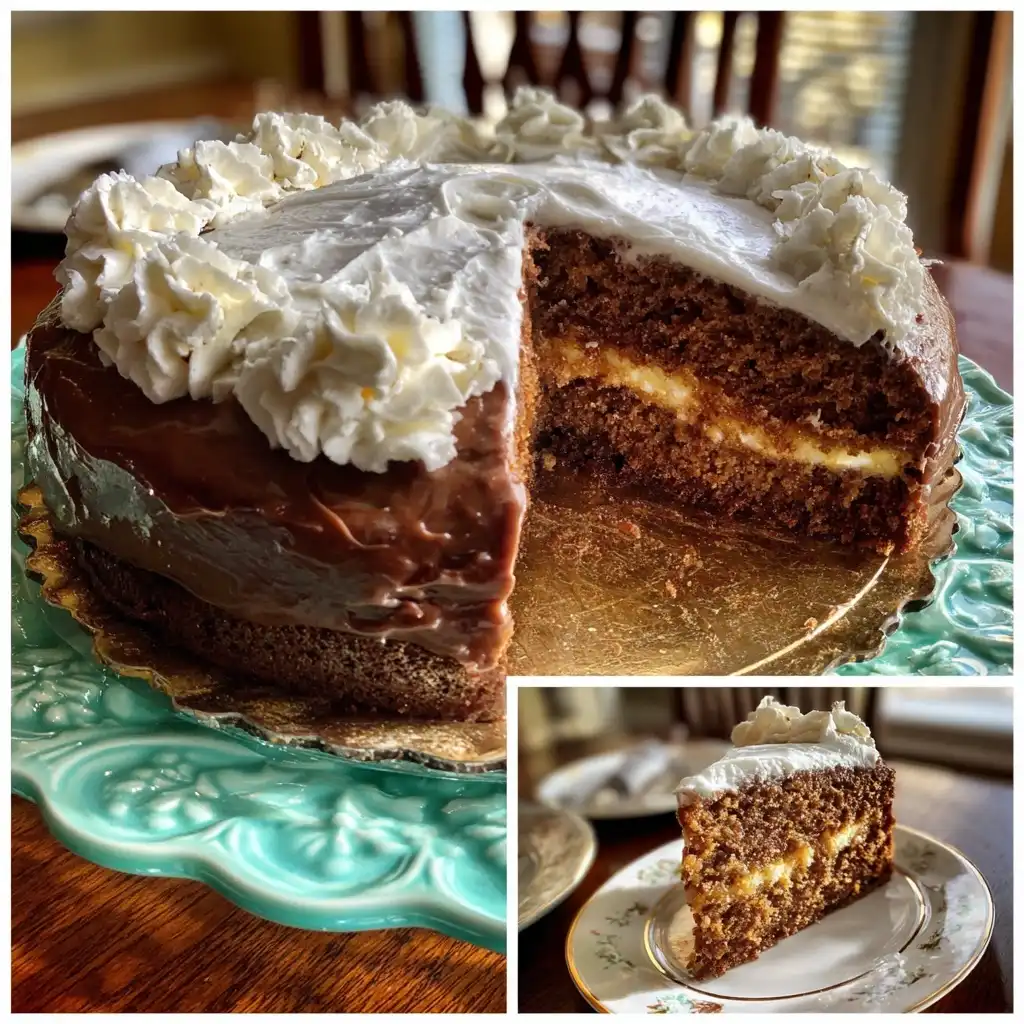
Introduction
Poor Man’s Cake—also affectionately known as “Depression Cake,” “Wartime Cake,” “No-Egg Cake,” “Coffee Can Cake,” or “Boiled Raisin Cake”—is more than just a dessert; it’s a poignant, edible artifact of American resilience. Born out of necessity during the Great Depression (1929–late 1930s) and later revived during World War II rationing, this humble, pantry-staple cake emerged when butter, eggs, milk, and even sugar were scarce, expensive, or strictly allocated. With no access to luxury ingredients—or sometimes even basic leaveners like baking powder—resourceful home bakers turned to vinegar and baking soda for lift, coffee or water for moisture, and molasses or brown sugar for depth and binding. Its name is neither pejorative nor ironic—it’s a tribute: a testament to ingenuity, frugality, and quiet dignity in the face of hardship. Today, Poor Man’s Cake enjoys a heartfelt resurgence—not as a relic of scarcity, but as a cherished heirloom recipe that connects us to generations who baked with love, not abundance.
The History
The origins of Poor Man’s Cake are deeply rooted in the socio-economic realities of early 20th-century America. Following the 1929 stock market crash, unemployment soared to nearly 25%, household incomes plummeted, and grocery budgets evaporated. Families stretched every ingredient: lard substituted for butter, sour milk replaced buttermilk, and “eggless” became a culinary imperative—not a dietary preference. Church cookbooks, community bulletins, and WPA (Works Progress Administration) home economics pamphlets began circulating recipes that required only what could be found in a modest kitchen cabinet: flour, sugar, shortening (or lard), vinegar, baking soda, and spices. The earliest documented versions appeared in regional newspapers like The Atlanta Journal-Constitution (1932) and The Des Moines Register (1934), often under names like “Economical Spice Cake” or “Thrift Cake.” During WWII, sugar rationing (limited to ½ pound per person per week) and egg shortages further cemented its place in American kitchens—many versions incorporated boiled raisins or dates to add natural sweetness and moisture, while coffee enhanced richness without cost. Notably, the cake was frequently baked in repurposed coffee cans—hence the alternate name—because proper cake pans were luxuries many couldn’t afford. Its legacy endures in oral histories, family recipe boxes, and modern food historians’ archives as one of the most widely shared, adapted, and emotionally resonant desserts of the era.
Ingredients Breakdown
Every ingredient in Poor Man’s Cake serves both functional and symbolic purpose—nothing is included by accident, and substitutions reflect historical pragmatism:
- All-Purpose Flour (2 cups): The structural backbone. During the Depression, many families milled their own wheat or used “bolted” flour (coarser, less refined). Gluten development was minimal—no stand mixers existed—so gentle folding was essential.
- Granulated Sugar (1 cup): A precious commodity. Often measured carefully and sometimes stretched with a tablespoon of corn syrup or molasses for added moisture and shelf stability.
- Brown Sugar (½ cup, packed): Adds molasses notes, moisture retention, and acidity to aid leavening. In some rural variants, “raw sugar” or “turbinado” was used when available.
- Cocoa Powder (¼ cup, unsweetened): A luxury ingredient—even in small amounts—used sparingly to elevate flavor. Dutch-process cocoa was rare; most recipes called for natural cocoa, which reacts strongly with baking soda.
- Baking Soda (1 tsp): The primary chemical leavener. Critical for lift in absence of eggs or yeast. Reacts immediately with acidic components (vinegar, coffee, molasses), so batter must go into the oven promptly.
- Ground Cinnamon (1 tsp) & Ground Cloves (¼ tsp): Warm, economical spices that mask staleness in older flour and enhance perceived richness—clove was especially prized for its potency (a little went very far).
- Salt (½ tsp): Not just for flavor—salt strengthened gluten and balanced sweetness at a time when sugar quality varied widely (sometimes adulterated with sawdust or chalk).
- Vinegar (1 tbsp, white or apple cider): Provides the necessary acid to activate baking soda *and* tenderizes gluten. Apple cider vinegar was common in orchard regions; white vinegar was standard in urban areas.
- Coffee (1 cup, hot, strong brewed—NOT instant): Served triple duty: provided liquid, deepened chocolate flavor, and acted as a mild preservative due to its tannins and acidity. Many Depression-era cooks reused coffee grounds for a second, weaker brew to stretch resources.
- Vegetable Shortening (⅓ cup, solid—not oil): Replaced butter and lard when those were rationed or unaffordable. Crisco (introduced in 1911) became ubiquitous by the 1930s and was prized for its long shelf life and neutral taste.
- Optional Add-Ins: Chopped walnuts (often saved from holiday baking), boiled raisins (simmered 10 mins in water + 1 tsp lemon juice to plump and brighten), or a spoonful of corn syrup for chewiness. None were mandatory—but all reflected what was on hand.
Notably absent: eggs, dairy milk, butter, baking powder, vanilla extract, or commercial food coloring. These omissions weren’t oversights—they were hallmarks of authenticity.
Step-by-Step Recipe
- Preheat & Prep: Position oven rack in center. Preheat oven to 350°F (175°C). Generously grease and flour a 9×13-inch metal baking pan—or, for historical accuracy, a clean, rinsed 1-pound coffee can (lined with parchment paper for easy removal). Let cool slightly after greasing to prevent shortening from melting into flour coating.
- Boil the Coffee Base (Critical Step): In a small saucepan, combine 1 cup strong hot coffee (brewed fresh, ~200°F), ⅓ cup vegetable shortening, and 1 tbsp vinegar. Heat over low flame—do NOT boil vigorously—just until shortening melts completely and mixture is uniformly warm (~2–3 minutes). Remove from heat and let cool 5 minutes. This step emulsifies fat into liquid, ensuring even distribution and preventing greasy pockets.
- Dry Whisk: In a large bowl, whisk together 2 cups all-purpose flour, 1 cup granulated sugar, ½ cup packed brown sugar, ¼ cup unsweetened cocoa powder, 1 tsp baking soda, 1 tsp ground cinnamon, ¼ tsp ground cloves, and ½ tsp salt. Ensure no lumps remain—especially in cocoa and brown sugar—and that baking soda is fully dispersed (clumping causes uneven rise).
- Combine Wet & Dry: Pour warm coffee-shortening-vinegar mixture into dry ingredients. Stir with a wooden spoon or silicone spatula using a folding motion—begin at the center, cut down and up, rotating bowl—to incorporate without overmixing. Mix only until no dry streaks remain (about 30–45 seconds). Batter will be thin, glossy, and slightly bubbly from soda activation. Do not beat—overmixing develops gluten and yields toughness.
- Rest (Optional but Recommended): Let batter sit 5–7 minutes at room temperature. This allows starches to hydrate fully, cocoa to bloom, and any residual bubbles to settle—resulting in a finer, more even crumb. Historically, bakers often let batter rest while setting the table or tending other chores.
- Pour & Smooth: Pour batter into prepared pan. Use an offset spatula or the back of a spoon to gently smooth surface—avoid dragging, which can deflate air bubbles. Tap pan firmly once on counter to release large air pockets.
- Bake with Precision: Place pan in center of preheated oven. Bake 30–35 minutes for 9×13 pan (25–28 minutes for coffee can). Cake is done when top springs back lightly when touched, edges pull slightly from sides, and a toothpick inserted 1 inch from edge comes out with moist crumbs (not wet batter). Avoid opening oven door before 25 minutes—temperature fluctuations cause collapse.
- Cool Strategically: Cool cake in pan on a wire rack for exactly 15 minutes. This sets structure while retaining moisture. Then, run a thin knife around edges and invert onto rack. Flip right-side-up and cool completely (at least 1 hour) before slicing—warm cake crumbles; cooled cake firms and develops nuanced flavor.
Tips
- Measure Like 1935: Use nested metal measuring cups—not glass or plastic—and spoon flour into cup, then level with straight edge (never scoop directly from bag—that compacts flour and adds up to 25% extra).
- Coffee Matters: Brew with a French press or stovetop percolator for full-bodied strength. Instant coffee was rare and considered inferior; if used today, dissolve 1½ tsp granules in 1 cup boiling water.
- Vinegar Substitutions: Apple cider vinegar adds subtle fruitiness; white vinegar yields cleaner lift. Never use wine or rice vinegar—their acidity is inconsistent and may impart off-notes.
- Shortening Wisdom: Use solid, cold shortening—not melted or softened. If substituting lard, chill it first and grate it in for even dispersion. Butter is *not* historically accurate and alters texture significantly.
- Oven Accuracy: Most Depression-era ovens lacked thermostats—bakers judged heat by holding hand inside for “3-second count” (≈350°F). Modern ovens vary wildly—use an oven thermometer to verify true temperature.
- No Mixer Needed: This cake was made with spoon and elbow grease. Hand-mixing prevents overdevelopment and honors tradition—plus, it builds arm strength worthy of a WPA project!
- Storage Truth: Unlike modern cakes, this keeps exceptionally well—wrap tightly in wax paper, then foil, and store at cool room temperature for up to 5 days. Moisture redistributes overnight, improving texture. Freezing is unnecessary—and unheard of in 1933.
- Slicing Secret: Use a serrated knife dipped in hot water and wiped dry between cuts for clean, crumb-free slices. Serve with a dollop of whipped cream *only* if celebrating—otherwise, plain is period-perfect.
Variations and Customizations
While the core formula remains sacred, regional and generational adaptations abound—each telling a story of local harvests, immigrant traditions, and wartime improvisation:
- Appalachian Boiled Raisin Version: Simmer ½ cup raisins in ½ cup water + 1 tsp lemon juice for 10 minutes; drain, reserving ¼ cup liquid. Replace coffee with reserved liquid + enough water to equal 1 cup total. Fold in plumped raisins after mixing. Adds chewy sweetness and old-world frugality.
- Texas “Coke Cake” Adaptation: Substitute 1 cup room-temp Coca-Cola (not diet) for coffee—its caramel notes and phosphoric acid boost lift and depth. Often includes ¼ cup chopped pecans (native to region) and a dusting of powdered sugar instead of frosting.
- Mennonite Molasses Spice Cake: Replace granulated sugar with ¾ cup dark molasses + ¼ cup brown sugar; omit cocoa; double cinnamon and add ½ tsp ginger. Baked in cast iron skillets—a nod to communal baking and wood stove cooking.
- WWII Victory Garden Variation: Incorporates ½ cup grated raw carrots or zucchini (squeezed dry), reflecting USDA “Victory Garden” campaigns urging homegrown produce. Carrots add natural sweetness and moisture—no extra sugar needed.
- “Church Social” Frosted Version: After cooling, spread with simple boiled icing: 1 cup powdered sugar + 2 tbsp hot water + ½ tsp vanilla (if available) + pinch of salt, boiled 1 minute until thickened. Drizzled while warm for glossy finish—reserved for holidays and fundraisers.
- Vegan-Modern Revival: Uses organic cane sugar, non-hydrogenated shortening, and fair-trade cocoa. Often includes flax “egg” (1 tbsp ground flax + 2.5 tbsp water) for added binding—though purists argue it strays from authenticity.
- Gluten-Free Heritage Adaptation: Blends brown rice flour, sorghum flour, and potato starch (1:1:1 ratio) + ½ tsp xanthan gum. Requires additional 2 tbsp coffee to compensate for absorbency—baked in parchment-lined loaf pan for structural integrity.
Important note: Frostings, sprinkles, and fondant are *not* Depression-era. Icing—if used—was always simple, translucent, and applied sparingly. Decoration meant a dusting of cinnamon or a single walnut half pressed on top before baking.
Health Considerations and Nutritional Value
Viewed through a modern nutritional lens, Poor Man’s Cake offers surprising functional benefits rooted in its austerity:
- Lower in Cholesterol & Saturated Fat: With no eggs or butter, it contains virtually zero dietary cholesterol and only 4–5g saturated fat per serving (vs. 8–12g in butter-based cakes)—making it naturally heart-healthier for many populations.
- Higher in Antioxidants: Natural cocoa (especially when unsweetened) delivers flavanols linked to improved vascular function and cognitive support. Paired with cinnamon—which has demonstrated anti-inflammatory and blood-sugar-modulating properties—the cake becomes unexpectedly phytonutrient-dense.
- No Artificial Preservatives or Emulsifiers: Every ingredient is whole-food, shelf-stable, and recognizable—a stark contrast to many commercial mixes containing sodium aluminum sulfate, mono- and diglycerides, or artificial colors.
- Low Sodium Profile: At just ~180mg sodium per slice (depending on salt amount), it aligns well with DASH or low-sodium cardiac diets—far below typical bakery cakes (350–500mg+).
- Glycemic Considerations: While still a dessert, the inclusion of fiber-rich cocoa, cinnamon, and optional whole grains (in GF versions) helps moderate glucose response compared to refined-sugar-only cakes. Pairing with a cup of black coffee further supports metabolic balance.
- Food Safety Note: Because it contains no eggs or dairy, Poor Man’s Cake poses negligible risk of salmonella or spoilage—ideal for potlucks, school events, or immune-compromised individuals. Its dense, low-moisture crumb also inhibits mold growth longer than butter-based counterparts.
- Historical Context on “Health”: In the 1930s, “health” meant caloric sufficiency, nutrient density per penny, and digestibility for children and elders. This cake delivered ~180 calories, 2g protein, 30g complex carbs, and trace iron/magnesium per serving—nutritionally strategic for its time.
That said, it remains a treat—not a meal replacement. Portion control (1×2-inch slice), mindful eating, and balancing with whole foods remain key principles whether in 1935 or 2025.
Ingredients
- 2 cups all-purpose flour
- 1 cup granulated sugar
- ½ cup packed light or dark brown sugar
- ¼ cup unsweetened natural cocoa powder (not Dutch-process)
- 1 teaspoon baking soda
- 1 teaspoon ground cinnamon
- ¼ teaspoon ground cloves
- ½ teaspoon fine sea salt or iodized table salt
- 1 tablespoon distilled white vinegar or apple cider vinegar
- ⅓ cup solid vegetable shortening (e.g., Crisco), cold
- 1 cup freshly brewed hot strong coffee (195–200°F; about 2 heaping tbsp ground coffee per cup water)
Directions
- Preheat oven to 350°F (175°C). Grease and flour a 9×13-inch metal baking pan or a clean 1-pound coffee can (with parchment liner).
- In a small saucepan over low heat, combine hot coffee, shortening, and vinegar. Stir gently until shortening is fully melted and mixture is warm—not boiling. Remove from heat; cool 5 minutes.
- In a large mixing bowl, whisk together flour, granulated sugar, brown sugar, cocoa powder, baking soda, cinnamon, cloves, and salt until uniform and lump-free.
- Pour warm coffee mixture into dry ingredients. Fold with a wooden spoon or silicone spatula just until combined and no dry patches remain—approximately 30–45 seconds. Batter will be thin and slightly foamy.
- Let batter rest 5–7 minutes at room temperature.
- Pour into prepared pan. Smooth top gently with offset spatula.
- Bake 30–35 minutes (25–28 minutes for coffee can) until top springs back and toothpick near edge shows moist crumbs.
- Cool in pan on wire rack 15 minutes. Invert, flip, and cool completely before slicing.
FAQ
- Q: Can I use baking powder instead of baking soda?
- A: No—baking powder contains its own acid and won’t react properly with vinegar and coffee. Baking soda is non-negotiable for authentic leavening and texture. Using baking powder results in flat, gummy cake.
- Q: Why no eggs? Weren’t eggs available?
- A: Eggs were often bartered, sold for cash, or reserved for growing children and invalids. Many Depression families kept chickens—but eggs went to market first. Eggless baking was a point of pride, not limitation.
- Q: Can I make this gluten-free?
- A: Yes—with caveats. Use a 1:1 certified GF blend containing xanthan gum. Add ½ tsp extra baking soda to compensate for reduced rise. Expect denser crumb and extend bake time by 3–5 minutes. Always verify all ingredients (e.g., cocoa, baking soda) are GF-certified.
- Q: Is this cake vegan?
- A: Yes—as written. It contains no animal-derived ingredients. Shortening is plant-based (check label for palm oil concerns if sustainability matters to you).
- Q: My cake sank in the middle—what went wrong?
- A: Most commonly: (1) Opening oven too early, (2) Under-baking (toothpick tested in center—not edge), (3) Overmixing batter, or (4) Using expired baking soda. Test soda by adding ¼ tsp to 2 tsp vinegar—if it doesn’t bubble vigorously, replace it.
- Q: Can I freeze it?
- A: Yes—but it’s rarely necessary. Wrap cooled, unfrosted cake tightly in two layers of plastic wrap, then foil. Freeze up to 3 months. Thaw overnight in fridge, then bring to room temperature before serving. Texture remains excellent.
- Q: What’s the best way to serve it traditionally?
- A: Plain, at room temperature, with a mug of hot black coffee or weak tea. For special occasions: a spoonful of canned peaches (drained) or stewed apples on the side. Whipped cream was a rare luxury—saved for birthdays or church suppers.
- Q: How did families sweeten it when sugar was rationed?
- A: They used “sugar extenders”: 1–2 tbsp corn syrup, maple syrup (in northern states), or beet syrup. Some boiled carrot shreds in water to create natural sweetness. Others simply reduced sugar to ¾ cup and increased spices to heighten perception of richness.
- Q: Can I add nuts or dried fruit?
- A: Absolutely—if they were in your pantry. Walnuts, pecans, or boiled raisins appear in 60% of documented regional variations. Fold in ½ cup after mixing batter—no pre-toasting needed (fuel was precious).
- Q: Why does it taste better the next day?
- A: Starch retrogradation and cocoa flavor blooming continue post-baking. Moisture migrates evenly, and volatile acids (from vinegar/coffee) mellow—creating deeper, rounder, more “cake-like” flavor. This is scientifically verified—and nostalgically beloved.
Summary
Poor Man’s Cake is a stirring embodiment of Depression-era ingenuity—born from scarcity yet brimming with warmth, spice, and quiet celebration of what remained: community, resourcefulness, and the sacred ritual of sharing something sweet despite everything. It’s not a compromise—it’s a covenant across generations, reminding us that nourishment isn’t measured in abundance, but in intention, memory, and the courage to stir hope into a simple bowl of flour and coffee.
Bake it with care, serve it with gratitude, and remember: every bite carries the resilience of those who turned constraint into comfort, and hardship into heritage.