
Introduction
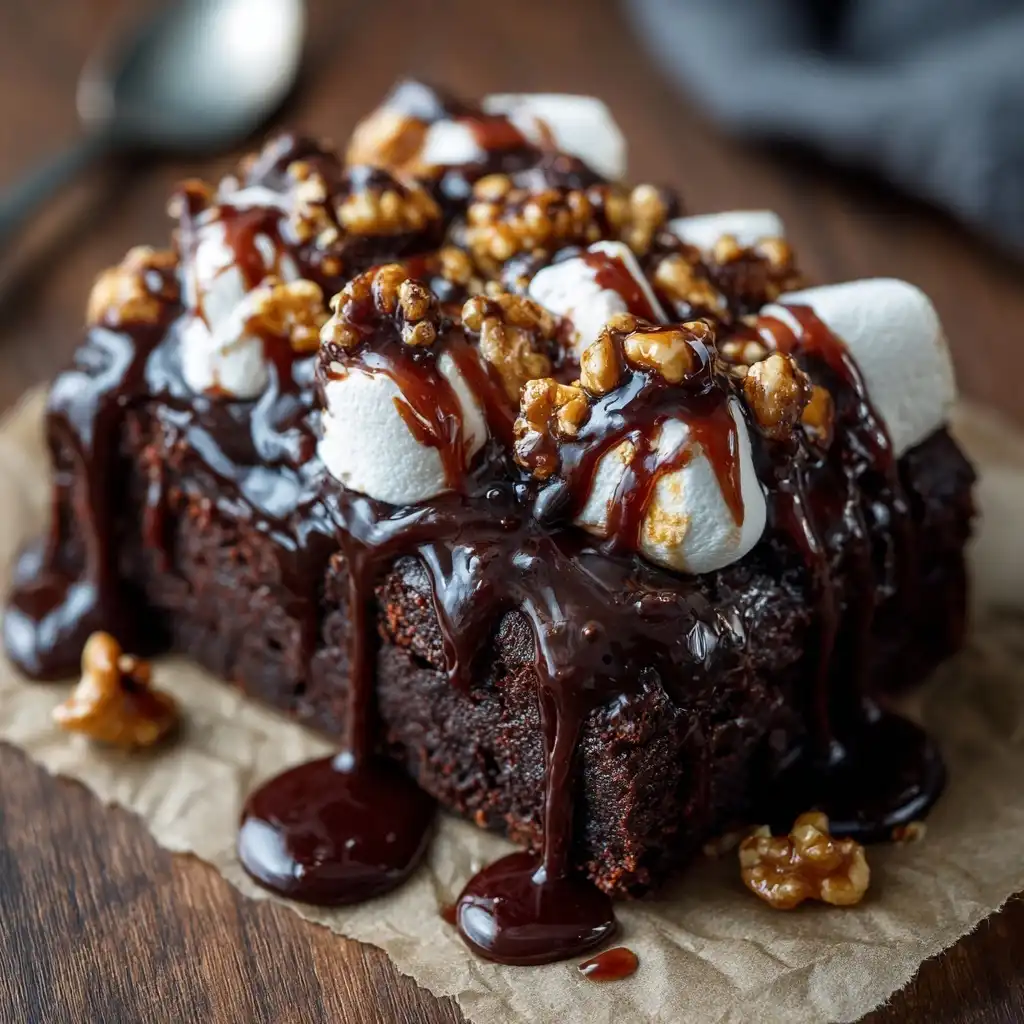
Mississippi Mud Cake is not just a dessert—it’s a decadent, soul-satisfying experience that embodies the very essence of Southern indulgence. Rich, dense, fudgy, and unapologetically chocolate-forward, this legendary cake evokes images of slow river currents, warm porches, and generations gathered around cast-iron skillets and vintage mixing bowls. With its molasses-dark crumb, gooey marshmallow layer, crunchy pecan topping, and glossy chocolate ganache finish, Mississippi Mud Cake is more than a treat—it’s edible nostalgia. If you’re a true chocolate lover—someone who keeps cocoa powder in their pantry like emergency rations and considers dark chocolate a food group—this cake isn’t optional. It’s essential.
The History
The origins of Mississippi Mud Cake are as rich and layered as the dessert itself—steeped in regional pride, culinary improvisation, and a healthy dose of Southern folklore. While no single documented “birth certificate” exists, food historians widely agree the cake emerged in the American South during the mid-20th century—most likely the 1930s–1950s—as home bakers sought ways to create deeply satisfying, economical desserts using pantry staples: cocoa, sugar, flour, eggs, and butter or shortening. The name “Mississippi Mud” is widely believed to reference the thick, dark, silty texture of the riverbed along the mighty Mississippi—a visual and textural metaphor that perfectly captures the cake’s dense, moist, almost pudding-like crumb and its signature muddy-brown hue.
Early versions appeared in church cookbooks, Junior League collections (notably The Delta Cook Book and Mississippi Recipes & Lore), and local newspaper food columns across Jackson, Vicksburg, and Natchez. Some accounts credit home cooks in the Delta region for adding the now-iconic toasted pecans and marshmallow layer—both abundant regional ingredients—while others trace the ganache finish to post-war innovations when chocolate became more accessible. Interestingly, the cake’s evolution mirrors broader cultural shifts: the rise of boxed cake mixes in the 1950s led to “mud cake hacks,” while the 1980s Southern food revival cemented it as a cornerstone of fine-dining dessert menus—from Oxford’s City Grocery to New Orleans’ Commander’s Palace. Today, Mississippi Mud Cake stands proudly alongside Lane Cake and Chess Pie as a defining icon of Southern confectionery heritage—equal parts comfort, craft, and chocolate reverence.
Ingredients Breakdown
Every ingredient in an authentic Mississippi Mud Cake serves a precise, non-negotiable purpose—not merely flavor, but structure, moisture retention, texture contrast, and depth. Let’s dissect them with the attention they deserve:
- Unsweetened Cocoa Powder (Dutch-processed preferred): The soul of the cake. Dutch-processed cocoa delivers deeper, smoother, less acidic chocolate notes—critical for achieving that profound, velvety mud-like richness. Natural cocoa can be substituted, but expect a sharper, fruitier edge and slightly drier crumb.
- Granulated Sugar & Brown Sugar (dark, molasses-rich): Granulated sugar provides lift and crispness; dark brown sugar contributes moisture, caramel complexity, and that unmistakable “muddy” earthiness. The molasses in brown sugar also reacts with baking soda to enhance tenderness.
- All-Purpose Flour (or cake flour for ultra-tenderness): Not just filler—flour forms the delicate gluten matrix that supports the cake’s dense-yet-moist architecture. Too much = tough; too little = collapse. Sifting is non-optional for even distribution and air incorporation.
- Buttermilk (full-fat, cultured): Far more than acidity—it tenderizes gluten, activates leaveners, adds subtle tang, and infuses luxurious creaminess. Low-fat or powdered substitutes yield inferior texture and diminished depth.
- Coffee (strong, hot brewed—NOT instant): A secret weapon. Coffee doesn’t make the cake taste like coffee—it *amplifies* chocolate’s inherent bitterness, sweetness, and aromatic compounds. Think of it as a flavor catalyst. Decaf works equally well if caffeine is a concern.
- Vegetable Oil (or melted unsalted butter for nuttier depth): Oil ensures unparalleled moisture and shelf life (mud cake tastes *better* on Day 2). Butter adds luxury and complexity—but must be cooled to avoid cooking the eggs.
- Eggs (large, room temperature): Binders, emulsifiers, and leavening agents all in one. Room temp ensures uniform batter integration and optimal rise. Cold eggs cause separation and uneven texture.
- Vanilla Extract (pure, Madagascar Bourbon-grade): Not a background note—it’s the aromatic bridge between chocolate, coffee, and caramel. Imitation vanilla lacks the phenolic richness needed to balance intensity.
- Baking Soda & Baking Powder (double-acting): Soda neutralizes cocoa’s acidity and reacts with buttermilk for gentle lift; powder provides secondary, reliable rise. Skipping either results in flat, gummy density.
- Salt (fine sea salt or kosher): The silent conductor. Salt doesn’t “make it salty”—it heightens sweetness, deepens chocolate perception, and balances every other element. Omitting it is like conducting an orchestra without a baton.
- Mini Marshmallows (fresh, not stale): Melting into a gooey, cloud-like stratum between cake and topping—their sugar content caramelizes slightly, adding subtle chew and nostalgic campfire warmth. Stale marshmallows won’t melt properly and leave rubbery bits.
- Pecans (toasted, chopped, preferably native Mississippi or Georgia varieties): Toasting unlocks buttery, woody, almost maple-like oils. Pecans aren’t just crunch—they’re terroir on a plate. Walnuts work, but lack the Southern authenticity and nuanced fat profile.
- Heavy Cream & Semi-Sweet Chocolate (60–70% cacao) for Ganache: The crown jewel. Heavy cream’s high fat content creates a satiny, stable emulsion; quality chocolate ensures clean snap, lingering finish, and complex roast notes. Cheap chips? They’ll seize, split, or taste waxy.
Step-by-Step Recipe
This is not a recipe to rush—or to half-measure. Respect the process, and the mud will reward you.
- Prep Like a Pro: Preheat oven to 350°F (175°C). Grease a 9×13-inch metal baking pan *thoroughly*, then line bottom and long sides with parchment paper—leaving 2-inch overhangs for effortless lifting. Dust parchment lightly with cocoa powder (not flour—it prevents sticking *and* avoids white streaks).
- Bloom the Cocoa: In a medium heatproof bowl, whisk together ¾ cup unsweetened cocoa powder, 1 cup hot strong coffee, and ½ cup granulated sugar until smooth and glossy. Let cool to lukewarm (about 5 minutes)—this step unlocks maximum chocolate solubility and aroma.
- Dry Whisk Ritual: In a separate large bowl, sift together 2 cups all-purpose flour, 1 tsp baking soda, 1 tsp baking powder, and 1 tsp fine sea salt. Whisk 30 seconds—no clumps, no shortcuts.
- Wet Ingredients Ensemble: In another bowl, whisk 1 cup packed dark brown sugar, ½ cup vegetable oil, 3 large room-temp eggs, 1 tbsp pure vanilla, and 1 cup full-fat buttermilk until fully homogenized—about 90 seconds. No streaks, no separation.
- Combine with Intention: Pour the cooled cocoa-coffee mixture into the wet ingredients. Whisk gently *just until combined*. Then gradually add the dry ingredients in three additions, folding with a silicone spatula after each—*do not overmix*. Batter will be thick, glossy, and pourable but not runny. Overmixing = tunneling and toughness.
- Pan & Bake: Pour batter into prepared pan, smoothing top with offset spatula. Tap pan sharply twice on counter to release air bubbles. Bake 32–38 minutes—until a toothpick inserted 2 inches from edge comes out with *moist crumbs* (not wet batter, not clean). Center may look slightly underbaked—that’s ideal. Total bake time varies by oven calibration and pan material (metal heats faster than glass).
- Marshmallow Moment: Remove cake from oven. *Immediately* scatter 1½ cups mini marshmallows evenly over hot surface. Return to oven for *exactly 90 seconds*—just until marshmallows puff, soften, and begin to turn golden at edges. Do NOT open oven door during this step—heat loss causes deflation.
- Nut Topping Transformation: While marshmallows toast, toss 1¼ cups toasted, chopped pecans with 2 tbsp melted butter and 1 tbsp brown sugar. After 90 seconds, remove cake and *immediately* press nut mixture firmly over melted marshmallows using back of spoon. Let rest 15 minutes.
- Ganache Grand Finale: Heat 1 cup heavy cream in saucepan until steaming (not boiling). Pour over 12 oz finely chopped semi-sweet chocolate in heatproof bowl. Wait 3 minutes—then stir slowly from center outward until glossy and fully emulsified. Stir in 1 tbsp unsalted butter and ½ tsp flaky sea salt. Let cool 8 minutes until thickened but still pourable.
- Glaze & Set: Pour ganache over nut layer, tilting pan gently to coat evenly. Use offset spatula to spread into corners. Refrigerate uncovered 45 minutes—just until ganache sets to a soft, velvety sheen (not rock-hard). Over-chilling dulls flavor and creates condensation.
- Rest & Revere: Let cake sit at cool room temperature 20 minutes before slicing. This allows internal steam to redistribute, yielding cleaner cuts and intensified flavor harmony. Use a hot, thin-bladed knife wiped clean between slices.
Tips
- Toast Your Pecans Like a Southerner: Spread raw pecans on a rimmed sheet pan. Bake at 350°F for 7–9 minutes, shaking pan halfway, until fragrant and golden. Cool completely before chopping. Never skip—toasting transforms bland nuts into aromatic, buttery jewels.
- Coffee Is Non-Negotiable—But Flexibility Exists: Brew 1 cup strong coffee using a French press or pour-over (avoid bitter drip machine brew). For caffeine-free version, use decaf espresso or double-strength chicory infusion—chicory adds authentic Delta depth.
- Room Temperature Is Sacred: Take eggs and buttermilk out 90 minutes before baking. Cold dairy + hot cocoa mixture = seized batter and uneven texture.
- Measure Flour Correctly: Spoon flour into measuring cup, then level with straight edge. Scooping packs flour—adding up to 25% extra—and guarantees dry, dense cake.
- Don’t Peek—Especially During Marshmallow Melt: Opening the oven door drops temperature dramatically, causing marshmallows to deflate and cake to sink. Trust the timer.
- Use a Metal Pan—Not Glass or Ceramic: Metal conducts heat evenly and rapidly, ensuring proper crust formation and consistent bake. Glass retains heat too long, risking over-baked edges and under-baked centers.
- Chill Ganache Strategically: If ganache thickens too fast, place bowl over barely simmering water for 5 seconds, then stir. If too thin, refrigerate 2 minutes—no longer.
- Slice With Precision: Dip knife in hot water, wipe dry, slice, repeat. Warm blade glides through ganache and marshmallow without dragging.
- Aging Enhances Everything: Wrap tightly and store at cool room temperature (65–70°F) for up to 3 days. Flavor deepens, textures harmonize, and the crumb becomes even more luxuriously fudgy.
- Freeze for Future Bliss: Unfrosted baked cake layers freeze beautifully for 3 months. Thaw overnight in fridge, then ganache and top fresh. Marshmallow layer is best added day-of.
Variations and Customizations
While tradition is sacred, Mississippi Mud Cake welcomes thoughtful innovation—so long as chocolate remains sovereign. Here are beloved, tested variations that honor the spirit while expanding the horizon:
- Double-Chocolate Mud: Add ½ cup finely grated bittersweet chocolate (70% cacao) to dry ingredients. Replace ¼ cup granulated sugar with ¼ cup cocoa powder for intensified depth.
- Bourbon-Infused Mud: Substitute 2 tbsp of the buttermilk with high-quality Kentucky bourbon. Add 1 tsp bourbon to ganache. Toasted pecans tossed in 1 tsp bourbon before topping add smoky-sweet nuance.
- Espresso Mud: Replace coffee with equal parts strong espresso + hot water. Add 1 tsp instant espresso powder to dry ingredients for amplified roast notes.
- Spiced Mud (Delta Heat): Add ½ tsp ground cinnamon, ¼ tsp ground cardamom, and a pinch of cayenne to dry ingredients. Garnish with candied jalapeño slices for a sweet-heat crescendo.
- White Chocolate–Pecan Swirl: After pouring batter, dollop ½ cup melted white chocolate in 6 spots. Drag a knife through in figure-eights to create marbling—*before* marshmallows go on.
- Vegan Mud (True-to-Form): Use flax eggs (3 tbsp ground flax + 9 tbsp warm water), oat milk + 1 tbsp apple cider vinegar (for buttermilk), coconut oil, and vegan semi-sweet chocolate. Toasted coconut flakes replace pecans for crunch.
- Gluten-Free Mud (No Compromise): Substitute 2:1 ratio of certified GF all-purpose blend (like King Arthur Measure for Measure) + 2 tbsp tapioca starch. Add ½ tsp xanthan gum. Ensure cocoa and chocolate are GF-certified.
- Mud Cupcakes: Fill lined muffin tins ⅔ full. Bake 18–22 minutes. Top each with 3 mini marshmallows, 1 tsp toasted pecans, and 1 tsp ganache. Perfect for portion control—or gifting.
- Blackberry-Bourbon Mud Bars: Fold 1 cup fresh blackberry compote (simmered with 2 tbsp bourbon and 1 tbsp lemon juice) into batter *after* dry ingredients. Swirl gently—don’t overmix.
- Smoked Pecan Mud: Smoke raw pecans over hickory chips for 20 minutes at 225°F before toasting. Adds haunting, savory-sweet dimension beloved in Delta barbecue culture.
Health Considerations and Nutritional Value
Let’s be unequivocally honest: Mississippi Mud Cake is a celebration—not a health food. That said, understanding its nutritional profile empowers mindful enjoyment, especially for those managing dietary needs or seeking small optimizations without sacrificing soul.
Per Standard Slice (1/16 of 9×13 pan, approx. 210g):
- Calories: ~420–460 kcal
- Total Fat: 22–25g (13–15g saturated, primarily from chocolate, butter, and pecans)
- Carbohydrates: 54–58g (42–46g sugars—mostly added from brown/white sugar, marshmallows, and ganache)
- Protein: 5–7g (from eggs, dairy, and nuts)
- Fiber: 2–3g (from cocoa, whole pecans, and minimal flour contribution)
- Sodium: 220–260mg (moderate—enhanced by salt and baking soda)
- Key Micronutrients: Iron (from cocoa), Magnesium (cocoa & pecans), Zinc (pecans), Calcium (buttermilk, chocolate), and antioxidants (flavanols in dark chocolate)
Considerations & Thoughtful Swaps:
- Sugar Conscious? Reduce granulated sugar by ¼ cup and brown sugar by 2 tbsp. Compensate with 1 extra tbsp unsweetened applesauce for moisture. Ganache can be made with 70%+ dark chocolate (lower sugar) and reduced cream.
- Lower Fat Options: Replace oil with unsweetened almond milk + 1 tbsp melted coconut oil (adds structure). Note: this reduces shelf life and richness—best consumed within 48 hours.
- Dairy Sensitivity: Buttermilk can be replicated with 1 cup unsweetened soy or oat milk + 1 tbsp lemon juice (rest 5 min). Vegan ganache uses full-fat coconut cream instead of dairy cream.
- Nut Allergies: Replace pecans with toasted sunflower seeds or pumpkin seeds—same crunch, same toasting ritual. Ensure marshmallows are gelatin-free if vegan/religious needs apply (many contain pork gelatin).
- Portion Mindfulness: Serve smaller slices (1/20th of pan) with unsweetened whipped cream or Greek yogurt swirl. The intensity means smaller portions deliver full satisfaction.
- Functional Additions (Subtle & Effective):strong> Stir 2 tbsp ground flaxseed or chia seeds into dry ingredients for omega-3s and fiber—undetectable in flavor, transformative in nutrition.
Remember: joy, tradition, and shared moments are vital nutrients too. Enjoying Mississippi Mud Cake mindfully—with gratitude, presence, and love—is part of its holistic nourishment.
Ingredients
Makes one 9×13-inch cake (16 generous servings)
- ¾ cup unsweetened Dutch-process cocoa powder
- 1 cup strong hot brewed coffee (or decaf espresso)
- ½ cup granulated sugar
- 2 cups all-purpose flour (spooned & leveled)
- 1 teaspoon baking soda
- 1 teaspoon baking powder
- 1 teaspoon fine sea salt
- 1 cup packed dark brown sugar
- ½ cup vegetable oil (or melted unsalted butter, cooled)
- 3 large eggs, room temperature
- 1 tablespoon pure vanilla extract
- 1 cup full-fat buttermilk, room temperature
- 1½ cups mini marshmallows
- 1¼ cups toasted, chopped pecans
- 2 tablespoons unsalted butter, melted
- 1 tablespoon dark brown sugar
- 12 ounces semi-sweet chocolate (60–70% cacao), finely chopped
- 1 cup heavy cream (36–40% fat)
- 1 tablespoon unsalted butter
- ½ teaspoon flaky sea salt (for ganache)
Directions
- Preheat oven to 350°F (175°C). Generously grease a 9×13-inch metal baking pan, then line bottom and two long sides with parchment paper, leaving 2-inch overhangs on both ends for easy removal.
- In a medium heatproof bowl, whisk together cocoa powder, hot coffee, and ½ cup granulated sugar until completely smooth and glossy. Set aside to cool to lukewarm (about 5 minutes).
- In a large bowl, sift together flour, baking soda, baking powder, and salt. Whisk vigorously for 30 seconds to aerate and combine.
- Pour the cooled cocoa-coffee mixture into the wet ingredients and whisk gently until combined. Gradually add the dry ingredients in three parts, folding with a silicone spatula after each addition—stopping as soon as no dry streaks remain. Batter will be thick, shiny, and pourable.
- Pour batter into prepared pan. Tap pan firmly twice on countertop to release air pockets. Smooth top with an offset spatula.
- Bake for 32–38 minutes, rotating pan halfway through, until a toothpick inserted 2 inches from the short edge comes out with moist crumbs (not wet batter, not clean). The center may appear slightly soft—that’s correct.
- Remove cake from oven. Immediately scatter mini marshmallows evenly over hot surface. Return to oven and bake for exactly 90 seconds—until puffed and lightly golden at edges.
- While marshmallows bake, combine toasted pecans, melted butter, and 1 tbsp brown sugar in a small bowl. Stir until evenly coated.
- After 90 seconds, remove cake and immediately press pecan mixture firmly over melted marshmallows using the back of a spoon.
- Let cake cool in pan on wire rack for 15 minutes.
- Meanwhile, prepare ganache: Heat heavy cream in a small saucepan over medium-low heat until steaming (small bubbles form at edges—do not boil). Pour over chopped chocolate in a heatproof bowl. Wait 3 minutes. Stir slowly from center outward until smooth and glossy. Stir in 1 tbsp butter and ½ tsp flaky salt.
- Let ganache cool 8 minutes—stirring occasionally—until thickened but still fluid enough to pour.
- Pour ganache over pecan layer. Tilt pan gently to distribute evenly. Use offset spatula to guide into corners and smooth surface.
- Refrigerate uncovered for 45 minutes—until ganache is set to a soft, velvety sheen (not hard or sticky).
- Using parchment overhangs, lift cake from pan onto cutting board. Trim uneven edges if desired. Slice with hot, dry knife, wiping between cuts.
- Let sit at cool room temperature for 20 minutes before serving. Store covered at cool room temperature up to 3 days, or refrigerate up to 1 week (bring to room temp before serving for optimal texture).
FAQ
- Can I make this cake ahead of time?
- Absolutely—and it’s recommended! Mississippi Mud Cake reaches peak flavor and texture on Day 2. Bake, cool, and store *un-ganached* at cool room temperature (65–70°F) wrapped tightly in plastic. Ganache and marshmallow topping are best added the day of serving for freshness and visual impact.
- Why did my cake sink in the center?
- Most commonly due to underbaking, opening the oven too early, or excessive leavener. Ensure your baking soda/powder is fresh (replace every 6 months), verify oven temperature with an oven thermometer, and resist peeking before the 30-minute mark. A slight dome is normal—the marshmallow layer will conceal minor imperfections.
- Can I use natural cocoa instead of Dutch-process?
- Yes—but adjust leavening. Natural cocoa is acidic, so replace baking soda with 1½ tsp baking powder and omit the baking soda entirely. Expect a brighter, sharper chocolate profile and potentially drier crumb.
- My ganache split or looks grainy—can I fix it?
- Yes! Gently re-warm in 5-second bursts in microwave (or over simmering water), stirring vigorously between intervals until smooth. If it’s too thin, chill 2 minutes and stir; if too thick, add ½ tsp warm cream and stir. Always use room-temp chocolate and near-boiling cream for best emulsion.
- Can I freeze the fully assembled cake?
- For best quality, freeze *unfrosted* cake layers only. Wrap tightly in plastic + foil and freeze up to 3 months. Thaw overnight in fridge, then bring to room temperature before applying marshmallow, nuts, and ganache. Fully assembled cake freezes poorly—ganache cracks, marshmallows weep, and texture suffers.
- What makes Mississippi Mud Cake different from regular chocolate cake?
- Three pillars: (1) Its uniquely dense, fudgy, pudding-like crumb—achieved via high fat, low flour, and buttermilk; (2) The iconic triple-layer structure—cake + marshmallow + nut topping + ganache; (3) Deep, earthy, almost molasses-like chocolate profile from Dutch cocoa + coffee + dark brown sugar. It’s less “cake,” more “chocolate terrarium.”
- Can I make this gluten-free?
- Yes—with precision. Use a 1:1 certified gluten-free all-purpose blend (like Bob’s Red Mill or King Arthur) *with xanthan gum included*. Add ½ tsp additional xanthan gum to dry ingredients. Ensure all cocoa, chocolate, marshmallows, and baking powder are certified GF. Texture will be slightly more tender—but still gloriously muddy.
- Why do some recipes use sour cream instead of buttermilk?
- Sour cream adds even more fat and tang, yielding an ultra-rich, almost cheesecake-like crumb. Buttermilk provides superior lift and brightness. Choose based on preference—but don’t substitute one for the other 1:1 without adjusting liquid (sour cream is thicker; add 1–2 tbsp extra coffee or milk if swapping).
- Can I omit the marshmallows?
- You *can*—but you’ll lose the soulful, nostalgic,
Advertisment