
Introduction
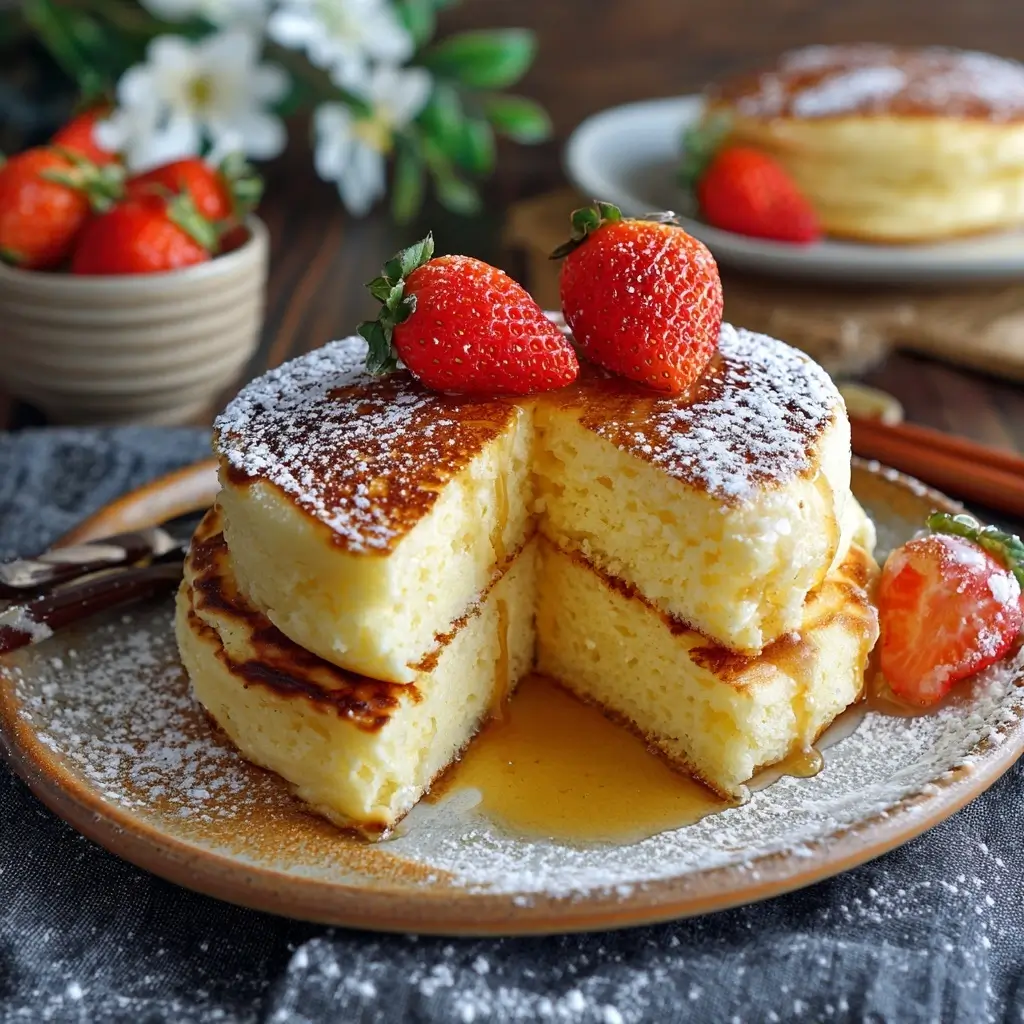
Fluffy Japanese Pancakes—often affectionately dubbed “cloud pancakes,” “soufflé pancakes,” or “jiggly pancakes”—are a culinary marvel that redefines breakfast expectations. Unlike traditional American pancakes, these ethereal delights boast an impossibly light, airy, and tremulously soft texture that wobbles like delicate meringue when nudged with a fork. Originating from Japan’s kawaii (cute) café culture, they’ve become a global sensation—not just for their photogenic appeal but for their sublime mouthfeel: crisp-edged yet cloud-like within, subtly sweet, delicately eggy, and luxuriously tender. Their magic lies not in exotic ingredients, but in precise technique—especially the careful folding of stiffly beaten egg whites into a rich, velvety batter—and a slow, gentle cooking process that allows them to rise without collapsing. Whether enjoyed stacked high with fresh berries and whipped cream or simply dusted with powdered sugar and a drizzle of maple syrup, Fluffy Japanese Pancakes offer a moment of serene indulgence—a breakfast experience that feels both artisanal and comforting, elegant and nostalgic.
The History
The origins of the Fluffy Japanese Pancake trace back to the early 2010s in Tokyo’s trendy Shibuya and Shinjuku districts, where avant-garde dessert cafés began experimenting with Western baking techniques through a distinctly Japanese lens—emphasizing texture, subtlety, visual harmony, and meticulous craftsmanship. While soufflé-inspired desserts have long existed in French patisserie, Japanese chefs adapted the concept for pancakes by borrowing methods from chiffon cake and Japanese cotton cheesecake: emphasizing air incorporation, minimal gluten development, and ultra-low-heat cooking. The first widely documented iteration appeared around 2013–2014 at cafés like *Flipper’s* (a now-iconic Tokyo chain founded in 2012), which popularized the towering, triple-layered “Soufflé Pancakes” served with seasonal fruit compotes and house-made syrups. Social media—particularly Instagram—catapulted them to international fame by 2016, as users shared mesmerizing slow-motion videos of the pancakes’ signature jiggle. Since then, the trend has inspired countless copycat recipes, dedicated pancake-only restaurants across Seoul, Taipei, Los Angeles, London, and Melbourne, and even Michelin-recognized interpretations featuring matcha-infused batters, yuzu curd fillings, or black sesame crème anglaise. Historically, this dish reflects Japan’s broader culinary philosophy of shun (seasonality), wa (harmony), and kokoro (heart/mindfulness)—where even a humble pancake becomes a meditation in balance, patience, and sensory delight.
Ingredients Breakdown
Every ingredient in Fluffy Japanese Pancakes serves a precise structural or sensory function—no element is arbitrary. Below is a detailed functional analysis:
- Egg Yolks: Provide richness, emulsification, and moisture retention. Their lecithin helps bind the batter while contributing subtle sweetness and golden hue.
- Egg Whites: The absolute cornerstone of fluffiness. When whipped to stiff, glossy peaks, they trap air bubbles that expand gently during low-heat cooking—creating the signature lift and spongy resilience. Fresh, room-temperature whites yield superior volume and stability.
- All-Purpose Flour (or Cake Flour): Offers just enough gluten for minimal structure without toughness. Cake flour (lower protein, ~7–8%) is preferred for maximum tenderness; all-purpose (~10–12%) works well if sifted thoroughly and mixed minimally to avoid overdevelopment.
- Granulated Sugar (for yolks & whites separately): In the yolk mixture, sugar dissolves fully to add sweetness and aid emulsification. In the meringue, sugar stabilizes the foam, strengthens bubble walls, and prevents weeping or collapse—especially critical given the pancakes’ fragile nature.
- Milk (whole or full-fat dairy alternative): Adds liquid, fat, and lactose for gentle browning and nuanced flavor. Whole milk is ideal for creaminess; oat or soy milk may be substituted, though coconut milk (unsweetened) adds luxurious richness.
- Unsalted Butter (melted & cooled): Contributes fat for tenderness, flavor depth, and sheen. Must be cooled to prevent cooking the egg whites upon folding. Ghee can be used for a nuttier profile and higher smoke point.
- Vanilla Extract (pure, not imitation): Enhances aromatic complexity and rounds out sweetness. Optional but highly recommended—vanilla beans scraped into the yolk mixture elevate luxury.
- Cream of Tartar (optional but recommended): An acid that lowers the pH of egg whites, accelerating foam formation and dramatically improving stability—crucial for maintaining height during the 15–20 minute cook time.
- Pinch of Salt: Balances sweetness and heightens all other flavors without perceptible saltiness.
Notably absent: baking powder, baking soda, or any chemical leavener. The sole rising agent is mechanical aeration—making technique far more important than any single ingredient.
Step-by-Step Recipe
- Prep & Equipment Setup: Gather two clean, grease-free mixing bowls (preferably stainless steel or glass), an electric hand mixer or stand mixer, silicone spatula, fine-mesh sieve, nonstick or well-seasoned cast-iron skillet or griddle, lid with tight seal (glass preferred for visibility), and instant-read thermometer (ideal range: 275–300°F / 135–150°C). Preheat oven to 200°F (95°C) for keeping cooked pancakes warm.
- Separate Eggs Meticulously: Using cold eggs (easier to separate), crack each into a small cup before adding yolks to one bowl and whites to another. Ensure zero yolk or shell fragments contaminate the whites—fat inhibits whipping.
- Prepare Yolk Batter: To the yolk bowl, add 2 tbsp sugar, milk, melted & cooled butter, vanilla, and salt. Whisk vigorously until fully emulsified and smooth (about 1 min). Sift flour directly over mixture and fold gently with spatula until *just* combined—no streaks, but do not overmix. Set aside.
- Whip Egg Whites to Stiff Peaks: To clean, dry whites, add cream of tartar. Begin whipping on medium-low until foamy (~30 sec), then gradually add remaining 3 tbsp sugar, 1 tsp at a time, while increasing speed to high. Continue beating 3–5 minutes until whites are voluminous, glossy, and hold stiff, upright peaks that curl slightly when beater is lifted. Test: invert bowl—no movement.
- Macaronage (Folding Technique): Add ⅓ of meringue to yolk batter and stir *vigorously* for 10 seconds to lighten. Then, using a large silicone spatula, cut down center, sweep along bottom, and fold up and over—rotating bowl ¼ turn each time. Repeat gently but purposefully until batter is homogenous and flows like thick ribbons (≈45–60 seconds). Overfolding deflates air; underfolding yields uneven texture.
- Portion & Pan-Prep: Lightly butter skillet/griddle and preheat over *lowest possible heat* (ideally with thermometer reading 275°F). Use ⅓-cup measuring cup or large ice cream scoop for consistent 4-inch rounds. Tap filled cup firmly on counter to settle batter and release air pockets.
- Cook Low & Slow: Pour batter onto skillet, spreading *very gently* into round shape with back of spoon (do not flatten). Cover immediately with lid. Cook undisturbed for 8–10 minutes—until top surface appears matte, edges look set, and underside is pale gold (lift corner carefully with thin spatula to check). Flip *once*, using two wide spatulas for support. Re-cover and cook another 6–8 minutes until deeply golden underneath and center springs back when lightly pressed.
- Rest & Serve Immediately: Transfer to wire rack for 30 seconds to halt carryover cooking and preserve jiggle. Stack no more than three high. Serve within 2 minutes for peak texture—top with seasonal fruit, real maple syrup, crème fraîche, or edible flowers.
Tips
- Room-Temperature Eggs Are Ideal—but Cold Whites Whip Better: Separate eggs while cold, then let whites sit uncovered at room temp 15–20 min before whipping for maximum volume.
- Wipe Bowls & Utensils with Vinegar or Lemon Juice: Any trace of oil or yolk residue will sabotage meringue—wipe with acidic solution and dry thoroughly.
- Understand Your Stove: Gas stoves often require flame diffusers; induction may need lowest “simmer” setting. If pancakes brown too fast, reduce heat further—even if it means waiting longer. Patience = fluff.
- Don’t Skip the Lid: Trapped steam creates gentle, even heat essential for vertical rise and tender crumb. A glass lid lets you monitor without lifting.
- Flip Only Once—and Confidently: Hesitation causes tearing. Slide both spatulas fully under pancake, lift together, and flip in one fluid motion. If it sticks, wait 15 more seconds.
- Use a Timer Religiously: First side: 8:30 min. Second side: 7:00 min. Adjust ±30 sec based on your stove and desired doneness (longer = drier; shorter = custard-soft center).
- Batch Cooking? Keep Warm—Not Hot: Place cooked pancakes on a cooling rack over a baking sheet in 200°F oven for up to 10 minutes. Avoid stacking or covering—they’ll sweat and lose spring.
- Practice Makes Perfect: Your first batch may be denser or less jiggly. Analyze: Was meringue under-whipped? Was batter overfolded? Did heat spike? Each attempt refines intuition.
- Invest in a Good Nonstick Skillet: Ceramic or high-quality PTFE-coated pans distribute heat evenly and release effortlessly—critical for preserving shape during flip.
- Seasonal Syrup Hack: Simmer ½ cup maple syrup + 1 tsp lemon juice + ¼ cup fresh blueberries until thickened (5 min). Cool slightly—adds bright acidity and jewel-toned drizzle.
Variations and Customizations
While classic vanilla remains beloved, Fluffy Japanese Pancakes serve as a sublime canvas for creative expression—always respecting the foundational technique. Here are meticulously tested variations:
- Matcha Green Tea: Sift 1½ tsp ceremonial-grade matcha with flour. Replace 1 tbsp milk with warm unsweetened almond milk to bloom matcha first. Garnish with white chocolate shavings and black sesame seeds.
- Ube (Purple Yam): Replace 3 tbsp milk with ¼ cup mashed, steamed ube (cooled). Add ½ tsp ube extract and a pinch of violet food gel for vibrant color. Serve with coconut whipped cream and toasted coconut flakes.
- Black Sesame: Toast 3 tbsp black sesame seeds, grind finely in spice grinder, and fold into yolk batter with 1 tsp honey. Top with kinako (roasted soybean flour) and candied ginger.
- Yuzu-Infused: Replace vanilla with 1 tsp yuzu zest + 1 tbsp yuzu juice (strained) in yolk batter. Drizzle with yuzu curd (made with yuzu juice, egg yolks, sugar, butter) and shiso leaves.
- Chocolate Soufflé: Sift 2 tbsp Dutch-process cocoa with flour. Add 1 oz melted dark chocolate (70%) to yolk batter. Fold in ¼ cup mini chocolate chips *after* meringue integration. Serve with raspberry coulis.
- Savory Miso-Cheese: Omit sugar from both yolk and meringue. Add 1 tbsp white miso paste + 1 tbsp grated aged Gouda to yolk batter. Top with scallions, nori strips, and tamari-maple glaze.
- Gluten-Free: Substitute 1:1 GF flour blend *with xanthan gum*. Add ¼ tsp psyllium husk powder to yolk batter for elasticity. Whip whites 10% longer for extra stability.
- Vegan Adaptation: Use aquafaba (3 tbsp per egg white), flax “eggs” (1 tbsp ground flax + 2.5 tbsp water per yolk), almond milk, and vegan butter. Whip aquafaba with ½ tsp cream of tartar + 2 tbsp sugar until stiff. Requires 20% longer cook time.
- Mini “Pancake Bites”: Pipe batter into greased, standard muffin tin cups (fill ¾ full). Bake at 325°F for 18–20 min. Perfect for brunch buffets or kids’ portions.
- Dessert Course Version: Double the batter thickness (use ½ cup per pancake), cook 12+ minutes per side, and layer with crème pâtissière, poached pears, and Calvados reduction.
Health Considerations and Nutritional Value
A single standard Fluffy Japanese Pancake (approx. 120g unbaked batter) contains roughly:
- Calories: 180–210 kcal
- Protein: 6–7g (high-quality complete protein from eggs)
- Fat: 9–11g (primarily unsaturated from butter/milk; moderate saturated fat)
- Carbohydrates: 18–22g (mostly simple sugars; minimal fiber)
- Vitamins/Minerals: Rich in choline (brain health), vitamin D (from egg yolks & fortified milk), selenium, and B12. Contains lutein and zeaxanthin for eye health.
Health Considerations:
- Sugar Content: Traditional recipe uses 5 tbsp sugar per 4 pancakes (~12g/serving). For reduced sugar: cut to 2 tbsp total and enhance sweetness with 1 tsp monk fruit extract + ½ tsp cinnamon, or use ripe banana purée (replace 2 tbsp milk) for natural fructose and potassium.
- Cholesterol: One large egg yolk contains ~186mg cholesterol. Current dietary guidelines no longer set strict limits for healthy adults, but those with familial hypercholesterolemia may opt for 1 whole egg + 2 additional whites per serving.
- Gluten Sensitivity: As noted above, reliable GF versions exist—but cross-contamination risk is high in home kitchens. Certified GF oats or rice flour blends improve safety.
- Dairy Alternatives: Unsweetened soy or oat milk provide comparable protein/fat profiles. Coconut milk adds saturated fat but lauric acid (immune-supportive); almond milk requires added fat (e.g., ½ tsp coconut oil) to prevent dryness.
- Portion Mindfulness: These pancakes are calorie-dense due to butter, eggs, and sugar. Serving 2–3 per person with generous fresh fruit and Greek yogurt balances macros and increases satiety via fiber and protein.
- Not “Diet-Friendly” But Nutritionally Dense: Unlike many breakfast pastries, they contain no trans fats, hydrogenated oils, or artificial additives—and deliver bioavailable nutrients rarely found in processed cereals or toaster pastries.
For athletes or active individuals, pairing with a side of smoked salmon or turkey bacon transforms them into a balanced, high-protein meal. For children, they’re an excellent vehicle for introducing vegetables—try blending spinach into the yolk batter (it disappears visually and nutritionally) or topping with mashed roasted sweet potato and cinnamon.
Ingredients
- 4 large eggs, separated (yolks and whites at room temperature)
- 5 tablespoons granulated sugar, divided (2 tbsp for yolks, 3 tbsp for whites)
- ¼ cup (60ml) whole milk, room temperature
- 2 tablespoons unsalted butter, melted and cooled to room temperature
- 1 teaspoon pure vanilla extract
- ¼ teaspoon fine sea salt
- ½ cup (60g) cake flour, sifted (or all-purpose flour, sifted twice)
- ⅛ teaspoon cream of tartar (highly recommended)
- Unsalted butter or neutral oil for cooking
Directions
- In a medium bowl, whisk together egg yolks, 2 tablespoons sugar, milk, melted butter, vanilla, and salt until smooth and slightly thickened (~1 minute). Sift cake flour over mixture and fold gently with a silicone spatula until just combined—no dry streaks remain. Set aside.
- In a clean, dry, grease-free bowl, combine egg whites and cream of tartar. Using an electric mixer on medium speed, beat until soft peaks form (~1 minute). Gradually add remaining 3 tablespoons sugar, 1 teaspoon at a time, while increasing speed to high. Continue beating 3–4 minutes until stiff, glossy peaks form that hold their shape when the beater is lifted.
- Add one-third of the meringue to the yolk batter and stir vigorously for 10 seconds to lighten. Then, using a large silicone spatula, gently fold in the remaining meringue in 2–3 additions, using a cutting-and-folding motion—scraping the bottom and turning the bowl—until the batter is uniform, shiny, and flows like thick honey (about 45 seconds). Do not overmix.
- Heat a nonstick skillet or griddle over the lowest possible heat (275–285°F). Lightly butter surface. Using a ⅓-cup measure or large scoop, portion batter onto skillet, smoothing gently into a 4-inch round. Tap pan lightly on counter once to release air bubbles.
- Cover skillet tightly with a lid and cook undisturbed for 8 minutes and 30 seconds. Check: top should appear matte and set; underside should be pale golden. Carefully slide a thin, flexible spatula under pancake and flip in one confident motion.
- Immediately re-cover and cook for another 7 minutes, until deeply golden underneath and center springs back when lightly pressed with fingertip.
- Transfer pancake to a wire rack for 30 seconds to stabilize. Serve immediately, stacked or single, with desired toppings. Repeat with remaining batter, re-buttering pan as needed.
FAQ
- Why did my pancakes collapse?
- Most commonly: meringue was under-whipped or over-folded into batter; heat was too high causing rapid rise then fall; or lid was lifted too early releasing steam. Also check for traces of fat in whites or old baking powder (which isn’t used here, but some mistakenly add it).
- Can I make the batter ahead?
- No—air bubbles begin degrading after 10 minutes. However, you can separate eggs and prep yolk batter 1 hour ahead (cover and refrigerate); bring to room temp before folding in freshly whipped whites.
- My pancakes aren’t jiggly—what went wrong?
- Jiggle requires perfect steam retention and delicate structure. Likely causes: insufficient meringue volume, too much flour (weigh, don’t scoop), flipping too late (causing dense base), or removing from heat before full set—let them rest 30 sec on rack to “settle” the jiggle.
- Can I freeze them?
- Yes—but texture changes. Cool completely, layer between parchment, freeze up to 1 month. Reheat uncovered in 350°F oven for 8–10 minutes. Best for meal prep, not peak experience.
- What’s the best syrup to use?
- Avoid corn syrup-based brands. Opt for pure maple syrup Grade A Amber (balanced flavor), or infuse your own: warm ½ cup syrup with 1 star anise, 3 black peppercorns, and 1 tsp orange zest for 10 minutes; strain and cool.
- Why no baking powder?
- Baking powder creates coarse, irregular bubbles and can impart bitterness. The mechanical aeration from meringue delivers finer, more stable air cells—essential for the tender, uniform crumb and signature wobble.
- Can I make them without a lid?
- Technically yes—but results suffer significantly. Without trapped steam, pancakes spread laterally instead of rising vertically, develop tough edges, and lack interior tenderness. A tight-fitting lid (even a baking sheet) is non-negotiable.
- How do I clean the pan between batches?
- Wipe with paper towel while warm—do not rinse with water (causes sticking). Re-butter lightly. If residue builds, deglaze with 1 tsp vinegar, wipe, then re-butter.
- Are they safe for pregnant women or immunocompromised individuals?
- Yes—the full 15+ minute cook time at low heat ensures egg whites and yolks reach pasteurization temperatures (>160°F internally). No raw egg remains.
- What makes them different from American pancakes?
- American pancakes rely on chemical leaveners and buttermilk tang, yielding thicker, denser, more robust cakes. Japanese pancakes prioritize air, minimal gluten, and gentle heat—yielding ethereal height, delicate sweetness, and a custard-soft, quivering bite unlike any other pancake style.
Summary
Fluffy Japanese Pancakes are a masterclass in precision baking—transforming humble eggs, flour, and milk into gravity-defying, cloud-soft delights through disciplined meringue technique and patient, low-heat cooking.
More than a trend, they embody a philosophy: that breakfast can be both meditative and magnificent, where every wobble tells a story of care, craft, and the quiet joy of eating something truly extraordinary.