
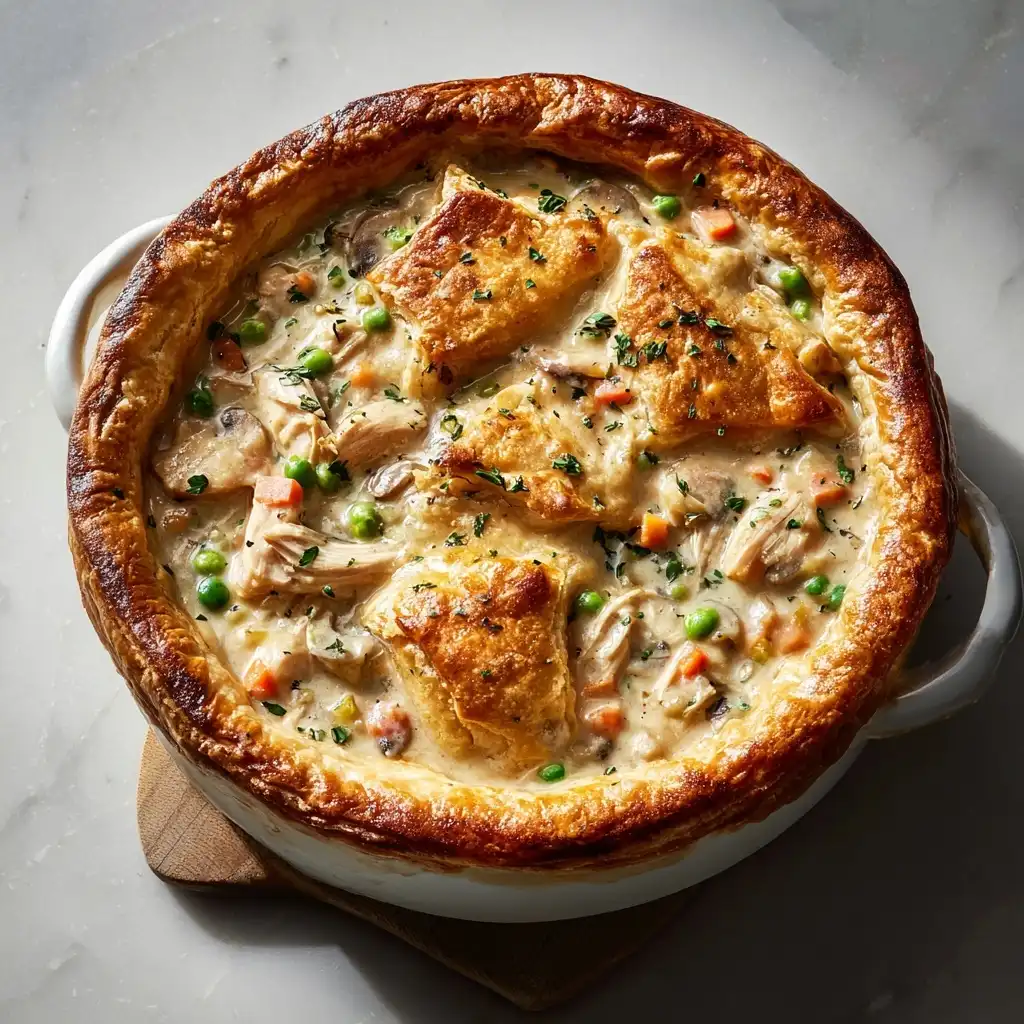
Introduction
Chicken Pot Pie is more than just a comforting dish—it’s a culinary heirloom, a nostalgic embrace served in a flaky, golden crust. Revered across generations and geographies, this classic American casserole embodies warmth, resourcefulness, and home-cooked love. Whether baked in a cast-iron skillet, layered in individual ramekins, or prepared as a creamy stovetop version without pastry, Chicken Pot Pie consistently delivers rich flavor, tender textures, and soul-soothing satisfaction. Its versatility makes it equally suitable for weeknight family dinners, holiday side dishes, potluck contributions, or freezer-friendly meal prep—truly a cornerstone of American comfort cuisine.
The History
The origins of Chicken Pot Pie stretch far beyond American soil, tracing back to medieval Europe where early “pies” were less about dessert and more about preservation and practicality. In 14th-century England, savory meat pies—often called “coffins”—were encased in dense, inedible rye or barley crusts designed solely to contain juices and extend shelf life. These were staples among nobility and commoners alike, frequently filled with poultry, game, herbs, dried fruits, and spices imported via the Silk Road.
By the 17th century, English colonists brought pie-making traditions to North America, adapting them to local ingredients: free-range chickens, seasonal root vegetables, and abundant dairy. The term “pot pie” first appeared in print in 1742 in *The Compleat Housewife* by Eliza Smith, referencing a stew-like filling baked under a crust—a direct precursor to today’s version. Unlike its British ancestor, the American pot pie evolved toward tenderness and flavor over function: crusts became edible and flaky; fillings grew creamier and herb-forward; and regional variations blossomed—from Pennsylvania Dutch versions enriched with dumpling dough, to Southern iterations featuring buttermilk biscuits instead of pastry, and Pacific Northwest renditions incorporating wild mushrooms and Dungeness crab accents.
In the 20th century, industrialization reshaped the dish: frozen convenience versions hit supermarket shelves in the 1950s (notably Swanson’s TV Dinners), embedding Chicken Pot Pie into postwar pop culture. Yet, despite mass production, the homemade version never lost its emotional resonance—frequently cited in surveys as one of the top “most craved comfort foods” in the U.S., and a perennial favorite in nursing homes, school cafeterias, and family recipe boxes passed down through handwritten index cards stained with butter and broth.
Ingredients Breakdown
Every exceptional Chicken Pot Pie begins with intentionality—not just in selection, but in understanding how each component contributes to structure, flavor, mouthfeel, and balance. Below is an in-depth analysis of core and optional ingredients:
Protein
- Chicken Breast or Thighs (or a combination): Boneless, skinless thighs offer superior moisture, richness, and collagen that melts into the sauce during simmering—ideal for deep umami notes. Breasts provide mild flavor and firm texture but risk dryness if overcooked. For best results, poach thighs gently in aromatic broth (with onion, celery, bay leaf, and peppercorns) for 15–18 minutes, then shred by hand to preserve fiber integrity.
- Rotisserie Chicken (store-bought shortcut): A time-saving option—but check sodium content and avoid pre-seasoned varieties with heavy spice blends that clash with traditional herbs. Always pick meat off while warm for optimal tenderness; reserve drippings and cartilage-rich scraps to simmer into your base stock for enhanced depth.
Aromatics & Vegetables
- Yellow Onions: Sweetness develops beautifully when sautéed low and slow; they form the foundational “soffritto” base. Avoid red onions (too sharp) or white onions (too pungent raw).
- Celery & Carrots: The classic “mirepoix” trio—celery adds herbal brightness and subtle bitterness; carrots lend natural sweetness and body. Dice uniformly (¼-inch) so they cook evenly and retain gentle bite—not mush.
- Fresh Garlic: Added in the last minute of sautéing to preserve its aromatic volatility and prevent acrid bitterness. Use 3–4 fresh cloves, minced fine—not powdered or jarred.
- Pearl Onions (optional luxury): Blanch first to loosen skins, then sauté separately until caramelized. Adds elegant sweetness and textural contrast.
- Frozen Peas & Green Beans: Use petite frozen peas—they retain vibrant color and sweet flavor better than canned. Trim and blanch fresh green beans for 90 seconds before adding to maintain crisp-tender integrity.
- Leeks (gourmet variation): Substitute half the onion with cleaned, sliced leeks for refined, delicate allium complexity. Soak thoroughly in cold water to remove grit between layers.
Liquid & Thickening Agents
- Homemade Chicken Stock (strongly recommended): Simmer roasted chicken bones, wings, necks, and carcasses with mirepoix, tomato paste, apple cider vinegar (to extract minerals), and herbs for 6–12 hours. Strain and defat. This yields gelatin-rich, deeply flavorful liquid that thickens naturally and carries unmatched savoriness.
- Store-Bought Stock (if using): Choose low-sodium, organic, and preferably collagen-rich brands (e.g., Kettle & Fire, Bonafide Provisions). Avoid bouillon cubes high in MSG and artificial colors.
- All-Purpose Flour: Used for roux-based thickening. Toasting flour in butter creates nutty depth and eliminates raw taste. For gluten-free options, use a 1:1 blend containing tapioca and brown rice flour—or make a slurry with arrowroot or cornstarch added at the end of cooking.
- Heavy Cream or Full-Fat Evaporated Milk: Adds luxurious silkiness and rounds out acidity. Evaporated milk offers richness without heaviness and enhances browning in the oven. Never substitute with skim or non-dairy milks unless fortified—coconut or oat milk may curdle or impart off-notes.
Herbs, Spices & Seasonings
- Fresh Thyme & Parsley: Thyme’s earthy, floral notes are irreplaceable; add whole sprigs while simmering, then strip leaves before assembling. Flat-leaf parsley stirred in at the end brightens the entire profile.
- Dried Sage (sparingly): A hallmark of traditional pot pie—use only ¼ tsp ground sage or 2 small rubbed leaves. Too much becomes medicinal.
- Bay Leaf: One dried leaf, removed before baking. Imparts subtle woodsy nuance.
- White Pepper (preferred over black): Offers clean heat without visible specks—critical for aesthetic appeal and smoother finish.
- Optional Umami Boosters: A teaspoon of white miso paste whisked in at the end, or ½ tsp fish sauce (yes, really!) adds profound depth without detectable flavor—just savoriness.
Pie Crust
- Homemade All-Butter Pastry: Made with chilled unsalted butter, ice water, and a touch of apple cider vinegar (inhibits gluten formation for tenderness). Rest dough at least 1 hour—preferably overnight—for optimal flakiness and ease of rolling.
- Butter-Lard Blend (50/50): Lard contributes unparalleled flakiness and melt-in-the-mouth quality, while butter ensures flavor. Ideal for bottom crusts needing structural integrity.
- Biscuit-Topped Variation: Drop biscuits made with buttermilk, baking powder, and cold butter create a rustic, pull-apart crown—especially beloved in Appalachia and the South.
- Phyllo or Puff Pastry (gourmet shortcut): Light, shatteringly crisp—but monitor closely in oven to prevent over-browning. Brush with egg wash and flaky sea salt before baking.
- Gluten-Free Options: Use a tested GF flour blend with xanthan gum; add 1 tbsp psyllium husk powder per cup of flour to mimic elasticity and prevent crumbling.
Step-by-Step Recipe
This meticulously crafted, chef-tested method yields a restaurant-quality Chicken Pot Pie with velvety filling, herb-infused aroma, and a crackling, golden-brown crust—every time.
Step 1: Prepare the Chicken
- Place 1.5 lbs boneless, skinless chicken thighs in a medium saucepan. Cover with 4 cups low-sodium chicken stock, 1 diced yellow onion, 2 chopped celery ribs, 2 peeled and chopped carrots, 2 garlic cloves (smashed), 1 bay leaf, 4 black peppercorns, and 1 tsp kosher salt.
- Bring to a gentle simmer over medium-low heat. Skim foam. Reduce heat to low, cover partially, and poach for 18 minutes—do not boil. Remove chicken, let rest 5 minutes, then shred with two forks. Reserve 2.5 cups of strained, defatted poaching liquid for the filling.
Step 2: Build the Flavor Foundation
- In a large Dutch oven or heavy-bottomed pot, melt 6 tbsp unsalted butter over medium heat. Add 1 finely diced yellow onion, 2 diced celery stalks, and 2 diced carrots. Sauté 8–10 minutes until softened but not browned.
- Add 4 minced garlic cloves and cook 60 seconds until fragrant.
- Stir in ⅓ cup all-purpose flour. Cook, stirring constantly, for 3 full minutes to eliminate raw taste and develop nutty roux character—do not let it darken.
Step 3: Create the Luxurious Filling
- Gradually whisk in the reserved 2.5 cups warm poaching liquid, ensuring no lumps remain. Bring to a gentle simmer, stirring continuously.
- Whisk in ¾ cup full-fat evaporated milk (or heavy cream), 1 tsp Dijon mustard (for brightness and emulsification), and 1 tbsp soy sauce or tamari (for umami lift).
- Reduce heat to low. Stir in shredded chicken, 1 cup frozen petite peas, 1 cup blanched green beans (cut into ½-inch pieces), ¼ cup finely chopped fresh parsley, 1 tbsp stripped fresh thyme leaves, ¼ tsp freshly grated nutmeg, ½ tsp white pepper, and 1 tsp kosher salt (adjust to taste).
- Simmer uncovered for 12–15 minutes, stirring occasionally, until thickened to a glossy, spoon-coating consistency—like warm hollandaise. It should mound slightly on a spoon without dripping. Remove from heat. Taste and adjust: add lemon zest for brightness, a pinch of sugar if overly salty, or more thyme if muted.
- Transfer filling to a 9×13-inch ceramic or enameled cast-iron baking dish. Cool 20 minutes—this prevents soggy crust and allows starches to set.
Step 4: Prepare & Apply the Crust
- Preheat oven to 400°F (200°C). Position rack in center.
- On a lightly floured surface, roll out chilled top-crust dough to ⅛-inch thickness—large enough to overhang dish by 1 inch. Carefully drape over cooled filling. Trim excess, leaving ½-inch overhang. Tuck edges under and crimp decoratively with fingers or fork.
- Cut 4–5 steam vents in center (a small star or leaf cutter adds charm). Brush entire surface with egg wash (1 egg + 1 tbsp water, whisked). Sprinkle generously with flaky sea salt and cracked black pepper.
Step 5: Bake to Perfection
- Place dish on a parchment-lined baking sheet (to catch spills). Bake 35–42 minutes—until crust is deeply golden, puffed, and sounds hollow when tapped, and filling bubbles vigorously around edges.
- Rotate pan halfway through for even browning.
- Let rest on wire rack for 25–30 minutes before slicing. This crucial step allows internal temperature to equalize, starches to fully set, and filling to thicken further—preventing a soupy slice.
Tips
- Chill Your Dough, Not Your Patience: Always chill rolled crust for 15 minutes before baking—cold fat = flaky layers. If dough gets too warm while handling, return to fridge for 10 minutes.
- Sauce Consistency Is King: Under-thickened filling leaks; over-thickened becomes gluey. Test with a spoon—if it coats and holds a line when you run finger across back, it’s perfect.
- Prevent Soggy Bottoms: Blind-bake bottom crust for 12 minutes at 425°F with pie weights if making double-crust. Or brush cooled bottom crust with beaten egg white before adding filling—it creates a moisture barrier.
- Golden Crust Hack: For extra shine and color, apply second egg wash 10 minutes before end of bake—and sprinkle with everything bagel seasoning or grated aged cheddar.
- Make-Ahead Mastery: Assemble unbaked pie up to 24 hours ahead; refrigerate covered. Add 5–7 minutes to bake time. Or freeze assembled (unbaked) pie for up to 3 months—bake from frozen, adding 20–25 minutes total.
- No-Waste Wisdom: Save chicken bones, veggie trimmings, and herb stems in freezer bag. When full, simmer into master stock—freeze in 2-cup portions for future pies, soups, and risottos.
- Resting Is Non-Negotiable: Cutting too soon causes structural collapse. Set timer! Even 20 minutes improves texture dramatically.
- Season in Layers: Salt the poaching liquid, season the sautéed aromatics, and adjust final filling—layered salting builds dimension, not just saltiness.
Variations and Customizations
Chicken Pot Pie is gloriously adaptable—celebrating regional roots, dietary needs, seasonal abundance, and creative whims. Here are thoughtfully curated variations, each with technique notes:
Classic Double-Crust (Traditional)
Uses all-butter pastry for both top and bottom. Roll bottom crust slightly thicker (¼ inch) for stability. Pre-bake bottom crust 12 minutes with weights to ensure crispness beneath rich filling.
Biscuit-Topped (Southern Style)
Whisk together 2 cups self-rising flour, 1 tbsp sugar, 1 tsp garlic powder, ½ tsp onion powder. Cut in ½ cup cold butter. Stir in ¾ cup buttermilk until shaggy. Drop 8–10 generous scoops over hot filling. Bake 22–26 minutes until biscuits are risen and golden. Brush with honey-butter glaze before serving.
Individual Mini Pot Pies (Elegant Entertaining)
Use six 6-oz ramekins. Divide filling evenly. Top with small circles of puff pastry or biscuit dough. Bake 28–32 minutes. Garnish with microgreens and edible flowers.
Vegetarian “Chicken” Pot Pie
Substitute shredded king oyster mushrooms (sliced lengthwise, seared until golden and chewy) and marinated, baked tofu cubes. Boost umami with 1 tbsp nutritional yeast, 1 tsp smoked paprika, and 2 tsp tomato paste in roux. Add roasted parsnips and fennel for complexity.
Low-Carb/Keto Version
Omit flour; thicken with 2 tsp xanthan gum blended into cold stock before adding. Replace crust with almond-flour “crumble”: 1 cup almond flour, ¼ cup grated Parmesan, 3 tbsp cold butter, ½ tsp garlic powder, salt, and rosemary. Sprinkle over filling and bake.
Mediterranean Twist
Add ½ cup kalamata olives (pitted), ¼ cup sun-dried tomatoes (chopped), 2 tbsp capers, and ¼ cup crumbled feta. Replace thyme with oregano and lemon zest. Skip cream—use whole milk and a splash of white wine in roux.
Asian-Inspired Umami Bomb
Sauté ginger and scallion whites with aromatics. Use tamari instead of soy sauce, add 1 tbsp mirin and 1 tsp toasted sesame oil at the end. Top with crispy wonton strips instead of pastry. Garnish with cilantro, lime zest, and chili threads.
Breakfast Pot Pie
Replace chicken with cooked breakfast sausage and scrambled eggs folded in at the end. Add caramelized apples and sage. Top with cheddar-chive biscuits.
Freezer-to-Oven Express
Assemble in disposable aluminum foil pans. Freeze unbaked. When ready, bake from frozen at 375°F for 75–85 minutes—cover with foil first 45 minutes, then uncover to brown.
Health Considerations and Nutritional Value
A single serving (1/6th of a 9×13-inch pie, approx. 1.5 cups with crust) provides balanced macronutrients and meaningful micronutrients—especially when prepared with whole-food, minimally processed ingredients:
Nutrition Snapshot (Approximate per Serving)
- Calories: 485 kcal
- Protein: 28 g (excellent source—supports muscle repair, satiety, immune function)
- Total Fat: 26 g (mostly unsaturated from chicken thighs and butter; includes heart-healthy monounsaturated fats)
- Saturated Fat: 14 g (moderate—reduced by using leaner chicken breast or removing skin)
- Carbohydrates: 34 g (primarily complex carbs from vegetables and whole-grain crust options)
- Dietary Fiber: 4.2 g (from carrots, peas, celery, onions—supports gut health and glycemic control)
- Sodium: 620 mg (highly variable—control by using low-sodium stock and limiting added salt)
- Vitamin A: 120% DV (from carrots and chicken liver if included—vital for vision and immunity)
- Vitamin C: 35% DV (from peppers if added, parsley, and tomatoes—antioxidant and collagen synthesis)
- Iron: 18% DV (heme iron from chicken—highly bioavailable)
- Calcium & Vitamin D: Enhanced by using fortified milk or adding calcium-set tofu in vegetarian versions
Dietary Adaptations
- Gluten-Free: Use certified GF flour blend for roux and crust. Ensure stock and seasonings are GF-certified. Note: Xanthan gum may cause bloating in sensitive individuals—substitute with psyllium or glucomannan.
- Dairy-Free: Replace butter with high-quality refined coconut oil or olive oil; use unsweetened almond or oat milk (add 1 tsp cornstarch to stabilize); skip cheese garnishes. Coconut milk adds richness but imparts subtle sweetness—balance with extra white pepper and lemon juice.
- Low-Sodium: Omit added salt entirely; rely on herbs, citrus zest, umeboshi paste, or mushroom powder for depth. Rinse canned beans or peas thoroughly.
- Weight-Conscious: Use skinless chicken breast, replace half the butter with Greek yogurt in filling, and opt for a thin, partial crust (e.g., lattice or crumble topping) to reduce calories by ~120 per serving.
- Kid-Friendly Modifications: Finely dice vegetables or purée half the filling for picky eaters. Add mild cheddar to crust or filling. Serve in fun-shaped mini pies.
Functional Benefits
Chicken Pot Pie isn’t just comforting—it’s physiologically supportive. The collagen-rich bone broth base aids joint and gut lining integrity. Turmeric or black pepper added to roux enhances curcumin absorption—supporting anti-inflammatory pathways. Prebiotic fibers from onions and leeks feed beneficial gut bacteria. And the mindful, slow-cooking process itself encourages presence and stress reduction—a holistic wellness practice disguised as dinner.
Ingredients
Makes one 9×13-inch pie (6–8 servings)
- For the Filling:
- 1.5 lbs boneless, skinless chicken thighs
- 4 cups low-sodium chicken stock (homemade preferred)
- 1 medium yellow onion, diced (plus 1 additional for poaching)
- 2 medium carrots, peeled and diced (¼-inch)
- 2 celery ribs, diced (¼-inch)
- 4 garlic cloves, minced
- 6 tbsp unsalted butter
- ⅓ cup all-purpose flour (or GF 1:1 blend)
- ¾ cup full-fat evaporated milk or heavy cream
- 1 tsp Dijon mustard
- 1 tbsp soy sauce or tamari
- 1 cup frozen petite peas
- 1 cup blanched green beans, cut into ½-inch pieces
- ¼ cup fresh flat-leaf parsley, finely chopped
- 1 tbsp fresh thyme leaves (stripped from stems)
- ¼ tsp freshly grated nutmeg
- ½ tsp freshly ground white pepper
- 1 tsp kosher salt (plus more to taste)
- 1 bay leaf (removed before baking)
- For the Crust:
- 1 double batch (about 1 lb) all-butter pie dough, chilled (recipe follows)
- 1 large egg + 1 tbsp water (egg wash)
- Flaky sea salt, for finishing
- Optional Enhancements:
- 1 tsp apple cider vinegar (in dough)
- 2 tsp tomato paste (sautéed with aromatics)
- 1 tbsp white miso paste (whisked in at end)
- 1 tsp lemon zest (brightens final flavor)
Directions
- Prepare the Chicken: In a medium saucepan, combine chicken thighs, 4 cups stock, 1 diced onion, 2 chopped celery ribs, 2 chopped carrots, 2 smashed garlic cloves, 1 bay leaf, 4 peppercorns, and 1 tsp salt. Bring to gentle simmer; poach 18 minutes. Remove chicken, cool slightly, shred. Strain and defat poaching liquid; reserve 2.5 cups.
- Sauté Aromatics: In Dutch oven, melt butter over medium heat. Add 1 diced onion, carrots, celery. Cook 8–10 min until soft. Add garlic; cook 1 min.
- Make Roux: Whisk in flour. Cook 3 min, stirring constantly.
- Build Sauce: Gradually whisk in reserved warm stock until smooth. Add evaporated milk, Dijon, soy sauce. Simmer 5 min.
- Combine Filling: Stir in shredded chicken, peas, green beans, parsley, thyme, nutmeg, white pepper, salt. Simmer uncovered 12–15 min until thickened. Remove bay leaf. Cool 20 min.
- Assemble: Pour cooled filling into greased 9×13-inch baking dish. Roll out top crust. Drape over filling; trim, tuck, crimp. Cut steam vents.
- Bake: Brush with egg wash; sprinkle with flaky salt. Bake at 400°F for 35–42 min until crust is golden and filling bubbles. Rotate at 20 min.
- Rest & Serve: Cool on wire rack 25–30 min. Slice with sharp serrated knife. Serve warm with simple green salad or roasted carrots.
FAQ
- Can I make Chicken Pot Pie ahead of time?
- Absolutely. Assemble unbaked pie up to 24 hours in advance—refrigerate covered. Add 5–7 minutes to bake time. For longer storage, freeze unbaked pie up
Advertisment