
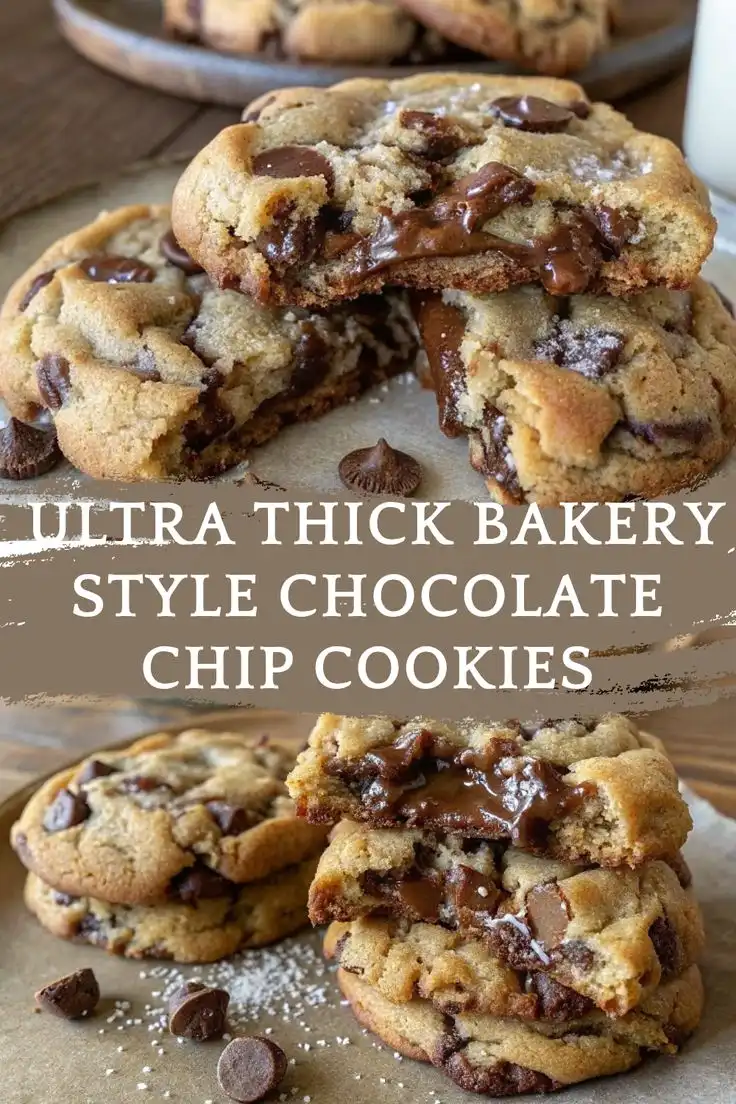
Ultra Thick Bakery Style Chocolate Chip Cookies – Crispy Edges, Gooey Centers
Introduction
Imagine pulling a cookie fresh from the oven—its surface deeply golden and delicately cracked, edges shatteringly crisp, yet the center yields with warm, molten resistance, studded generously with pockets of rich, bittersweet chocolate and flecks of sea salt. These aren’t just cookies—they’re an experience: ultra-thick (nearly 1½ inches tall), bakery-professional in stature and texture, yet entirely achievable in your home kitchen. Designed to mimic the legendary chewy-crisp dichotomy of premium artisanal cookies—think Levain, Dō, or Milk Bar—but with precise, science-backed techniques and accessible ingredients, this recipe delivers consistent, showstopping results every single time. Whether you’re feeding a crowd, gifting a thoughtful tin, or simply treating yourself to a moment of pure, buttery, chocolate-laden comfort, these cookies promise decadence, depth, and delightful textural contrast in every bite.
The History
The evolution of the chocolate chip cookie is a beloved American culinary saga—born in 1938 when Ruth Wakefield, owner of the Toll House Inn in Whitman, Massachusetts, famously substituted broken Nestlé semi-sweet chocolate bars into her butter drop dough, expecting them to melt evenly. Instead, they held their shape, creating the first recognizable chocolate chip cookie—and launching a national obsession. Yet for decades, the standard remained relatively thin, uniform, and moderately chewy. The “bakery style” revolution began in earnest in the early 2000s, led by New York’s Levain Bakery (founded 1995), whose massive, dense, craggy, four-ounce cookies—with their signature contrast of caramelized, crunchy perimeter and fudgy, underbaked core—redefined expectations. Social media accelerated this shift: viral baking accounts dissected temperature control, flour hydration, and resting protocols; food scientists (like J. Kenji López-Alt and Stella Parks) validated techniques such as brown butter infusion, cold fermentation, and strategic underbaking; and home bakers demanded more than convenience—they demanded *craft*. This recipe stands at the confluence of that history: honoring Wakefield’s ingenuity while applying modern food science, professional-grade timing, and elevated ingredient curation to achieve a truly iconic, ultra-thick, edge-crisp/center-gooey masterpiece.
Ingredients Breakdown
Every ingredient here serves a precise functional and sensory role—not merely flavor, but structure, moisture retention, browning, tenderness, and mouthfeel:
- Unsalted Butter (14 tablespoons / 200g, cold & cubed) — Cold butter is non-negotiable for height and flakiness. As it melts slowly in the oven, steam lifts the dough, creating lift and airy pockets. High-fat European-style butter (82–86% fat) is strongly recommended for richer flavor and superior browning.
- Brown Sugar (1 cup / 215g, packed dark) — Provides deep molasses notes, acidity (which tenderizes gluten), and hygroscopic moisture that keeps centers soft and chewy for days. Dark brown sugar contains more molasses than light, yielding richer color and more complex caramelization.
- Granulated Sugar (½ cup / 100g) — Adds structural integrity, promotes spreading *just enough*, and contributes to the delicate, lacy crispness of the edges via rapid caramelization.
- Large Egg (1, cold) — Acts as binder and emulsifier. Its proteins coagulate during baking to set structure, while water content adds steam for lift. Using a cold egg helps maintain overall dough temperature.
- Egg Yolk (1, cold) — Extra yolk boosts fat content significantly, enriching flavor, adding tenderness, and enhancing chewiness and sheen. It also increases emulsification, allowing more liquid to be absorbed without toughness.
- Pure Vanilla Extract (2 tsp) — Real Madagascar bourbon vanilla adds floral, creamy warmth that balances chocolate’s bitterness. Alcohol content also aids in flavor dispersion.
- All-Purpose Flour (2¼ cups / 280g, spooned & leveled) — A moderate-protein flour (10–11.7%) provides ideal balance: enough gluten for structure and chew, but not so much that cookies become tough or cakey. Avoid bread flour (too strong) or cake flour (too weak).
- Cornstarch (2 tbsp / 16g) — A secret weapon for bakery texture. Cornstarch inhibits gluten development, yielding a softer, more tender crumb while increasing viscosity to prevent over-spreading. It also enhances the “melt-in-your-mouth” quality of the center.
- Baking Soda (1 tsp) — The sole leavener. It reacts with the acid in brown sugar to produce carbon dioxide, creating lift and promoting spread. Too much causes bitterness; too little yields dense, flat cookies.
- Fine Sea Salt (1 tsp + ¼ tsp for finishing) — Enhances all other flavors, balances sweetness, and strengthens gluten slightly for better structure. Flaky Maldon or Fleur de Sel is reserved for the final sprinkle—it adds a bright, briny pop against the richness.
- High-Quality Semi-Sweet Chocolate (12 oz / 340g, chopped into uneven ½”–¾” chunks) — Not chips! Chopped chocolate (e.g., Valrhona Guayaquil 64%, Ghirardelli 60%, or Callebaut 54.5%) melts irregularly, creating gooey pools and satisfying, varied textures. Chips contain stabilizers that resist melting and yield waxy, uniform bites.
- Optional Add-In: Toasted Walnuts or Pecans (1 cup, roughly chopped) — Adds nutty depth, crunch contrast, and buttery aroma. Toast first for maximum flavor.
Step-by-Step Recipe
This method prioritizes precision, temperature control, and intentional resting—each step engineered to maximize thickness, crisp edges, and gooey centers:
- Prep & Chill Your Tools: Place your mixing bowl, paddle attachment (or sturdy wooden spoon), and baking sheets in the freezer for 15 minutes. Cold tools prevent premature butter softening.
- Cream Butter & Sugars (3–4 min): In the chilled bowl, beat cold, cubed butter, dark brown sugar, and granulated sugar on medium-low speed (stand mixer) or vigorous hand-mixing until *just combined*—no more than 3–4 minutes. Do NOT over-cream. You want a gritty, slightly sandy paste—not fluffy or pale. Over-creaming incorporates excess air, leading to puffing then collapse and thinner cookies.
- Add Wet Ingredients (1 min): Beat in the cold egg, cold yolk, and vanilla on low until fully incorporated and glossy—about 60 seconds. Scrape bowl thoroughly. The mixture will look thick and cohesive.
- Whisk Dry Ingredients Separately: In a separate bowl, whisk together flour, cornstarch, baking soda, and 1 tsp fine sea salt until completely homogenous and aerated. This ensures even distribution and prevents pockets of leavener or salt.
- Gradual Dry Incorporation (Low Speed, 1 min): With mixer on lowest speed (or using a spatula), add dry ingredients in three equal additions, mixing only until *just no dry streaks remain* after each addition. Overmixing develops gluten → toughness. Stop immediately when dough looks shaggy and slightly crumbly.
- Fold in Chocolate (By Hand): Using a flexible silicone spatula, gently fold in chopped chocolate (and nuts, if using) until evenly distributed, with some larger clusters remaining. This preserves chunk integrity and prevents smearing.
- Chill Dough — Non-Negotiable (Minimum 24 hrs, up to 72 hrs): Divide dough into two equal portions. Shape each into a 2-inch-thick disc. Wrap *tightly* in parchment paper, then plastic wrap or beeswax wrap. Refrigerate for *at least 24 hours* (48 hours preferred). This allows full hydration of flour, starch retrogradation (firming texture), butter fat crystallization (preventing spread), and flavor melding. Skipping this step guarantees flat, greasy, less flavorful cookies.
- Preheat & Prep (30 min before baking): Position oven racks in upper and lower thirds. Preheat oven to 325°F (163°C)—a lower temp ensures slow, even baking: edges crisp before centers overbake. Line two heavy-duty baking sheets with parchment (NOT silicone mats—they insulate too much and inhibit bottom crisping).
- Scoop & Shape: Remove one dough disc. Using a large ice cream scoop (3-tablespoon / ~60g capacity), portion dough. Roll *gently* into tight, smooth balls—do not overwork. Place 4 cookies per sheet, spaced at least 4 inches apart (they expand significantly). Lightly press the top of each ball with your palm to create a slight dome—this encourages vertical rise. Sprinkle each with a pinch (~⅛ tsp) of flaky sea salt.
- Bake (18–22 min): Bake sheets on separate racks, swapping positions halfway through. Cookies are done when edges are deeply golden brown, puffed, and set, with visible cracks radiating from the center—but centers still look soft, shiny, and slightly underbaked (they’ll sink and set as they cool). Total bake time varies by oven; start checking at 18 minutes. Do not overbake.
- Cool Strategically: Immediately upon removal, bang the hot baking sheet firmly on the counter *twice*—this collapses air pockets and creates signature crinkles while setting the structure. Let cookies cool on the sheet for exactly 12 minutes. Then, carefully slide parchment with cookies onto a wire rack. Cool for another 20–30 minutes before eating. This extended cooling allows carryover cooking to finish the center without drying it out.
Tips
These nuanced practices separate good cookies from extraordinary ones:
- Weigh Everything: Volume measurements for flour vary wildly. A kitchen scale is essential for consistency and height control.
- Cold Is King: Butter, eggs, bowl, and even dough scoops should be cold. Warm butter = greasy, flat cookies.
- Undermix Relentlessly: Mix only until ingredients are *just* combined. Gluten development is the enemy of tenderness.
- Chill Longer, Not Shorter: 48 hours > 24 hours. 72 hours yields even deeper flavor and firmer dough for taller cookies. Dough can be frozen for up to 3 months—bake straight from freezer, adding 1–2 minutes.
- Oven Thermometer Required: Most ovens run hot or cold. An accurate thermometer ensures your 325°F is truly 325°F.
- Rotate & Swap Racks: Ensures even heat exposure—critical for uniform browning and rise.
- The Bang is Crucial: That counter bang creates micro-fractures, sets the outer shell instantly, and prevents doming collapse.
- Resist the Bite: Eating before full cooling means a messy, under-set center. Patience rewards you with perfect texture.
- Sheet Choice Matters: Use heavy-gauge, rimmed aluminum sheets (Nordic Ware or USA Pan). Thin sheets warp and cause uneven baking.
- Batch Size Discipline: Never overcrowd a sheet. 4 cookies max per standard sheet. Crowding traps steam and steams instead of crisps.
Variations and Customizations
Build upon the foundational technique while preserving the ultra-thick, crispy/gooey integrity:
- Double Chocolate: Replace ¼ cup (30g) of flour with unsweetened cocoa powder (Dutch-process preferred). Add ½ cup (90g) extra chopped dark chocolate.
- Sea Salt & Caramel: Swirl in ⅓ cup (80g) thick, cooled homemade or high-quality store-bought caramel sauce before folding in chocolate. Sprinkle extra flaky salt.
- Espresso Infused: Dissolve 1½ tsp instant espresso powder in the vanilla extract before adding to wet ingredients. Deepens chocolate flavor without tasting like coffee.
- Oatmeal Chocolate Chunk: Replace ½ cup (60g) flour with old-fashioned rolled oats (not quick oats). Toast oats first for nuttiness. Reduce chocolate to 10 oz.
- White Chocolate & Tart Cherry: Substitute high-quality white chocolate for half the semi-sweet. Fold in ¾ cup (100g) dried tart cherries (soaked 10 min in warm water, drained & patted dry).
- Spiced Gingerbread: Add 1 tsp ground ginger, ½ tsp cinnamon, ¼ tsp cloves, and 1 tbsp molasses to wet ingredients. Use dark chocolate and crystallized ginger pieces.
- Gluten-Free Adaptation: Use a 1:1 GF blend containing xanthan gum (e.g., King Arthur Measure for Measure). Add 1 extra tbsp cornstarch. Chill dough 72 hours. Expect slightly more spread—compensate with 1 extra tbsp flour substitute.
- Vegan Version: Use cold, high-fat vegan butter (Miyoko’s or Naturli’), flax egg (1 tbsp ground flax + 2.5 tbsp water, chilled), and vegan dark chocolate. Increase cornstarch to 3 tbsp. Chill 72 hours.
- Mini Bakery Style: Scoop 1-tbsp portions. Bake at 325°F for 11–13 minutes. Yields 60+ petite cookies with intensified crisp-to-chew ratio.
- Stuffed Center: Flatten a 2-tbsp dough ball, place 1 tsp thick caramel or peanut butter cup inside, seal, and roll smooth. Chill 30 min before baking.
Health Considerations and Nutritional Value
While undeniably indulgent, mindful preparation and ingredient choices can enhance nutritional profile without sacrificing authenticity:
- Portion Control is Built-In: At ~60g per cookie (3 tbsp dough), these are naturally substantial. One satisfies more than three thin cookies—reducing overall sugar and calorie intake per serving.
- Quality Fat Matters: Using grass-fed butter or high-oleic sunflower oil-based vegan butter provides beneficial saturated and monounsaturated fats, supporting satiety and nutrient absorption.
- Dark Chocolate Benefits: 60–70% dark chocolate contributes flavonoids, antioxidants (epicatechin), magnesium, and iron. Choose brands with minimal added sugar and no artificial additives.
- Reduced Refined Sugar Option: Substitute ¼ cup (50g) of granulated sugar with coconut sugar (lower glycemic index, retains minerals) or erythritol (zero-calorie, non-glycemic). Note: texture may be slightly drier; add 1 tsp maple syrup if needed.
- Fiber Boost: Replace up to ¼ cup (30g) flour with oat fiber or resistant tapioca starch—adds soluble fiber without altering taste or spread.
- No Artificial Additives: This recipe avoids preservatives, emulsifiers, or artificial flavors found in commercial cookies, making it cleaner-label friendly.
- Not Low-Sugar/Low-Fat: These are celebratory treats. For dietary restrictions (diabetic, keto, low-FODMAP), significant reformulation is required and will alter texture fundamentally. Consult a registered dietitian for personalized adaptation.
- Nutritional Snapshot (per cookie, approx.): Calories: 285 | Fat: 16g (10g sat) | Carbs: 33g (22g sugars) | Protein: 3g | Fiber: 1g | Sodium: 175mg. Values vary based on exact ingredients and size.
Ingredients
Makes 16 ultra-thick, 3.5-inch cookies
- 14 tablespoons (200g) unsalted butter, cold & cubed (preferably European-style, 82%+ fat)
- 1 cup (215g) dark brown sugar, firmly packed
- ½ cup (100g) granulated sugar
- 1 large egg, cold
- 1 large egg yolk, cold
- 2 teaspoons pure vanilla extract
- 2¼ cups (280g) all-purpose flour, spooned & leveled
- 2 tablespoons (16g) cornstarch
- 1 teaspoon baking soda
- 1 teaspoon fine sea salt (plus extra flaky sea salt for finishing)
- 12 ounces (340g) high-quality semi-sweet or bittersweet chocolate (60–64%), chopped into uneven chunks
- (Optional) 1 cup (120g) toasted walnuts or pecans, roughly chopped
Directions
- Freeze mixing bowl, paddle attachment, and baking sheets for 15 minutes.
- In chilled bowl, beat cold butter, brown sugar, and granulated sugar on medium-low for 3–4 minutes until just combined and gritty—do not over-cream.
- Add cold egg, yolk, and vanilla; beat on low 60 seconds until glossy and smooth. Scrape bowl.
- In separate bowl, whisk flour, cornstarch, baking soda, and 1 tsp fine salt until fully blended.
- With mixer on lowest speed, add dry ingredients in 3 parts, mixing only until no dry streaks remain after each addition.
- Fold in chopped chocolate (and nuts, if using) by hand with spatula until evenly distributed.
- Divide dough into two discs. Wrap tightly in parchment + plastic. Refrigerate 24–72 hours.
- Preheat oven to 325°F (163°C) with racks in upper/lower thirds. Line two heavy baking sheets with parchment.
- Portion dough with 3-tbsp scoop. Roll gently into balls. Place 4 per sheet, 4″ apart. Press tops lightly to dome. Sprinkle with flaky salt.
- Bake 18–22 minutes, rotating & swapping sheets halfway, until edges are deeply golden and set, centers soft and shiny.
- Immediately bang sheet on counter twice. Cool on sheet 12 minutes. Slide parchment to wire rack; cool 20–30 minutes before serving.
FAQ
- Q: Why do I have to chill the dough for 24+ hours?
- A: Extended chilling hydrates flour fully, firms butter crystals (preventing spread), concentrates flavor, and allows enzymes to break down starches—yielding superior chew, height, and caramel complexity. Skipping this guarantees flat, greasy cookies.
- Q: My cookies spread too much—even after chilling. What went wrong?
- A: Likely culprits: butter was too warm during mixing, oven ran too hot (use thermometer), flour was under-measured (always weigh), dough wasn’t cold enough when scooped, or baking sheets were too thin/warm. Also verify your baking soda isn’t expired.
- Q: Can I use chocolate chips instead of chopped chocolate?
- A: Technically yes, but strongly discouraged. Chips contain stabilizers (like soy lecithin and additional cocoa butter) that resist melting, resulting in uniform, waxy, less-gooey pockets instead of luxurious, irregular molten rivers.
- Q: Why bake at 325°F instead of the standard 350–375°F?
- A: Lower temperature allows slower, more even heat penetration. Edges crisp and caramelize gradually while the center stays molten and fudgy. Higher temps cause rapid rise followed by collapse and over-baked centers.
- Q: How do I store these cookies to keep them fresh and gooey?
- A: Cool completely, then store in an airtight container at room temperature for up to 5 days. To revive freshness, microwave individual cookies for 8–10 seconds. For longer storage, freeze baked cookies (up to 3 months) or unbaked dough balls (up to 3 months)—bake frozen, adding 1–2 minutes.
- Q: Can I make these dairy-free?
- A: Yes. Use cold, high-fat vegan butter (Miyoko’s or Naturli’) and vegan dark chocolate. Replace egg with flax egg (1 tbsp ground flax + 2.5 tbsp water, chilled 15 min). Increase cornstarch to 3 tbsp to compensate for binding loss.
- Q: Why does the recipe use both whole egg and yolk?
- A: The whole egg provides structure and leavening; the extra yolk adds fat, emulsification, richness, and chew—critical for the signature bakery-style center. Omitting the yolk yields drier, less tender cookies.
- Q: My cookies are too cakey. How do I fix that?
- A: Cakey texture usually stems from too much flour (measure by weight), overmixing (develops gluten), or excessive baking soda. Ensure precise weighing, minimal mixing, and verified leavener freshness. Adding 1 extra tbsp cornstarch also helps tenderize.
- Q: Can I double the batch?
- A: Yes—but chill dough in smaller portions (max 16 oz per disc) for even, rapid chilling. Doubling the entire batch in one mass leads to uneven temperature and inconsistent results.
- Q: What’s the best way to reheat or refresh day-old cookies?
- A: Place on parchment-lined baking sheet. Warm in a 300°F oven for 4–5 minutes until edges crisp and center is molten. Alternatively, microwave on 50% power for 12–15 seconds—cover loosely with damp paper towel to retain moisture.
Summary
These Ultra Thick Bakery Style Chocolate Chip Cookies deliver an unparalleled sensory experience: towering height, shatteringly crisp caramelized edges, and a luxuriously warm, fudgy, molten center studded with premium chocolate—achieved through meticulous cold-temperature technique, 48-hour fermentation, and precise ingredient science. They’re not just cookies; they’re edible craftsmanship, worthy of the finest artisan bakeries, now perfectly reproducible in your own kitchen with patience, precision, and passion.