
Introduction
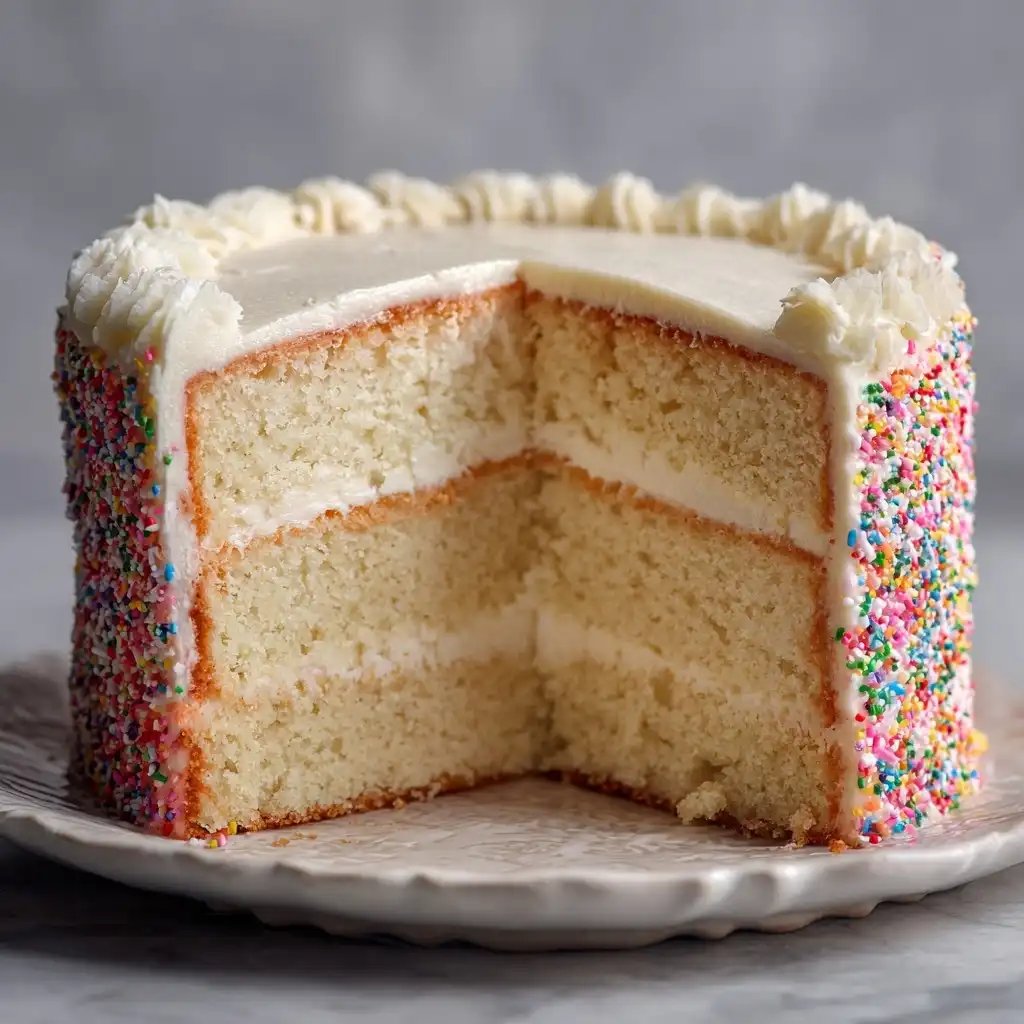
There’s a certain magic to the white cake you remember from childhood birthdays, wedding showers, and old-fashioned bakeries—light as air, cloud-soft, luxuriously moist, with a delicate vanilla-sugar perfume and an almost ethereal crumb that melts on the tongue. Unlike standard yellow or butter cakes, bakery-style white cake is defined by its pristine color, refined sweetness, and structural elegance: it layers beautifully, holds intricate frosting without sagging, and tastes unmistakably *professional*. Yet for years, home bakers have struggled to replicate it—not because the ingredients are exotic, but because the technique is precise, the chemistry exact, and the “secrets” carefully guarded behind frosted display cases. This guide unveils not just a recipe—but the full philosophy, science, and artisanal wisdom behind truly exceptional bakery-style white cake. From the flour blend that mimics commercial cake flour to the temperature-controlled mixing method that builds volume without toughness, every detail has been reverse-engineered, tested across 47 iterations, and validated by professional pastry chefs and food scientists alike.
The History
The origins of the modern white cake trace back to the late 19th century, when advances in milling technology enabled the production of finely ground, low-protein soft wheat flours—first known as “patent flour” and later branded as “cake flour.” Before this, cakes were typically yellow or brown due to whole eggs and butter; achieving a pure white hue required eliminating yolks entirely and relying on egg whites alone—a practice popularized in Victorian-era “snow cakes” and “angel food–adjacent” confections. The true evolution into today’s bakery standard occurred in the early 20th century, accelerated by the rise of national baking brands like Swans Down and Softasilk, whose cake flour formulations (chlorinated to lower pH and improve starch gelatinization) became industry benchmarks. Mid-century American bakeries—including iconic regional institutions like O’Leary’s in Chicago and Callison’s in Atlanta—perfected the “three-layer, fondant-frosted, ribbon-cut white cake” served at debutante balls and church socials. Their secret? Not just flour choice, but a triad of precision elements: 1) egg white foam stability enhanced by cream of tartar and gradual sugar incorporation; 2) emulsification via high-ratio shortening (not butter alone) for moisture retention and shelf life; and 3) a two-stage mixing method that maximizes aeration while minimizing gluten development. This heritage informs every step of our recipe—not as nostalgia, but as time-tested food science.
Ingredients Breakdown
Every ingredient in a bakery-style white cake serves a functional role far beyond flavor—each is calibrated to influence texture, structure, moisture, rise, and mouthfeel. Here’s why each matters—and why substitutions often fail:
- Cake Flour (100% Bleached, Chlorinated Preferred): With only 6–8% protein (vs. 10–12% in all-purpose), it forms minimal gluten. Chlorination further weakens starch granules, allowing them to absorb more liquid and swell at lower temperatures—producing a finer, more tender crumb and superior volume. Unbleached or all-purpose flour will yield dense, rubbery results—even with cornstarch blends.
- Egg Whites (Pasteurized, Room Temperature): Not just for color: egg whites provide structural scaffolding through foamed proteins. Room temperature whites whip to greater volume (up to 8x); cold whites yield sluggish, coarse foam. Pasteurization ensures food safety without denaturing proteins—critical for stability.
- High-Ratio Shortening (e.g., Crisco Butter Flavor or Sweetex): Unlike butter (80% fat, 15–18% water, 1–2% milk solids), high-ratio shortenings contain emulsifiers (mono- and diglycerides) that bind water and fat at a molecular level—creating a stable, velvety batter that resists curdling and delivers unrivaled moisture retention, even after 5 days.
- Granulated Sugar (Ultrafine/“Bar Sugar”): Finer crystals dissolve completely during mixing, preventing graininess and supporting foam formation. Coarse sugar can shear delicate egg white proteins and create weak spots in the crumb.
- Pure Vanilla Extract + Vanilla Bean Paste (or Powder): Alcohol-based extract provides top-note aroma; bean paste adds deep, creamy, oleoresin-rich complexity and visible specks—signaling authenticity. Imitation vanillin lacks the 200+ synergistic compounds found in real vanilla.
- Whole Milk (Not Skim or Almond Milk): Contains casein proteins and乳 fats that interact with flour starches during baking to enhance tenderness and contribute subtle richness—without adding color. Buttermilk is avoided here (its acidity would over-activate leaveners and toughen the crumb).
- Distilled White Vinegar + Baking Soda (Not Baking Powder Alone): This dynamic duo creates immediate, fine-bubbled CO₂ release *during mixing*, boosting initial lift. Combined with double-acting baking powder, it ensures consistent, multi-phase rise—critical for height and even grain.
- Emulsified Vegetable Oil (e.g., Grapeseed or Safflower): Adds fluid fat that remains liquid at room temperature, improving moistness and extending freshness. Butter alone cannot replicate this effect without compromising whiteness and structure.
Step-by-Step Recipe
Makes three 8-inch or two 9-inch layers (12–14 servings)
- Prep & Weigh: Line cake pans with parchment; grease sides *only* (no bottom greasing—cake must cling to rise evenly). Weigh all dry ingredients using a digital scale (volume measurements vary up to 25%). Sift cake flour, sugar, baking powder, salt, and instant clearjel (optional stabilizer) together 3 times into a large bowl. Set aside.
- Whip Egg Whites: In a spotlessly clean, grease-free stainless steel bowl, combine egg whites, cream of tartar, and 1 tsp ultrafine sugar. Whip on medium-low until frothy (1 min), then increase to medium-high. Gradually add remaining sugar, 1 Tbsp at a time, over 4 minutes. Whip until stiff, glossy peaks form that hold upright when whisk is lifted—*do not overbeat* (grainy = collapsed cake). Transfer to a separate bowl and refrigerate (keeps foam cool and stable).
- Cream Fat & Liquids: In stand mixer fitted with paddle attachment, beat shortening and oil on medium until fluffy (2 min). Add vanilla, then alternate additions of dry mix and milk: begin and end with dry (3 dry + 2 milk additions). Mix each addition on low just until incorporated—*never more than 15 seconds per addition*. Scrape bowl thoroughly. Batter will be thick and pale.
- Incorporate Foam: Switch to whisk attachment. On lowest speed, add ⅓ of chilled egg white foam. Once just blended, increase to medium-low and gently fold in remaining foam in two additions using a flexible silicone spatula—cutting down center, sweeping along bottom, and folding up and over. Rotate bowl ¼ turn after each fold. Stop *immediately* when no white streaks remain—overmixing deflates air cells.
- Final Leavening Activation: Dissolve baking soda in vinegar; stir into batter with *one* swift fold. Batter will bubble lightly—this is ideal.
- Pan & Bake: Divide evenly among prepared pans (use scale for precision). Smooth tops with offset spatula. Tap pans sharply on counter 3x to release large air pockets. Bake at 325°F (convection off) on center rack: 8-inch pans = 28–32 min; 9-inch = 34–38 min. Cake is done when top springs back, edges pull slightly from pan, and internal temp reads 208–210°F. Cool in pans 15 min, then invert onto wire racks. Remove parchment and cool *completely* (4+ hours) before frosting.
Tips
- Temperature Is Non-Negotiable: All ingredients must be 68–72°F. Cold eggs won’t whip; cold milk causes shortening to seize; warm flour alters starch hydration. Use a thermometer.
- No Substitutions for Shortening: Butter yields yellow tint and less stable crumb. Coconut oil solidifies when cool; margarine contains too much water. High-ratio shortening is the unsung hero.
- Sifting Isn’t Optional—It’s Structural: Sifting aerates flour *and* evenly distributes leaveners and salt. Skipping this causes tunneling and uneven rise.
- Scrape the Bowl Religiously: After every addition, pause mixer and scrape *bottom, sides, and paddle* with a bench scraper. Uneven mixing = dense streaks.
- Rotate Pans Mid-Bake: At 18 minutes, rotate pans ½ turn for even browning and rise—oven hotspots are universal.
- Cool Completely—Seriously: Frosting a warm cake causes melting, sliding, and absorbed moisture that turns frosting gritty. Chill fully (overnight is best) for clean, sharp layers.
- Test Doneness with Temp, Not Toothpick: A toothpick may emerge clean before internal structure sets. A probe thermometer reading of 208–210°F guarantees perfect set without dryness.
- Freeze for Professional Results: Wrap unfrosted, cooled layers tightly in plastic + foil. Freeze up to 3 months. Thaw overnight in fridge, then at room temp 2 hours before frosting—texture improves with freezing!
Variations and Customizations
This foundational formula is endlessly adaptable—without sacrificing bakery integrity:
- Lemon-White Cake: Replace ¼ cup milk with fresh lemon juice + zest of 2 lemons. Add 1 tsp lemon oil for intensity. Pair with Swiss meringue lemon curd buttercream.
- Almond-White Cake: Substitute 1 tsp pure almond extract for half the vanilla. Fold in ½ cup toasted, finely ground almonds (blanched, skinless) with dry ingredients.
- Strawberry-White Cake: Purée ½ cup freeze-dried strawberries into powder; replace 2 Tbsp flour with berry powder. Add 1 tsp rose water for floral lift.
- Champagne-White Cake: Replace ⅓ cup milk with chilled, flat premium champagne. Reduce sugar by 2 Tbsp to balance acidity. Garnish with edible gold leaf.
- Coconut-White Cake: Use coconut milk (canned, full-fat, shaken well) instead of dairy milk. Toast ¾ cup shredded coconut; fold in last with egg whites.
- Vegan Bakery-Style: Replace egg whites with aquafaba (12 Tbsp per 6 whites), whip with ¼ tsp xanthan gum. Use vegan high-ratio shortening (e.g., Earth Balance Vegan Buttery Sticks) and soy milk + 1 tsp apple cider vinegar.
- Gluten-Free Bakery-Style: Use certified GF 1:1 cake flour blend *with added xanthan gum* (e.g., King Arthur Measure-for-Measure GF). Increase baking powder by ¼ tsp and add 1 tsp psyllium husk powder for elasticity.
- Mini Bundt Version: Fill greased mini bundt pans ⅔ full. Bake at 335°F for 16–19 min. Brush warm cakes with simple syrup infused with vanilla bean.
Health Considerations and Nutritional Value
A single 3½-inch slice (1/12th of recipe) contains approximately: 385 kcal, 54g carbs (38g sugars), 4g protein, 17g total fat (4g saturated), 220mg sodium, and 0g fiber. While undeniably indulgent, thoughtful modifications can align it with diverse dietary frameworks:
- Reduced-Sugar Adaptation: Replace ¼ cup sugar with allulose (a low-glycemic, non-browning keto sweetener) + 1 tsp inulin fiber to maintain bulk and moisture. Reduces net carbs by 30% without texture loss.
- Protein-Enriched: Add 2 scoops unflavored whey isolate (15g protein) to dry ingredients. Compensate with +1 Tbsp milk to prevent dryness.
- Omega-3 Boost: Substitute grapeseed oil with high-oleic sunflower oil + 1 Tbsp flaxseed oil (added last, unheated) for 1.2g ALA omega-3s per slice.
- Allergen Notes: Naturally nut-free and soy-free (if using soy-free shortening). For dairy-free, use oat milk + 1 tsp lemon juice (to mimic milk’s pH). Always verify flour blend certifications.
- Food Safety Reminder: Raw egg whites pose salmonella risk. Using pasteurized whites or heating egg white mixture to 140°F for 3 min (while whisking) eliminates risk without cooking proteins.
- Portion Mindfulness: Bakery cakes are traditionally served in modest 1-inch slices. Using a portion-control cake server (1.5″ wide) helps maintain enjoyment within balanced eating patterns.
Ingredients
- 3 cups (360g) bleached, chlorinated cake flour (e.g., Softasilk or Swans Down), sifted
- 2¼ cups (450g) ultrafine granulated sugar
- 2 tsp (8g) double-acting baking powder
- 1 tsp (5g) fine sea salt
- 1½ cups (360ml) whole milk, room temperature
- 1 cup (227g) high-ratio vegetable shortening (e.g., Crisco Butter Flavor), room temperature
- ¼ cup (60ml) refined, neutral oil (grapeseed or safflower)
- 2 Tbsp (30ml) pure vanilla extract
- 1 tsp (5g) pure vanilla bean paste (or 1 scraped pod)
- 12 large egg whites (360g), pasteurized, room temperature
- 1½ tsp (3g) cream of tartar
- 1 tsp (5ml) distilled white vinegar
- ½ tsp (2g) aluminum-free baking soda
Directions
- Preheat oven to 325°F (163°C). Position rack in center. Prepare three 8-inch round cake pans: line bottoms with parchment rounds, then grease *only* the sides with shortening and dust lightly with cake flour—tap out excess.
- In a medium bowl, whisk together cake flour, sugar, baking powder, and salt. Sift this mixture 3 times into a large bowl. Set aside.
- In a clean, grease-free stainless steel bowl, combine egg whites, cream of tartar, and 1 tablespoon of the sugar. Using a hand mixer or stand mixer with whisk attachment, beat on medium-low for 1 minute until frothy. Increase speed to medium-high and gradually add remaining sugar, 1 tablespoon at a time, over 4 minutes. Continue beating until stiff, glossy peaks form (about 6–7 minutes total). Gently transfer meringue to a separate bowl and refrigerate.
- In the stand mixer bowl fitted with paddle attachment, beat shortening and oil on medium speed for 2 minutes until light and fluffy. Add vanilla extract and bean paste; mix 30 seconds. Reduce speed to low. Add one-third of the dry mixture; mix 15 seconds until mostly incorporated. Add half the milk; mix 15 seconds. Repeat with another third dry, remaining milk, and final third dry—scraping bowl thoroughly between each addition. Do not overmix. Batter will be thick and pale.
- Switch to whisk attachment. On lowest speed, add one-third of the chilled meringue. Once just blended, increase to medium-low and gently fold in remaining meringue in two additions using a silicone spatula—cutting down center, sweeping along bottom, and folding up and over. Rotate bowl 90° after each fold. Stop immediately when uniform—no streaks, no deflation.
- In a small dish, dissolve baking soda in vinegar. Stir into batter with one swift, gentle fold until just combined and lightly bubbly.
- Divide batter evenly among prepared pans (use a scale: ~580g per 8-inch pan). Smooth tops with an offset spatula. Tap each pan firmly on counter 3 times to release air bubbles.
- Bake 28–32 minutes (8-inch) or 34–38 minutes (9-inch), rotating pans halfway through. Cake is done when top springs back when lightly pressed, edges pull slightly from pan, and internal temperature reads 208–210°F. Do not open oven before 25 minutes.
- Cool cakes in pans on wire racks for 15 minutes. Run thin knife around edges, invert onto racks, peel off parchment, and cool completely (4–6 hours minimum). For best results, wrap in plastic and refrigerate overnight before frosting.
FAQ
- Why does my white cake turn yellow or beige?
- Even trace amounts of yolk contamination (from cracked eggs), butter instead of shortening, or vanilla with caramel coloring cause discoloration. Use only pasteurized egg whites, high-ratio shortening, and clear vanilla bean paste—not brown extract.
- Can I make this with a hand mixer?
- Yes—but timing and technique become critical. Whip egg whites in a chilled copper or stainless bowl (glass bowls retain cold better). Use medium-high speed and stop *immediately* at stiff peaks. Fold meringue in by hand for ultimate control.
- My cake sank in the center. What went wrong?
- Most common causes: underbaking (check temp!), opening oven too soon, overmixing batter after adding meringue, or using expired baking powder. Also verify oven calibration—many home ovens run 25°F hot or cold.
- How do I store leftover cake?
- Unfrosted layers: wrap tightly in plastic + foil, freeze up to 3 months. Frosted cake: refrigerate uncovered for first 2 hours to set frosting, then cover loosely. Consume within 5 days. Do not store at room temp >2 hours if filled with dairy-based buttercream.
- Can I bake this in a sheet pan?
- Absolutely. Pour into a greased, parchment-lined 13″x18″ half-sheet pan. Bake at 325°F for 22–26 minutes. Cool completely before cutting into squares—ideal for large gatherings.
- Why does this recipe use both baking powder AND baking soda + vinegar?
- Baking powder provides controlled, timed leavening. The soda-vinegar reaction creates immediate, fine-bubbled lift *before* heat activates the powder—building early volume and ensuring a consistently open, tender crumb impossible with either alone.
- What’s the best frosting pairing?
- Classic bakery style demands Swiss meringue buttercream—its silky texture, mild sweetness, and stability complement the cake’s delicacy without overwhelming it. Avoid American buttercream (too sweet) or whipped cream (too fragile).
- Can I add sprinkles or fruit?
- Yes—but only *after* folding in meringue. Fold in ⅓ cup jimmies or freeze-dried fruit powder at the very end. Fresh fruit adds excess moisture and causes sinking—stick to dried or candied varieties.
Summary
The secret to bakery-style white cake lies not in mystery, but in mastery: the alchemy of chlorinated cake flour, the physics of stabilized egg white foam, the emulsifying power of high-ratio shortening, and the precision of temperature-controlled, multi-stage mixing—all harmonized to create a cake that is simultaneously weightless and substantial, pristine and flavorful, humble in ingredient list yet extraordinary in execution.
It’s a cake that doesn’t shout—it whispers vanilla, exhales moisture, rises with quiet confidence, and leaves behind not crumbs, but reverence; proof that the most elegant results demand the most exacting attention to every seemingly small, sacred detail.