
Introduction
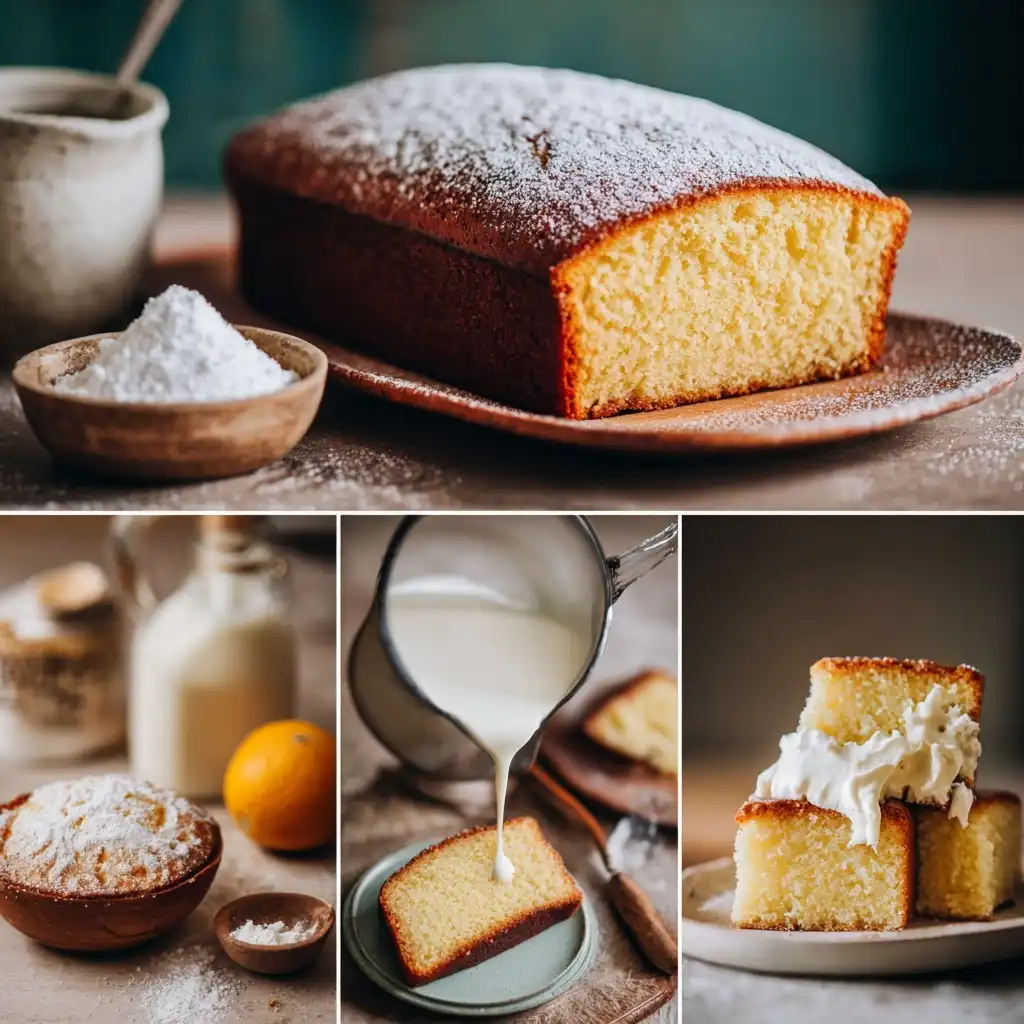
Vintage Hot Milk Cake is a beloved relic of mid-20th-century American home baking—a tender, moist, and subtly rich cake that owes its signature texture to a simple yet ingenious technique: scalding milk and butter together before incorporating them into the batter. Unlike modern cakes reliant on chemical leaveners or oil-based moisture, this heirloom recipe harnesses the transformative power of heat-activated emulsification, resulting in an exceptionally fine crumb, velvety mouthfeel, and delicate sweetness that never overwhelms. Revered for its simplicity, reliability, and nostalgic charm, the Hot Milk Cake evokes the warmth of grandmother’s kitchen—where ingredients were few, technique was intuitive, and every slice carried the quiet dignity of unhurried craftsmanship. More than just dessert, it represents a philosophy of baking: respect for foundational methods, reverence for humble ingredients, and the profound comfort found in consistency across generations.
The History
The origins of Hot Milk Cake trace back to the early 1900s, with documented appearances in regional cookbooks as early as 1912—but it truly blossomed during the Great Depression and World War II eras, when resourcefulness and pantry-conscious baking became essential. Its rise coincided with the widespread availability of reliable home ovens, standardized measuring tools, and the growing popularity of community cookbooks published by churches, women’s clubs, and agricultural extension services. Notably, the 1931 edition of The Boston Cooking-School Cook Book (revised under Fannie Farmer’s legacy) included a “Hot Milk Sponge Cake,” while the 1942 USDA Bulletin No. 563: Nutrition and Food Preparation featured a streamlined version explicitly designed for wartime rationing—calling for reduced eggs, no shortening, and reliance on scalded milk to maximize tenderness without added fat. By the 1950s, the cake had become a staple in Woman’s Day, Betty Crocker’s Picture Cook Book, and countless mimeographed church social booklets—often baked in tube pans for even heat distribution and served plain, dusted with confectioners’ sugar, or crowned with a glossy boiled icing. Its decline in mainstream popularity after the 1970s reflects broader shifts toward boxed mixes, high-ratio shortenings, and faster preparation—but its recent resurgence among heritage baking enthusiasts, vintage recipe archivists, and slow-food advocates underscores its timeless integrity and quiet sophistication.
Ingredients Breakdown
Every ingredient in Vintage Hot Milk Cake serves a precise functional and sensory role—none are mere placeholders:
- Whole Milk (1 cup): Scalding denatures whey proteins and slightly caramelizes lactose, enhancing richness and promoting emulsification. Whole milk provides necessary fat and water content for both structure and tenderness; skim or low-fat milk yields a drier, less cohesive crumb.
- Unsalted Butter (½ cup / 1 stick): Added to the scalding milk to melt fully and form a stable fat-in-water emulsion. Butter contributes flavor, moisture retention, and steam generation during baking—critical for lift and tenderness. Salted butter may alter sodium balance and mask nuanced dairy notes.
- All-Purpose Flour (2 cups, spooned & leveled): Provides gluten-forming proteins and starch for structure. The moderate protein content (10–12%) strikes the ideal balance between elasticity and delicacy. Sifting is non-negotiable—it aerates flour, prevents compaction, and ensures uniform incorporation.
- Granulated Sugar (1¼ cups): Functions not only as sweetener but also as a tenderizer (inhibiting gluten development), moisture retainer (hygroscopic properties), and browning agent (via Maillard reaction). Superfine sugar dissolves more readily but isn’t required if creamed properly.
- Baking Powder (2 tsp) + Baking Soda (½ tsp): A dual-leavening system: baking powder supplies consistent acid-reactive lift, while baking soda neutralizes lactic acid from the hot milk mixture and boosts oven spring. Freshness is paramount—test baking powder by mixing ½ tsp with hot water (should fizz vigorously); replace if >6 months old.
- Salt (½ tsp): Enhances all flavors, controls yeast activity (if using fermented variants), and strengthens gluten bonds at low concentrations—counterintuitively improving texture cohesion.
- Eggs (4 large, room temperature): Act as emulsifiers, structural scaffolds (via coagulating proteins), and moisture reservoirs. Room temperature ensures uniform blending with the warm milk-butter mixture and prevents premature cooking or separation. Cold eggs can cause the emulsion to break.
- Vanilla Extract (2 tsp pure, not imitation): Adds aromatic complexity and rounds out dairy sweetness. Alcohol-based extract integrates seamlessly; vanilla bean paste or scraped seeds offer deeper floral notes for special occasions.
Notably absent: sour cream, yogurt, oil, or buttermilk—ingredients common in modern “moist” cakes. This cake achieves its legendary texture solely through thermal emulsification, careful mixing order, and balanced leavening—making it a masterclass in minimalist technique.
Step-by-Step Recipe
- Preheat & Prep: Position oven rack in the lower third. Preheat oven to 350°F (175°C). Generously grease a 10-inch tube pan (not Bundt—smooth interior is essential) with unsalted butter, then line the bottom with parchment and dust entire surface—including center tube—with all-purpose flour, tapping out excess. Avoid nonstick sprays with lecithin, which may inhibit browning.
- Scald the Dairy Base: In a heavy-bottomed saucepan, combine milk and butter. Heat over medium-low heat, stirring constantly, until small bubbles form around the edges and temperature reaches 180–185°F (use instant-read thermometer). Do not boil—excessive heat causes protein curdling. Remove from heat immediately and let cool just until warm to the touch (about 110°F), ~5 minutes. This cooling window is critical: too hot → cooks eggs; too cold → fails to emulsify.
- Cream Dry Ingredients: In a large bowl, whisk together sifted flour, sugar, baking powder, baking soda, and salt until perfectly homogeneous—no streaks, no lumps. Whisking dry ingredients first ensures even leavener distribution and prevents dense pockets.
- Incorporate Eggs Gradually: Add eggs one at a time to the dry mixture, beating with a sturdy wire whisk (or hand mixer on low) for 30 seconds after each addition until fully absorbed and batter begins to thicken slightly. Scrape bowl thoroughly. This step builds viscosity before introducing liquid.
- Emulsify Warm Milk Mixture: Slowly pour the warm milk-butter mixture into the egg-flour batter in a thin, steady stream, whisking constantly in one direction. Continue whisking vigorously for 90–120 seconds until batter is completely smooth, satiny, and slightly increased in volume. It should coat the back of a spoon and drip in a thick, ribbon-like stream. Undermixing yields uneven texture; overmixing develops gluten and causes toughness.
- Add Vanilla & Final Fold: Stir in vanilla extract with a silicone spatula using 15 gentle fold-turns—just enough to incorporate, no more. Over-folding deflates air bubbles essential for rise.
- Pour & Tap: Immediately pour batter into prepared pan. Lift pan 6 inches and drop firmly onto countertop three times to release large air pockets. Smooth top with offset spatula.
- Bake with Precision: Place pan in preheated oven. Bake 55–65 minutes—do not open oven door before 45 minutes. Cake is done when deep golden brown, springs back when lightly pressed, and a long skewer inserted into the thickest part (avoiding center tube) emerges clean. Rotate pan 180° at 40 minutes for even browning.
- Cool Inverted: Remove cake from oven and let rest in pan on a wire rack for exactly 15 minutes. Then, invert onto cooling rack, carefully remove parchment, and reinvert cake right-side-up to cool completely (minimum 2 hours). This double-inversion prevents moisture pooling and sets the crumb.
Tips
- Thermometer Is Non-Negotiable: Guesswork with milk temperature leads to broken emulsions or scrambled eggs. Invest in a digital instant-read thermometer—it pays for itself in one successful batch.
- Room-Temperature Discipline: Take eggs out 2 hours before baking. To warm cold eggs quickly: place in warm (not hot) water for 5 minutes—then dry thoroughly.
- Flour Measurement Matters: Never scoop flour directly from the bag. Use the “spoon-and-level” method: fluff flour in container, spoon gently into measuring cup, level with straight edge. 1 cup = 120–125g. Weight-based baking is strongly recommended for consistency.
- Tube Pan Nuance: Use a true aluminum tube pan—not decorative Bundt. The smooth, unridged surface allows optimal cling and even heat transfer. Dark nonstick pans bake faster; reduce temp by 25°F if substituting.
- Oven Calibration Check: Many home ovens run hot or cold. Use an independent oven thermometer placed on the center rack to verify accuracy. A 25°F variance can mean collapsed cake or burnt crust.
- No Substitutions Mid-Bake: Resist adding extra vanilla, swapping sugars, or “boosting” leaveners. This recipe is mathematically balanced—alterations disrupt emulsion stability and gas expansion timing.
- Patience in Cooling: Cutting into a warm cake releases trapped steam, causing gummy texture and collapse. Wait full 2+ hours—even overnight is ideal. Wrap cooled cake tightly in beeswax wrap or parchment-lined foil to retain moisture for up to 4 days.
- Reviving Stale Cake: If cake firms slightly after day two, refresh by wrapping slices in damp (not wet) paper towels and microwaving 10–15 seconds. The steam rehydrates starch granules instantly.
Variations and Customizations
While the classic Hot Milk Cake honors tradition, thoughtful adaptations preserve its structural integrity while expanding its expressive range:
- Lemon-Hot Milk Cake: Add 2 tbsp finely grated lemon zest to dry ingredients and replace 2 tsp vanilla with 1 tbsp fresh lemon juice (added with vanilla). Top with lemon glaze: 1½ cups confectioners’ sugar + 2 tbsp lemon juice + 1 tsp zest.
- Spiced Colonial Variation: Add 1 tsp ground cinnamon, ¼ tsp freshly grated nutmeg, and ⅛ tsp ground cloves to dry mix. Serve with spiced whipped cream (½ cup heavy cream + 1 tbsp maple syrup + pinch cinnamon, whipped to soft peaks).
- Chocolate Ribbon Swirl: Reserve ½ cup batter. Mix into it 3 tbsp unsweetened cocoa powder + 2 tbsp hot coffee (cooled) + 1 tbsp sugar. Alternately spoon plain and chocolate batters into pan; cut through once with knife for marbled effect. Do not over-swirl.
- Nut-Enhanced Texture: Fold in ¾ cup toasted, chopped walnuts or pecans *after* final vanilla addition. Toasting deepens flavor and prevents sogginess.
- Tea-Infused Elegance: Steep 2 Earl Grey tea bags in scalding milk for 3 minutes before adding butter. Remove bags, squeeze gently, and proceed. Complement with bergamot-scented buttercream.
- Gluten-Free Adaptation: Substitute 2 cups King Arthur Gluten-Free Measure-for-Measure Flour + ½ tsp xanthan gum. Increase milk by 1 tbsp and add 1 extra egg yolk for binding. Bake 5–8 minutes longer.
- Miniature Format: Bake in greased and floured muffin tins (fill ⅔ full) for 18–22 minutes. Yields 24–30 cupcakes—ideal for portion control and gift-giving.
- Alcohol-Enhanced Depth: Replace 2 tbsp milk with 2 tbsp bourbon, dark rum, or amaretto. Add with vanilla. Pairs exquisitely with caramel or toasted almond frosting.
Important Note: All variations must retain the scalded milk-butter emulsion step and exact leavening ratios. Flavor additions go in *last*, after emulsification is complete.
Health Considerations and Nutritional Value
A single 1/12th slice (approx. 115g) of unfrosted Vintage Hot Milk Cake contains approximately:
- Calories: 290–310 kcal
- Total Fat: 10–11g (6–7g saturated)
- Carbohydrates: 46–49g (32–35g sugars)
- Protein: 4–5g
- Fiber: 0.5g
- Sodium: 220–250mg
From a nutritional standpoint, the cake is best understood as an occasional, mindful indulgence—not a health food, nor intended to be. However, its composition offers meaningful context: it contains zero trans fats, no artificial preservatives, hydrogenated oils, or high-fructose corn syrup. The use of whole eggs provides choline (vital for brain health) and lutein (supporting eye function); butter contributes fat-soluble vitamins A, D, E, and K2; and the absence of refined vegetable oils avoids omega-6 inflammatory overload. For those managing blood sugar, pairing a modest slice (1/16th) with Greek yogurt and berries balances glycemic load. Gluten-sensitive individuals should note that traditional versions contain wheat gluten—though verified GF adaptations exist. Those reducing sodium can omit added salt (butter contributes ~90mg/slice) without compromising structure. While not low-calorie, its satiating fat and protein content promote longer-lasting fullness compared to ultra-processed sweets—making portion awareness its most powerful wellness tool. As registered dietitian Dr. Marion Nestle observed, “The healthiest dessert is the one you savor slowly, made with care, and shared with love.”
Ingredients
- 1 cup (240ml) whole milk
- ½ cup (1 stick / 113g) unsalted butter
- 2 cups (250g) all-purpose flour, spooned, leveled, and sifted twice
- 1¼ cups (250g) granulated sugar
- 2 teaspoons (8g) double-acting baking powder
- ½ teaspoon (3g) baking soda
- ½ teaspoon (3g) fine sea salt
- 4 large eggs, room temperature
- 2 teaspoons (10ml) pure vanilla extract
Directions
- Preheat oven to 350°F (175°C). Grease a 10-inch tube pan with unsalted butter, line bottom with parchment, and flour pan thoroughly—including center tube. Set aside.
- In a heavy-bottomed saucepan, combine milk and butter. Heat over medium-low, stirring constantly, until tiny bubbles appear at edges and temperature reaches 180–185°F (82–85°C). Remove from heat. Cool 5 minutes, until warm to touch (~110°F).
- In large bowl, whisk together sifted flour, sugar, baking powder, baking soda, and salt until fully blended and no streaks remain.
- Add eggs one at a time to dry mixture, whisking vigorously for 30 seconds after each addition until fully incorporated and batter thickens slightly. Scrape bowl with rubber spatula between eggs.
- Slowly pour warm milk-butter mixture into batter in thin, steady stream, whisking constantly in one direction. Continue whisking 2 minutes until smooth, glossy, and ribbon-thick.
- Gently fold in vanilla extract with silicone spatula using 15 turns—just until combined.
- Pour batter into prepared pan. Tap pan firmly on counter 3 times to release air bubbles. Smooth top.
- Bake 55–65 minutes—do not open oven before 45 minutes. Cake is done when deep golden, springs back when touched, and skewer comes out clean.
- Cool in pan on wire rack 15 minutes. Invert onto rack, remove parchment, then reinvert to cool completely (2+ hours).
FAQ
- Why must the milk be scalded—and why can’t I skip cooling it?
- Scalding transforms milk’s protein structure and enhances emulsification with butter. Skipping the cooling step risks cooking the eggs upon contact, creating lumpy, scrambled bits that destabilize the entire batter. The 5-minute cooldown ensures thermal compatibility without sacrificing emulsion integrity.
- Can I use a Bundt pan instead of a tube pan?
- Technically yes—but not advised. Bundt pans have intricate ridges that interfere with the cake’s natural cling and upward rise. The smooth interior of a classic tube pan allows optimal steam circulation and structural support. If using Bundt, increase baking time by 8–12 minutes and check doneness earlier.
- My cake sank in the center. What went wrong?
- Sinking almost always results from one of four causes: (1) Opening oven too early (<45 min), causing rapid steam loss; (2) Underbaking—skewer test must be clean *and* cake springs back; (3) Overmixing after adding milk, collapsing air cells; or (4) Cooling too quickly—never refrigerate warm cake or place on cold surface.
- Can I make this cake ahead and freeze it?
- Absolutely. Once completely cooled, wrap cake *tightly* in plastic wrap, then in aluminum foil. Freeze up to 3 months. Thaw overnight in refrigerator, then bring to room temperature before serving. Texture remains virtually unchanged.
- Is there a dairy-free version?
- A reliable dairy-free adaptation exists: substitute full-fat canned coconut milk (not “lite”) for dairy milk, and use high-quality vegan butter (e.g., Miyoko’s or Earth Balance Vegan Buttery Sticks). Ensure baking powder is aluminum-free and gluten-free if needed. Expect subtle coconut notes—complementary with tropical variations.
- Why does this recipe use both baking powder AND baking soda?
- This dual system provides layered lift: baking powder delivers immediate, predictable rise during mixing and initial oven heat, while baking soda reacts instantly with residual acidity from the warm milk (lactic acid) and creates additional carbon dioxide during the critical first 10 minutes of baking—maximizing volume and crumb openness.
- Can I halve the recipe successfully?
- Yes—with caveats. Halve all ingredients *by weight* for accuracy. Bake in a 6-cup bundt or two 8-inch round pans (reduce time to 30–38 minutes). Avoid halving volumetric measurements (cups/tsp) due to compaction errors. Use digital scale.
- What’s the best way to store leftovers?
- Store uncovered at room temperature for up to 2 days (the crust forms a natural barrier). After day two, wrap tightly in parchment-lined foil or beeswax wrap. Avoid airtight plastic—it traps condensation and promotes sogginess. Refrigeration is unnecessary unless your kitchen exceeds 78°F.
Summary
Vintage Hot Milk Cake is a masterwork of restrained elegance—where scalded milk and butter fuse into a silken emulsion that yields a cake of astonishing tenderness, fine-grained delicacy, and quiet, enduring flavor.
Rooted in thrift, refined by time, and sustained by reverence for process, it reminds us that the deepest comforts often arise not from abundance, but from precision, patience, and the profound satisfaction of getting it exactly right.